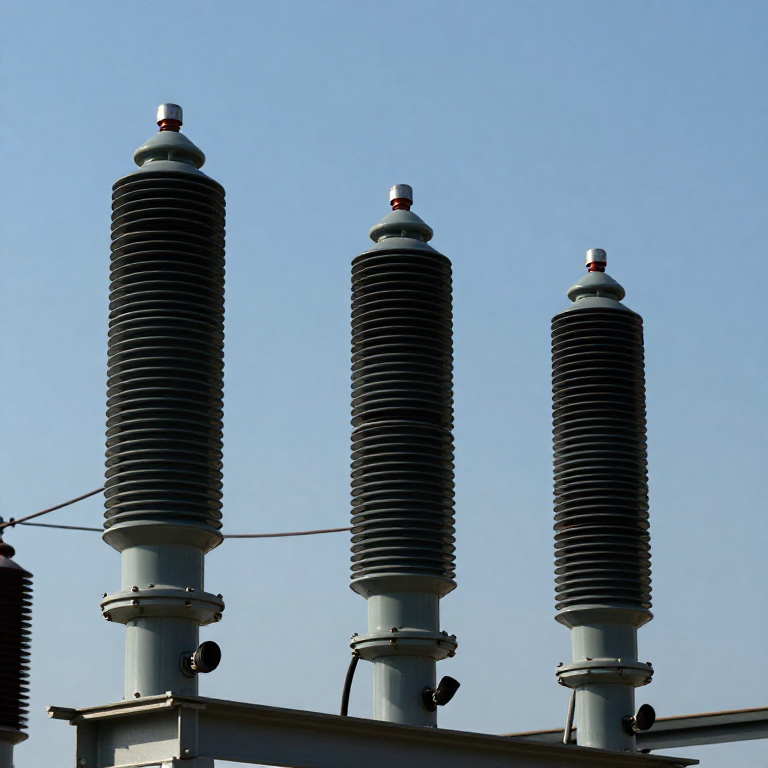


Lightning Arrester
Instrucciones
Build a simple spark gap and find its breakdown voltage
Build a simple spark gap and find its breakdown voltage
The crudest arrester is two electrodes and an air gap.
- Mount two rounded electrodes facing each other with an adjustable gap.
- Raise the voltage until the gap breaks down, and record the value.
- Repeat at several gap settings and plot breakdown voltage against distance.
- Note how repeatable the figure is from one test to the next.
The relationship is roughly proportional but the scatter is significant. Breakdown depends on humidity, air pressure, dust, and the state of the electrode surfaces, so a plain gap set to protect at a chosen voltage may operate well above or below it. That imprecision is tolerable for crude protection and useless for equipment worth protecting properly.
Round the electrodes. Sharp points concentrate the field and break down at much lower voltage, which is useful in a lightning ROD but wrong in an arrester meant to hold off the working voltage.Materiales para este paso:
 Barra redonda de latón1 pieza
 Papel milimetrado1 pad
Herramientas necesarias:
 Multímetro digital de laboratorio
 Fuente de alimentación de banco ajustable
 Calibre digital de 6 pulgadas
 Juego de limas
Discover the follow current problem
Discover the follow current problem
The gap conducts the surge away — and then refuses to stop.
- Connect the spark gap across a live low-voltage AC source through a current limit.
- Trigger a breakdown by momentarily raising the voltage.
- Observe what happens after the surge has passed.
- Note whether the arc extinguishes on its own.
Once the gap has broken down it is an ionised conducting path, and the line's normal voltage is quite enough to keep it burning. So the arrester has turned a momentary surge into a permanent short circuit — a fault, which then trips the circuit breaker and takes the line out of service. The surge is gone and the customers are still in the dark.
This is the central difficulty of surge protection and it is why a plain spark gap is not an arrester. Everything that follows in this blueprint is about making the path close again.Herramientas necesarias:
 Osciloscopio digitalMultímetro digital de laboratorio
 Cronómetro
Add a series resistance that changes with voltage
Add a series resistance that changes with voltage
The solution is a material whose resistance collapses under high voltage and returns afterwards.
- Obtain or make a non-linear resistor element — a varistor, or a stack of silicon carbide discs.
- Measure its resistance at low voltage, then at progressively higher voltages.
- Plot current against voltage on logarithmic axes.
- Place the element in series with the spark gap and repeat the follow-current test.
The curve is startlingly non-linear — a modest voltage rise produces an enormous current rise. At surge voltage the element is effectively a conductor and passes the strike to earth; at normal line voltage it is effectively an insulator, so the follow current is choked down to almost nothing and the gap's arc starves and goes out. The material does the switching.
Silicon carbide arresters used exactly this from the 1930s. Modern metal-oxide varistors are so sharply non-linear that the series gap can be omitted entirely — the element alone holds off working voltage and conducts surges, which is a considerable simplification.Materiales para este paso:
 Kit de resistencias de 1/4 W1 kitPapel milimetrado1 pad
Herramientas necesarias:
Multímetro digital de laboratorioOsciloscopio digitalFuente de alimentación de banco ajustable Lote de resistencias sensibles a la fuerza
Measure the protective margin, which is the whole specification
Measure the protective margin, which is the whole specification
An arrester is useful only in the gap between two voltages.
- Record the highest voltage at which the arrester passes negligible current — it must exceed the line's normal peak.
- Record the voltage across it while it is conducting a surge — its clamping voltage.
- Compare that clamping figure with the insulation strength of the equipment being protected.
- The difference between the two is the protective margin.
Herramientas necesarias:
Osciloscopio digitalMultímetro digital de laboratorioCalibre digital de 6 pulgadasA weak link that repairs itself, and history
A weak link that repairs itself, and history
Lightning arresters developed alongside transmission from the 1890s onward, beginning as plain spark gaps and horn gaps, then adding the non-linear elements that solved follow current. Silicon carbide arresters with series gaps dominated from the 1930s; zinc oxide varistor arresters, developed in Japan in the late 1960s, replaced them and are now standard.
It belongs to a family this catalogue has met several times. The shear pin, the fuse and the safety valve are all deliberate weak links that fail so something expensive does not. The arrester is the sophisticated member of that family: it does not fail at all, it conducts and then recovers, ready for the next surge without intervention. A self-resetting weak link is a considerably harder thing to build than a sacrificial one.
The scale of what it handles is worth stating. A lightning strike delivers tens of thousands of amperes in tens of microseconds. The arrester must absorb or divert that, hold its own against the line's continuous voltage immediately afterwards, and do it repeatedly for decades on a pole nobody visits. Very few components are asked to survive that ratio between their working condition and their fault condition.
Its honest limits: a finite energy capability, so a severe or repeated strike can destroy it; gradual degradation of the varistor material, which eventually leads to thermal runaway if it is not replaced; and it protects only what is electrically close to it, which is why arresters appear at every transformer rather than once per line.
Materiales
3- 1 piezaMarcador de posición
- 1 padMarcador de posición
- Marcador de posición
Herramientas requeridas
7- Marcador de posición
- Marcador de posición
- Marcador de posición
- Marcador de posición
- 1 vendor sell this, none ship to you yetMarcador de posición
- Marcador de posición
- Marcador de posición
Blueprints relacionados
Estos blueprints comparten conocimiento — técnicas, materiales o principios


CC0 Dominio público
Este Blueprint se publica bajo CC0. Eres libre de copiar, modificar, distribuir y usar este trabajo para cualquier propósito, sin pedir permiso.
Apoya al Maker comprando productos a través de su Blueprint, donde gana una Comisión del Maker establecida por los vendedores, o crea una nueva iteración de este Blueprint e inclúyela como conexión en tu propio Blueprint para compartir ingresos.