ARTE
BELLEZA Y BIENESTAR
ARTESANÍA
CULTURA E HISTORIA
ENTRETENIMIENTO
MEDIO AMBIENTE
COMIDA Y BEBIDAS
INGENIERÍA INVERSA
CIENCIAS
DEPORTES
TECNOLOGÍA
TECNOLOGÍA VESTIBLE



After the Tank: Passivation, Sealing and the Bake
The part coming out of the plating tank is not finished. Several things still have to happen, and each one is the reason a particular kind of failure does not occur later.
**Rinsing and drying** stop staining. **Passivation** puts a thin conversion film over a reactive coating like zinc. **Sealing** closes the pores of an anodised layer. **Baking** drives hydrogen out of high-strength steel before it cracks.
None of them changes how the part looks on the day, and every one of them changes how it looks in a year.
Intermedio
3 hours
Instrucciones
1
1
Rinse, dry, and do it quickly
Rinse, dry, and do it quickly
**Rinse immediately and thoroughly**, in several changes, finishing with distilled or deionised water. Plating solution left in a crevice continues to act on the part, and dried-on salts are both a stain and a corrosion site.
**Dry fully and fast.** Warm air, or a hot-water dip followed by air — a part lifted from hot water carries enough heat to dry itself, which is why the last rinse in a plating line is often hot.
**Water spots are a real defect**, not a cosmetic one. Where a droplet dries it leaves whatever was dissolved in it, concentrated at that point.
**Blow out blind holes and crevices.** Solution trapped in a hole weeps out over the following days and streaks the part. On an assembly it corrodes from the inside where nobody can see it.
**Handle the finished part with gloves too.** A fingerprint on fresh zinc or silver etches into it over weeks — the salts in skin are corrosive to both — and it is not removable afterwards.
Materiales para este paso:
 Agua destilada2 piezas
Herramientas necesarias:
 Vaso de precipitados de borosilicato
 Guantes resistentes a productos químicos
 Termómetro de laboratorio
2
2
Passivation: a film on top of the film
Passivation: a film on top of the film
**Zinc corrodes quickly on its own.** Fresh zinc plating left bare develops white powdery corrosion — white rust — within weeks in damp air. It is doing its job, sacrificially, far faster than anyone wants.
**A chromate or chromium-free conversion coating** is applied immediately after plating: a brief dip that grows a thin, gel-like film over the zinc, which slows its corrosion by an order of magnitude and self-heals small scratches.
The familiar colours of plated fasteners are this film: **clear or blue** (thinnest), **yellow or iridescent** (thicker, more protective), **black**, and **olive drab** (thickest). The colour is a direct indication of how much protection there is, which is unusually convenient.
**Hexavalent chromium passivation is being replaced.** It works extremely well and it is a confirmed carcinogen and is restricted in most jurisdictions. Trivalent chromium and chromium-free alternatives are now standard, and a maker has no reason to use the hexavalent chemistry.
**Stainless steel is passivated too**, with nitric or citric acid, to dissolve free iron left on the surface by machining and to let the chromium oxide film form properly. It is not a coating; it is the removal of what was preventing the natural film.
Materiales para este paso:
 Placa de acero dulce1 pieza
Herramientas necesarias:
Vaso de precipitados de borosilicatoGuantes resistentes a productos químicos Gafas de protección química
3
3
Anodising is not plating, and it must be sealed
Anodising is not plating, and it must be sealed
**Anodising grows an oxide out of the metal rather than depositing one onto it.** The aluminium part is the ANODE — the opposite of plating — and the oxide forms by converting the surface of the part itself.
Three consequences follow:
**It cannot peel**, because there is no interface to fail at. The oxide grades continuously into the metal.
**The part grows and shrinks at once.** About half the oxide thickness is above the original surface and half below, so a 20 micron anodised layer adds about 10 microns to the dimension. That matters on a fitted part.
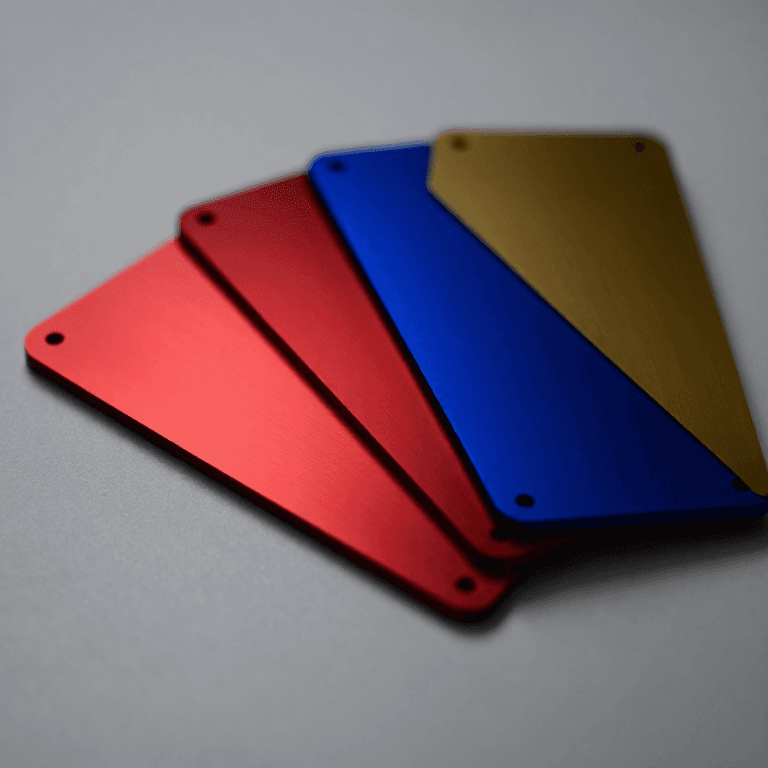
**The fresh layer is porous** — a dense array of fine tubes — which is why it takes dye so well and why an anodised part can be coloured by simply dipping it in dye before sealing.
**Sealing closes the pores**, and it is not optional: an unsealed layer holds dirt, loses its dye and corrodes. Boiling water or steam hydrates the oxide so it swells and closes; a nickel acetate seal does the same more durably; a cold seal uses a nickel fluoride solution.
**Seal immediately after dyeing.** The window is short, and an unsealed layer left overnight has already picked up contamination into its pores.
Materiales para este paso:
 Ácido sulfúrico1 piezaAgua destilada1 pieza
Herramientas necesarias:
 Fuente de alimentación de banco ajustableVaso de precipitados de borosilicatoTermómetro de laboratorioGuantes resistentes a productos químicos
4
4
The hydrogen bake, and when it is mandatory
The hydrogen bake, and when it is mandatory
Acid pickling and plating both produce hydrogen at the steel surface, and some of it dissolves into the metal. In high-strength steel it collects at defects and causes **delayed brittle fracture** — the part is fine on the day and snaps hours or weeks later under a load it should carry easily.
**It is a real and well-documented failure mode**, and it is why plated high-tensile fasteners carry a baking requirement.
**Bake at 190 to 220 C for 4 to 24 hours**, depending on the strength and the section, and **within a few hours of plating** — the hydrogen has to be driven out before it has time to accumulate where it does damage.
**It is mandatory above about 1000 MPa tensile strength**, which covers high-tensile fasteners, springs, and anything hardened and tempered low. Below about 800 MPa it is not generally required.
**The coating has to survive the bake**, which is another reason zinc is passivated AFTER baking rather than before — chromate films are damaged by the temperature.
**Electroless nickel is also baked**, for a different reason: heat treatment at around 400 C precipitates nickel phosphide and takes the hardness from about 500 to over 1000 HV, which is most of the point of using it on a wear surface.
Materiales para este paso:
Placa de acero dulce1 piezaHerramientas necesarias:
Termómetro de laboratorioMateriales
3- 3 piezasMarcador de posición
- 1 piezaMarcador de posición
- 1 piezaMarcador de posición
Herramientas requeridas
5- Marcador de posición
- Marcador de posición
- Marcador de posición
- Marcador de posición
- Marcador de posición
Blueprints relacionados
Estos blueprints comparten conocimiento — técnicas, materiales o principios



CC0 Dominio público
Este Blueprint se publica bajo CC0. Eres libre de copiar, modificar, distribuir y usar este trabajo para cualquier propósito, sin pedir permiso.
Apoya al Maker comprando productos a través de su Blueprint, donde gana una Comisión del Maker establecida por los vendedores, o crea una nueva iteración de este Blueprint e inclúyela como conexión en tu propio Blueprint para compartir ingresos.