ARTE
BELLEZA Y BIENESTAR
ARTESANÍA
CULTURA E HISTORIA
ENTRETENIMIENTO
MEDIO AMBIENTE
COMIDA Y BEBIDAS
INGENIERÍA INVERSA
CIENCIAS
DEPORTES
TECNOLOGÍA
TECNOLOGÍA VESTIBLE
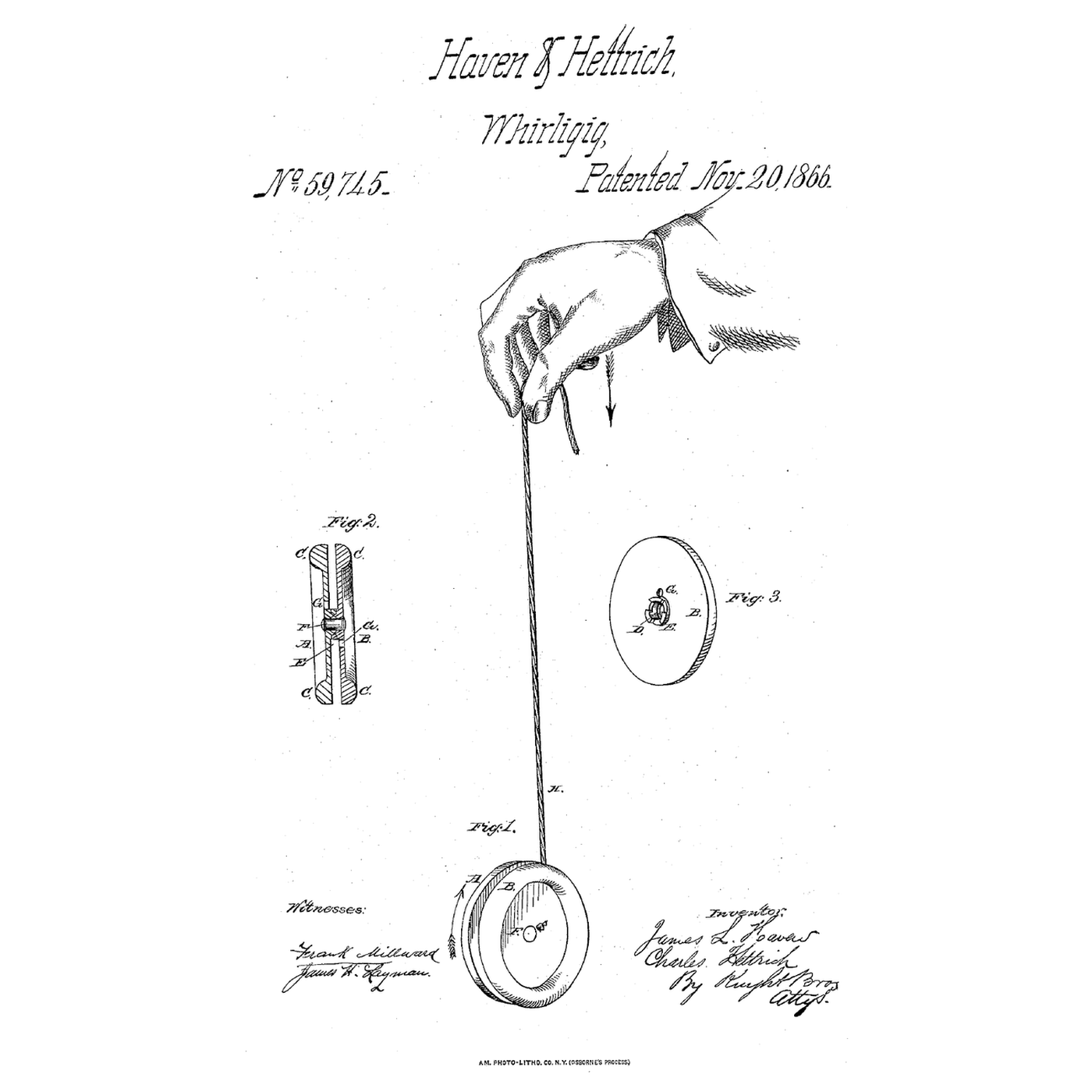


The Bandalore: A Yo-Yo With a Flywheel Rim
The toy called a bandalore in the nineteenth century — a yo-yo — is a pair of disks on a short axle with a string wound round it. Let it fall and it spins up; at the bottom its spin winds the string back and it climbs.
James L. Haven and Charles Hettrick of Cincinnati took out US 59,745, dated 20 November 1866, for a bandalore made of two metal disks, each with a thickened marginal rim, joined at the centre by a rivet through interlocking bosses. Made of metal, it had the "momentum which is essential to easy operation of the toy", and the rim acted as a flywheel.
This rung works out why a heavy rim makes a better yo-yo and makes and times two.
Principiante
About 2 hours
Instrucciones
1
1
Falling, spinning and the flywheel rim
Falling, spinning and the flywheel rim
Cargando el cuaderno de Jupyter…
2
2
Read the 1866 bandalore
Read the 1866 bandalore
US 59,745 shows two similar circular disks A and B, each with "a marginal rim or swell" C on its outside and a central hole D. On the inner side of each, round the hole, is an indented annular boss E; the indentations of one fit the projections of the other, so the two "interlock firmly together on the principle of a clutch" when a rivet F is put through and clenched. A small hole G next to the boss anchors the string H.
The patent claims only the construction — the two disks joined by the rivet and interlocking bosses — but names the reason: the rim "exercises the function of a fly-wheel". The drawing sheet itself is headed "Whirligig", and shows a hand letting the toy fall on its string.
3
3
Make two yo-yos and race them
Make two yo-yos and race them
3D-print two pairs of disks 56 mm across with a 6 mm axle between them: one pair solid and flat, the other with most of the plastic in a thick outer rim and a thin web. Weigh them and add steel washers to the lighter so both have the same mass.
Tie 80 cm of cotton string to each axle and wind it on. Drop both from the same height at the same moment: the rim-weighted one falls more slowly. Time the drops with a stopwatch, and film them if you can, and compare with the notebook. Then try a loop instead of a knot on the axle, and see which one 'sleeps' longer at the bottom.
Materiales para este paso:
 Bramante de algodón para cocina1 pieza
 Arandela plana6 piezas
 Filamento PETG1 pieza
Herramientas necesarias:
 Impresora 3D de filamento (FDM)Filamento PETG
 Báscula digital de cocina
 Cronómetro
 Calibre digital de 6 pulgadas
4
4
A yo-yo that will not come back
A yo-yo that will not come back
Yo-yo troubleshooting.
Flow
Loading...
5
5
History and honest limits
History and honest limits
Toys of this kind are very old; in English they were called bandalores or quizzes by the eighteenth century. **James L. Haven** and **Charles Hettrick** of Cincinnati patented their metal bandalore as **US 59,745** on 20 November 1866. The name yo-yo and the loose-looped 'sleeping' string became popular in the United States in the late 1920s.
**Honest limits.** The notebook assumes a rigid string and no slip or friction; real yo-yos lose energy in the string and at the axle, so they never climb all the way back.
Materiales
3- Marcador de posición
- 6 piezasMarcador de posición
- 1 piezaMarcador de posición
Herramientas requeridas
5- Marcador de posición
- Marcador de posición
- Marcador de posición
- Marcador de posición
- Marcador de posición
Este plano hace

Blueprints relacionados
Estos blueprints comparten conocimiento — técnicas, materiales o principios


CC0 Dominio público
Este Blueprint se publica bajo CC0. Eres libre de copiar, modificar, distribuir y usar este trabajo para cualquier propósito, sin pedir permiso.
Apoya al Maker comprando productos a través de su Blueprint, donde gana una Comisión del Maker establecida por los vendedores, o crea una nueva iteración de este Blueprint e inclúyela como conexión en tu propio Blueprint para compartir ingresos.