ARTE
BELLEZA Y BIENESTAR
ARTESANÍA
CULTURA E HISTORIA
ENTRETENIMIENTO
MEDIO AMBIENTE
COMIDA Y BEBIDAS
INGENIERÍA INVERSA
CIENCIAS
DEPORTES
TECNOLOGÍA
TECNOLOGÍA VESTIBLE
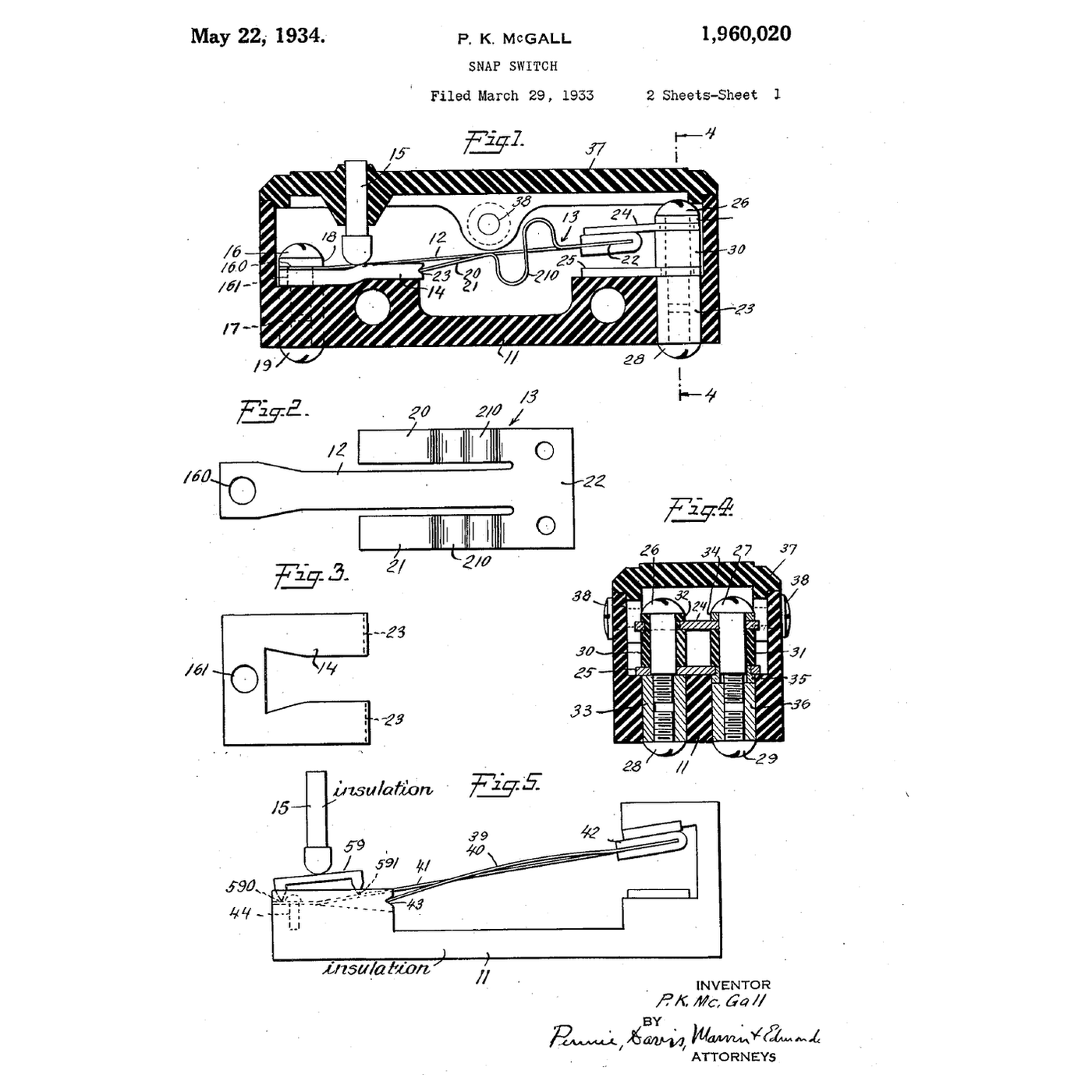


The Snap-Action Switch: A Spring That Jumps Past Its Own Centre
A contact that opens slowly draws an arc that eats it away; one that wavers at the edge chatters. A snap-action switch cannot do either: its contact is held by springs arranged over-centre, so a small, slow push on the plunger builds up to a point and then the contact jumps from one stop to the other in a few milliseconds.
Philip Kenneth McGall of Orange, New Jersey, working for C. F. Burgess Laboratories, filed US 1,960,020, *Snap Switch*, on 29 March 1933; it was granted 22 May 1934. A thin beryllium-copper leaf spring is held in tension by two side strips in compression, pivoted near the middle of the leaf; silver contacts at the free end move between two stops. It became the "micro switch" found in machines, appliances and mice.
This rung models the snap-through force, shows why the lower stop sits above dead centre, and makes a snap switch from spring steel.
Intermedio
About 3 hours
Instrucciones
1
1
The drooping force and the speed of the snap
The drooping force and the speed of the snap
Cargando el cuaderno de Jupyter…
2
2
Read McGall's switch
Read McGall's switch
Fig. 1 of US 1,960,020 shows the switch in section: a base 11 of wood, hard rubber or Bakelite; the thin leaf spring 12 bolted at one end over a thick metal shim 14; two parallel spring strips 20 and 21, joined to the leaf's free end by a U-shaped stirrup 22 and pivoted in notches in the shim; and a plunger 15 pressing the leaf near its anchored end.
What the specification specifies: the leaf "preferably is a thin beryllium copper strip" (or phosphor bronze); the strips are in longitudinal compression, putting the leaf in tension; contacts "preferably made of silver … which minimizes the damage resulting from arcing"; "the bottom contact 25 is placed above the neutral or dead-center position" so the arm returns when released; and the leaf is widened ahead of its anchorage so it does not fatigue there.
3
3
Make a snap switch from spring steel
Make a snap switch from spring steel
Cut a strip of thin spring steel 60 mm long and 12 mm wide. Cut a slot 3 mm wide down its middle for 40 mm, leaving the two outer legs and a solid end. Bend the centre tongue slightly so that, when you clamp the solid end and push the tongue's tip back into line with the legs, the legs bow — now they are in compression and the tongue is in tension, as in McGall's switch.
Clamp the solid end to a plywood base with a machine screw. Set two machine-screw stops either side of the free end, the lower one just above the point where the strip flips over, and solder a wire to the strip and to each stop.
Press slowly near the clamped end with a spring scale: the force rises, then the free end jumps to the lower stop with a click. Release it and it jumps back. Wire the lower stop through a buzzer: it sounds cleanly, with no chatter, however slowly you press. Note the operating force and compare with the notebook's curve.
Materiales para este paso:
 Fleje de acero para muelles1 pieza
 Tablero contrachapado1 pieza
 Tornillos de máquina4 piezas
 Zumbador piezoeléctrico1 pieza
 Estaño-plomo de soldadura1 pieza
 Microrruptor (accionado por palanca)1 pieza
Herramientas necesarias:
 Soldador de estaño
 Dinamómetro (balanza de resorte)
 Tornillo de banco
 Guantes de trabajo de cuero
 Fuente de alimentación de corriente continua
4
4
A switch that chatters or will not reset
A switch that chatters or will not reset
Snap switch faults.
Flow
Loading...
5
5
History and honest limits
History and honest limits
**Philip Kenneth McGall** filed **US 1,960,020** on 29 March 1933, assigned to C. F. Burgess Laboratories of Madison, Wisconsin; it was granted 22 May 1934. The company Micro Switch was formed later in the 1930s, and the name came to stand for the small snap-action switch itself.
**Honest limits.** The notebook's two-spring model shows the snap-through and the role of the stops; McGall's real geometry, with a leaf in tension and strips pivoted near its middle, has a different force curve with the same character. Spring steel strip has sharp edges: wear gloves when cutting and bending it.
Materiales
6- 1 piezaMarcador de posición
- 1 piezaMarcador de posición
- 4 piezasMarcador de posición
- 1 piezaMarcador de posición
- 1 piezaMarcador de posición
- Marcador de posición
Herramientas requeridas
5- 2 vendors sell this, none ship to you yetMarcador de posición
- Marcador de posición
- Marcador de posición
- Marcador de posición
- Marcador de posición
Blueprints relacionados
Estos blueprints comparten conocimiento — técnicas, materiales o principios


CC0 Dominio público
Este Blueprint se publica bajo CC0. Eres libre de copiar, modificar, distribuir y usar este trabajo para cualquier propósito, sin pedir permiso.
Apoya al Maker comprando productos a través de su Blueprint, donde gana una Comisión del Maker establecida por los vendedores, o crea una nueva iteración de este Blueprint e inclúyela como conexión en tu propio Blueprint para compartir ingresos.