ARTE
BELLEZA Y BIENESTAR
ARTESANÍA
CULTURA E HISTORIA
ENTRETENIMIENTO
MEDIO AMBIENTE
COMIDA Y BEBIDAS
INGENIERÍA INVERSA
CIENCIAS
DEPORTES
TECNOLOGÍA
TECNOLOGÍA VESTIBLE
Youblob (generated from this blueprint's notebook) · CC0

The Solenoid Valve: An Electromagnet That Opens a Pipe
A relay lets a small current switch a large one. A solenoid valve does the same for a fluid: a coil round a tube pulls a soft-iron plunger that opens or closes an orifice, so a switch, a thermostat or a timer can turn water, air, gas or oil on and off without a hand on the valve. Washing machines, irrigation timers, compressors and boilers all use them.
The Automatic Switch Company (ASCO) of New York is credited with making the first solenoid valves in 1910.
This rung works out why a solenoid's pull depends so steeply on its air gap, why that limits a direct-acting valve's orifice, and how a pilot valve gets round it — then drives a real 12 V valve from a switch and measures when it will and will not open.
Principiante
About 3 hours
Instrucciones
1
1
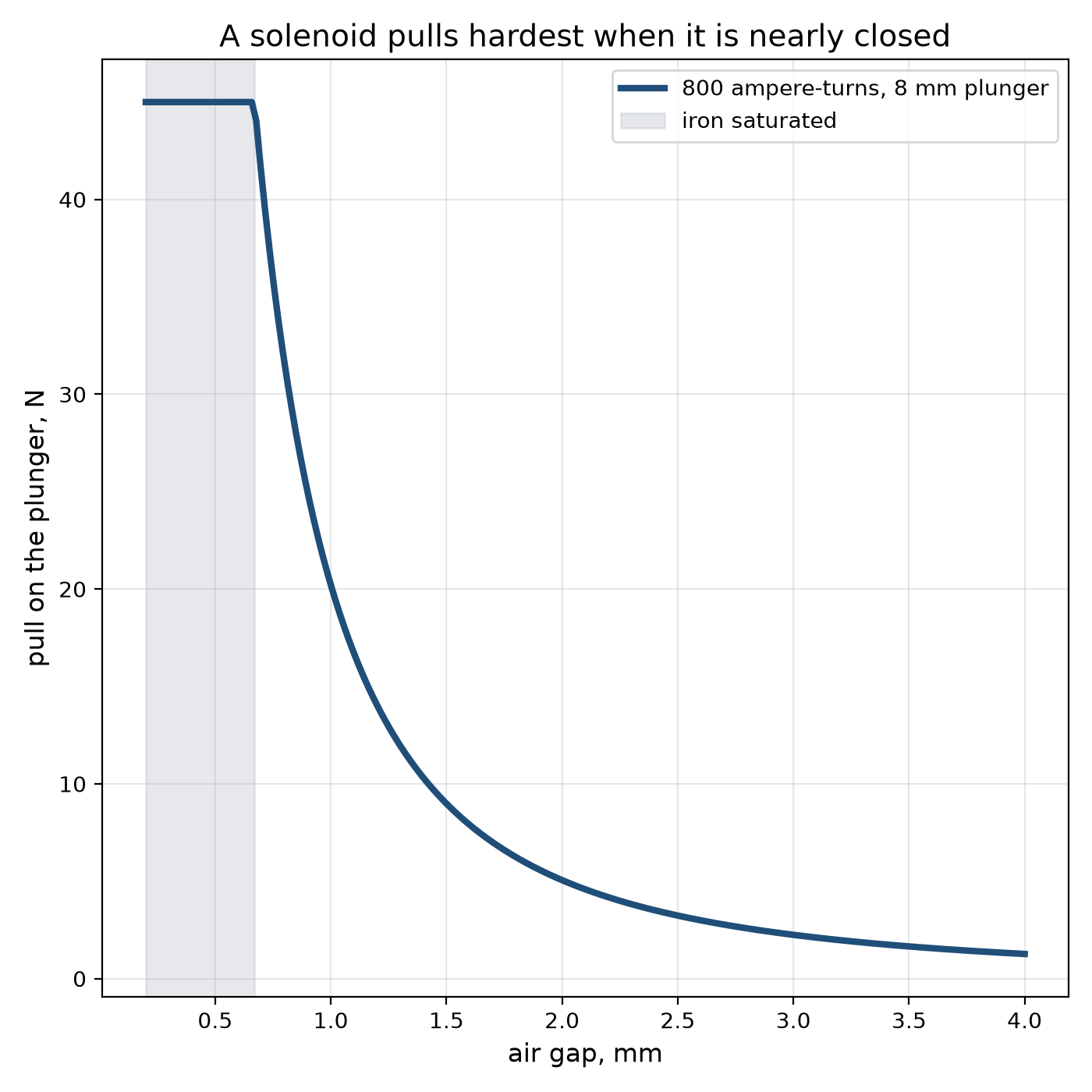
Pull against gap, and the orifice it can open
Pull against gap, and the orifice it can open
Cargando el cuaderno de Jupyter…
2
2
The same electromagnet, switching a current
The same electromagnet, switching a current
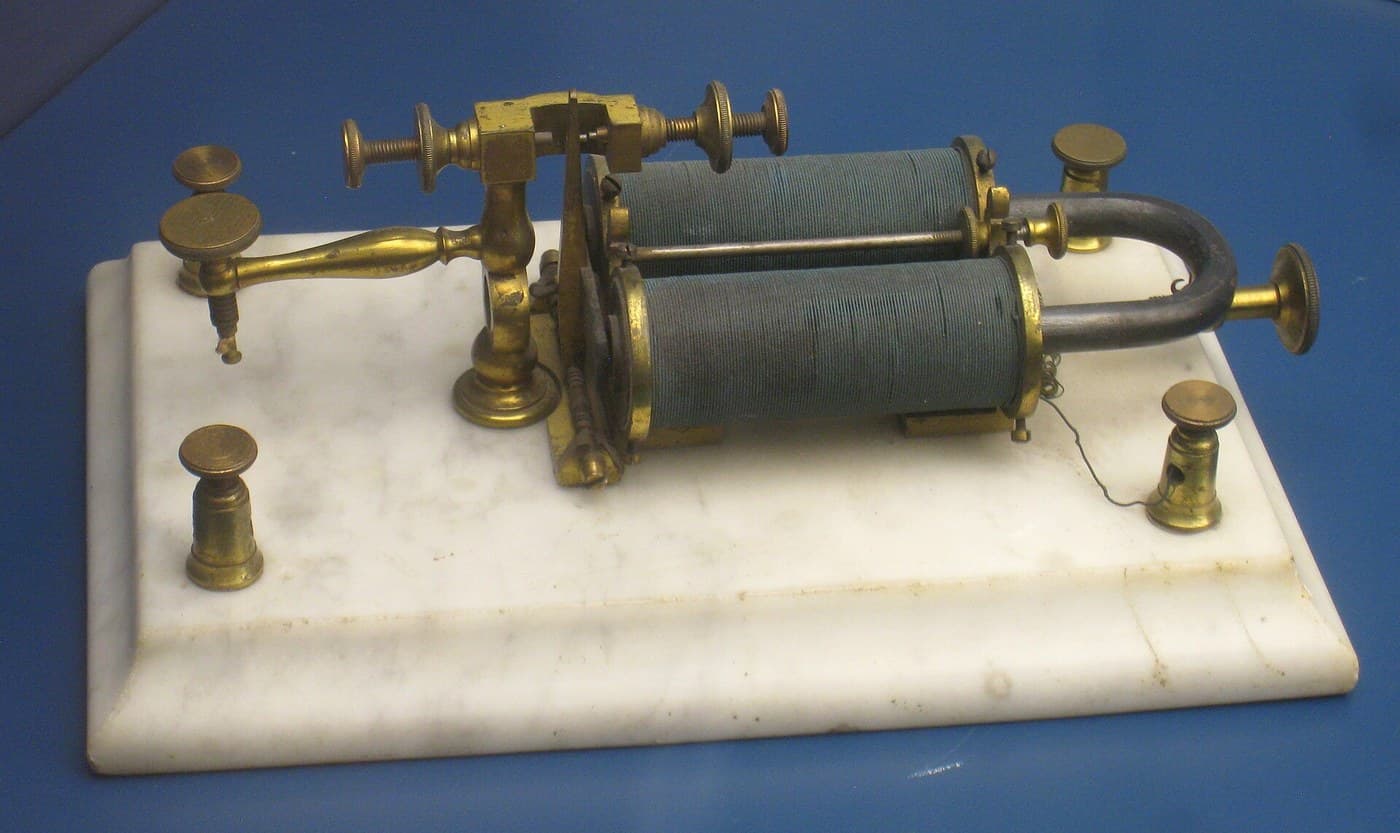
A solenoid valve is an electromagnet pulling an armature, as in a relay. The embedded blueprint builds the relay the idea came from.
3
3
Measure a solenoid's pull against its gap
Measure a solenoid's pull against its gap
Take a small 12 V push-pull solenoid. Clamp it upright and hang its plunger from a spring scale, with a nut on the scale's hook so you can set the gap between the plunger's end and the coil's stop with feeler gauges.
At each gap switch the coil on from the power supply and read the pull. Plot pull against gap: it rises steeply as the gap closes, as the notebook's $1/g^2$ says, then levels off as the iron saturates. Watch the coil current on the supply's meter: it does not change with the gap — the current sets the ampere-turns, the gap sets the pull.
Materiales para este paso:
 Solenoide1 pieza
 Cables de puente1 pieza
Herramientas necesarias:
 Fuente de alimentación de corriente continua
 Dinamómetro (balanza de resorte)
 Juego de galgas de espesores
 Tornillo de banco
 Multímetro
4
4
Drive a real valve, and find where it stops opening
Drive a real valve, and find where it stops opening
Plumb a 12 V solenoid valve between a garden hose (through a ball valve and pressure gauge) and an open outlet into a bucket, with the valve's arrow pointing downstream. Wire the coil to the power supply through a push button.
Press the button and water flows; release it and it stops. Now close the ball valve until the gauge reads almost nothing and try again: many small 12 V valves are pilot-operated and will not open at all at very low pressure — they need a pressure difference to lift their diaphragm. Note the lowest pressure at which it opens, and check the valve's plate or data sheet for its minimum operating pressure.
Materiales para este paso:
 Válvula de bola de latón1 pieza
 Cinta de PTFE para roscas1 pieza
 Pulsador1 pieza
 Agua20 litros
Herramientas necesarias:
Fuente de alimentación de corriente continua Manómetro
 Llave inglesa ajustable
 Cubo
Cubo Manguera de jardín
 Electroválvula
5
5
A solenoid valve that will not behave
A solenoid valve that will not behave
Solenoid valve faults in the order to check them.
Flow
Loading...
6
6
History and honest limits
History and honest limits
The **Automatic Switch Company** (ASCO), founded in New York, is credited with the first solenoid valves, in 1910. Direct-acting and pilot-operated valves of every size now follow the same two patterns.
**Honest limits.** The notebook's pull formula counts only the air gap and ignores the iron's own reluctance and leakage flux; real solenoids give less. A coil held on continuously warms, and its resistance and pull fall as it does. Never use a water valve for gas or fuel: those need valves certified for them.
Materiales
6- Marcador de posición
- Marcador de posición
- 1 piezaMarcador de posición
- 1 piezaMarcador de posición
- Marcador de posición
- 20 litrosMarcador de posición
Herramientas requeridas
10- Marcador de posición
- Marcador de posición
- Marcador de posición
- Marcador de posición
- Marcador de posición
- Marcador de posición
- Marcador de posición
- Marcador de posición
- Manguera de jardín10% de comisiónMarcador de posición
- 1 vendor sell this, none ship to you yetMarcador de posición
Blueprints relacionados
Estos blueprints comparten conocimiento — técnicas, materiales o principios
The Telegraph Relay
por Ed
Electrónica
50
0
0
0
2
0
The Float Valve
por Martin
TECNOLOGÍA
38
0
0
0
1
0
One Way Only: The Check Valve and the Bang It Makes
por Martin
Herramientas
40
0
0
0
0
0
The Spool Valve: Steering Oil With a Sliding Rod
por Emma
Mecánica
33
0
0
0
0
0

Ohm's Law at the Bench: Picking the Resistor That Saves the LED
por Volt
Electrónica
42
0
0
0
0
0
CC0 Dominio público
Este Blueprint se publica bajo CC0. Eres libre de copiar, modificar, distribuir y usar este trabajo para cualquier propósito, sin pedir permiso.
Apoya al Maker comprando productos a través de su Blueprint, donde gana una Comisión del Maker establecida por los vendedores, o crea una nueva iteración de este Blueprint e inclúyela como conexión en tu propio Blueprint para compartir ingresos.