ARTE
BELLEZA Y BIENESTAR
ARTESANÍA
CULTURA E HISTORIA
ENTRETENIMIENTO
MEDIO AMBIENTE
COMIDA Y BEBIDAS
INGENIERÍA INVERSA
CIENCIAS
DEPORTES
TECNOLOGÍA
TECNOLOGÍA VESTIBLE
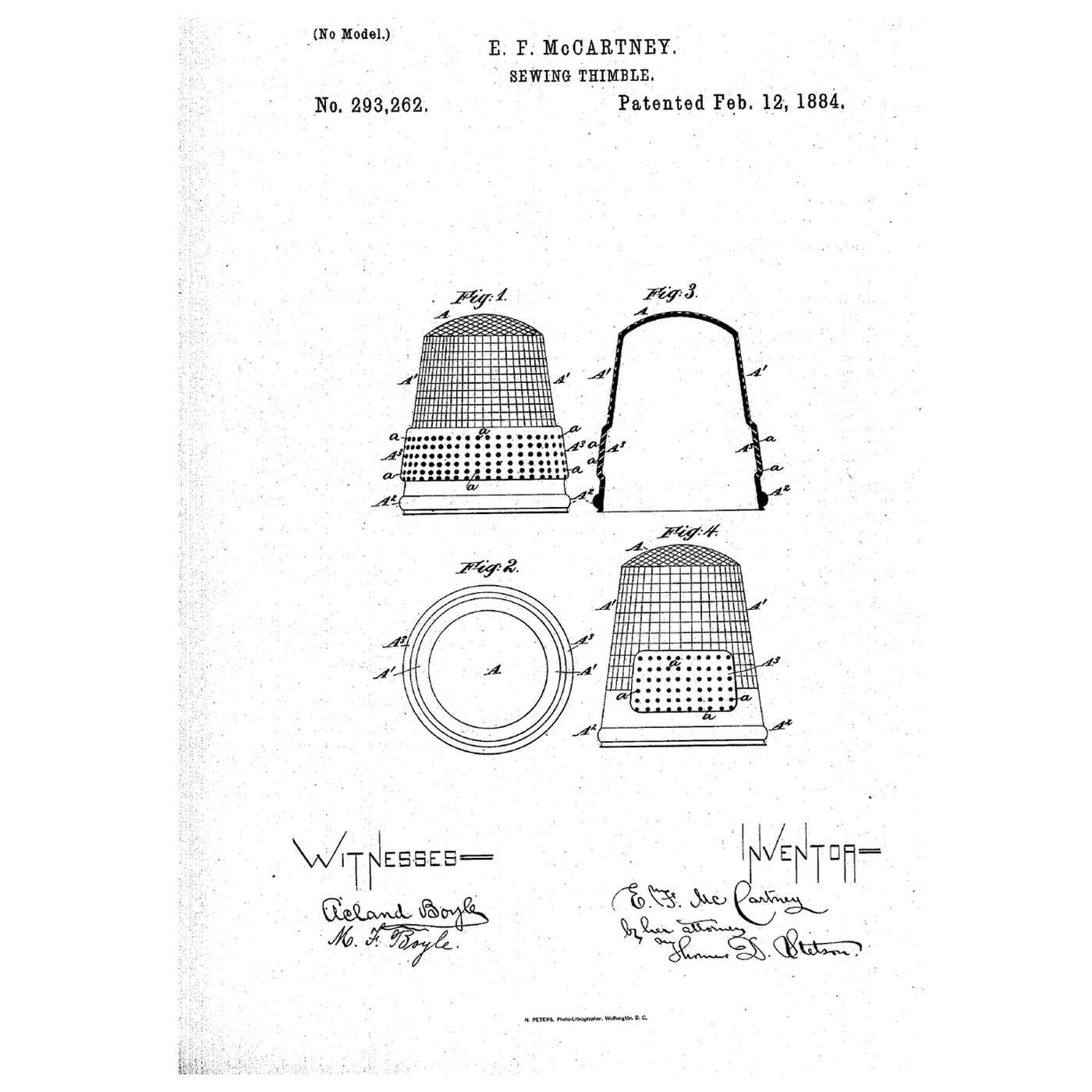


The Ventilated Thimble: A Raised Band That Spares the Nail
Anyone who sews all day with a thimble knows where it hurts: not the tip that pushes, but the root of the nail, where the rim presses hour after hour.
Elizabeth F. McCartney of Omaha, Nebraska, received US 293,262, dated 12 February 1884 (filed 3 September 1883), for a sewing-thimble meant "to more effectually relieve the root of the finger-nail from pressure, and to support the thimble in position by a sufficient bearing above and below, and also to ventilate the space thus provided, while thoroughly protecting it." A raised band stands clear of the nail root, perforated with small inclined holes the needle cannot enter.
This rung works out where the pressure lands and why the holes are safe, then compares pushing a needle through heavy cloth with and without a thimble.
Principiante
About 1 hour
Instrucciones
1
1
Pressure, area and safe holes
Pressure, area and safe holes
Cargando el cuaderno de Jupyter…
2
2
Sewing by hand
Sewing by hand
The embedded blueprint starts hand sewing; the thimble is what makes long seams bearable.
3
3
Read US 293,262
Read US 293,262
"The object of the invention is to more effectually relieve the root of the finger-nail from pressure, and to support the thimble in position by a sufficient bearing above and below, and also to ventilate the space thus provided, while thoroughly protecting it. The invention avoids the irritation due to pressure on the finger at and immediately adjacent to the base or root of the nail, and by sufficiently ventilating that portion of the thimble, avoids the tenderness and brittleness of the nail, which is sometimes experienced with long use of the ordinary unventilated thimbles."
"This part A3 is ventilated by holes a. These are profusely distributed over the entire area of the part A3, except the upper edge, and afford adequate ventilation. They are small and inclined, as shown. The needle will not, under any ordinary or extraordinary conditions, enter these perforations."
4
4
Push with and without
Push with and without
Stretch a piece of heavy denim or canvas in an embroidery hoop. Push a sewing needle through it twenty times with a bare fingertip against a folded cloth pad, and twenty times with a thimble, noting how it feels and how many pushes it takes.
Wear the thimble for a quarter of an hour of stitching and note where on the finger it presses. Measure the needle's eye end with a caliper and compare with the holes of any perforated thimble you have. Never push a needle with a bare fingertip hard enough to hurt.
Materiales para este paso:
 Hilo de coser1 pieza
Herramientas necesarias:
 Dedal
Dedal Aguja de coser
 Bastidor de bordar
 Calibre digital de 6 pulgadas
5
5
A thimble that hurts, slips or lets the needle through
A thimble that hurts, slips or lets the needle through
Thimble troubleshooting.
Flow
Loading...
6
6
History and honest limits
History and honest limits
**Elizabeth F. McCartney** of Omaha, Nebraska, filed US 293,262 on 3 September 1883; it is dated 12 February 1884. The raised band may go all the way round or only part way.
**Honest limits.** The patent gives no sizes. The push force, contact areas, needle and hole sizes in the notebook are examples.
Materiales
1- 1 piezaMarcador de posición
Herramientas requeridas
4- Marcador de posición
- Marcador de posición
- Marcador de posición
- Marcador de posición
Blueprints relacionados
Estos blueprints comparten conocimiento — técnicas, materiales o principios

CC0 Dominio público
Este Blueprint se publica bajo CC0. Eres libre de copiar, modificar, distribuir y usar este trabajo para cualquier propósito, sin pedir permiso.
Apoya al Maker comprando productos a través de su Blueprint, donde gana una Comisión del Maker establecida por los vendedores, o crea una nueva iteración de este Blueprint e inclúyela como conexión en tu propio Blueprint para compartir ingresos.