ARTE
BELLEZA Y BIENESTAR
ARTESANÍA
CULTURA E HISTORIA
ENTRETENIMIENTO
MEDIO AMBIENTE
COMIDA Y BEBIDAS
INGENIERÍA INVERSA
CIENCIAS
DEPORTES
TECNOLOGÍA
TECNOLOGÍA VESTIBLE
Understanding Neon from Air Separation — The Gas That Lit the Modern City
Intermedio
Instrucciones
1
1
Understand Neon's Discovery
Understand Neon's Discovery
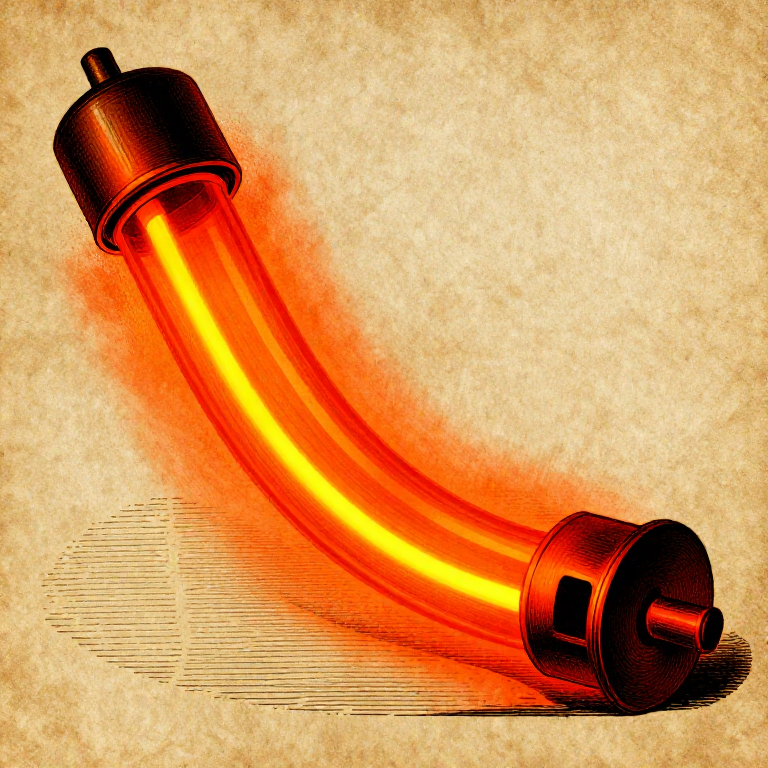
William Ramsay and Morris Travers discovered neon in 1898 by fractional distillation of liquid air at University College London. After removing nitrogen, oxygen, argon, krypton, and xenon, a small residual fraction produced a brilliant crimson-orange glow in a discharge tube. Ramsay's 13-year-old son suggested the name 'novum' (new), but Ramsay chose the Greek 'neon' (new) instead. Travers later wrote that 'the blaze of crimson light was a sight to dwell upon and never forget.'
2
2
Identify Neon in Earth's Atmosphere
Identify Neon in Earth's Atmosphere
Neon makes up just 18.18 ppm of Earth's atmosphere — the fifth most abundant gas after nitrogen, oxygen, argon, and carbon dioxide. Despite being rare on Earth, neon is the fifth most abundant element in the universe, produced by carbon fusion in massive stars. Earth's low neon abundance reflects our planet's inability to gravitationally retain this light noble gas during formation. All commercial neon is extracted as a byproduct of cryogenic air separation plants.
Herramientas necesarias:
 Juego de tubos de descarga de gas (6 elementos)
3
3
Examine Cryogenic Air Separation
Examine Cryogenic Air Separation
Neon is extracted during the cryogenic distillation of air in industrial air separation units (ASUs). Air is compressed, cooled to -200°C, and distilled into nitrogen and oxygen. Neon, with a boiling point of -246°C, accumulates in the nitrogen-rich overhead fraction along with helium and hydrogen. This crude neon is purified by selective adsorption and further cryogenic processing to achieve 99.999% purity required for semiconductor applications.
4
4
Discover Neon Signs and Lighting
Discover Neon Signs and Lighting
Georges Claude demonstrated the first neon lamp in 1910 and the first neon advertising sign in 1912 at a Paris barbershop. By 1923, neon signs arrived in America when a Los Angeles Packard car dealership paid $24,000 for two signs. The distinctive red-orange glow of neon gas discharge became the defining visual of 20th-century urban nightlife. Technically, only red signs contain actual neon — other colors use different gases or phosphor-coated tubes.
5
5
Understand Semiconductor Lithography Applications
Understand Semiconductor Lithography Applications
Neon's most critical modern application is in excimer lasers used for semiconductor photolithography. Deep ultraviolet (DUV) lithography uses krypton-fluoride (248 nm) and argon-fluoride (193 nm) excimer lasers that require large volumes of ultra-pure neon as a buffer gas. Every advanced computer chip manufactured in the world passes through neon-consuming lithography tools. The semiconductor industry consumes approximately 50% of global neon production.
6
6
Examine the Ukraine Neon Supply Crisis
Examine the Ukraine Neon Supply Crisis
Before 2022, Ukraine supplied approximately 50% of global semiconductor-grade neon, produced as a byproduct of large steel-industry air separation plants in Odesa and Mariupol. Russia's invasion disrupted this supply chain overnight, causing neon prices to spike 10-fold. The semiconductor industry scrambled to diversify sources and increase neon recycling. This crisis revealed a hidden vulnerability in the global chip supply chain that few had anticipated.
7
7
Explore Scientific and Laser Applications
Explore Scientific and Laser Applications
The helium-neon (HeNe) laser, invented in 1960 by Ali Javan, was the first continuous-wave gas laser. It produces a highly coherent red beam at 632.8 nm and was the workhorse laser for alignment, holography, and barcode scanning for decades. Neon is also used in high-voltage indicator lamps, wave meter tubes, and as a cryogenic refrigerant for applications that need temperatures between liquid helium (4 K) and liquid nitrogen (77 K).
8
8
Survey Gas Properties and Behavior
Survey Gas Properties and Behavior
Neon is a colorless, odorless, monatomic gas with the narrowest liquid range of any element — just 2.6°C between melting point (-248.6°C) and boiling point (-246.0°C). Its refrigeration capacity per unit volume is 40 times greater than liquid helium, making it useful for cryogenic applications. Neon has the most intense discharge color of any noble gas and the lowest voltage required to initiate a glow discharge, which is why it was the first noble gas used in commercial lighting.
9
9
Understand Supply Chain and Pricing
Understand Supply Chain and Pricing
Global neon production is approximately 540 tonnes per year. Crude neon costs $30-100 per cubic meter, while semiconductor-grade neon (99.999%) commands $300-1,000+ per cubic meter depending on market conditions. Major producers are now diversifying away from Ukrainian dependence — China, South Korea, and the United States are expanding neon purification capacity. Neon recycling systems in lithography fabs can recover and purify 90% of used neon.
Herramientas necesarias:
 Balanza de precisión
10
10
Document Findings and Strategic Importance
Document Findings and Strategic Importance
Record neon's key data: atomic number 10, density 0.9002 g/L, boiling point -246.0°C, colorless noble gas with characteristic orange-red glow. Neon has evolved from a curiosity lighting gas to a strategically critical material for semiconductor manufacturing. The Ukraine supply disruption proved that even a common atmospheric gas can become a geopolitical chokepoint when purification capacity is concentrated. Every advanced microchip depends on neon.
11
11
Half-life: what is left, and when
Half-life: what is left, and when
Cargando el cuaderno de Jupyter…
Herramientas requeridas
2- Marcador de posición
- Marcador de posición
Materiales de Blueprints conectados
10% de atribución
Understanding Helium from Natural Gas — The Element That Escapes Earth Forever
por Peter
Minería
21
0
0
0
4
0

10% de atribución
Growing Saltpeter from Niter Beds — The Explosive Element in Every Living Thing
por Peter
Antiguo
287
0
0
0
5
0
10% de atribución
Understanding Oxygen Through Combustion — The Element That Makes Fire Breathe
por Peter
Antiguo
65
0
0
0
4
0
10% de atribución
Generating Hydrogen Gas from Acid and Metal — The Lightest Element in the Universe
por Peter
Antiguo
81
0
0
0
3
0
Peligroso
10% de atribución
Understanding Fluorine from Fluorite — The Most Reactive Element on Earth
por Peter
Minería
40
0
0
0
4
0
Blueprints relacionados
Estos blueprints comparten conocimiento — técnicas, materiales o principios
CC0 Dominio público
Este Blueprint se publica bajo CC0. Eres libre de copiar, modificar, distribuir y usar este trabajo para cualquier propósito, sin pedir permiso.
Apoya al Maker comprando productos a través de su Blueprint, donde gana una Comisión del Maker establecida por los vendedores, o crea una nueva iteración de este Blueprint e inclúyela como conexión en tu propio Blueprint para compartir ingresos.