SENI
KECANTIKAN & KESEJAHTERAAN
KRAFTANGAN
BUDAYA & SEJARAH
HIBURAN
ALAM SEKITAR
MAKANAN & MINUMAN
KEJURUTERAAN TERBALIK
SAINS
SUKAN
TEKNOLOGI
BOLEH PAKAI
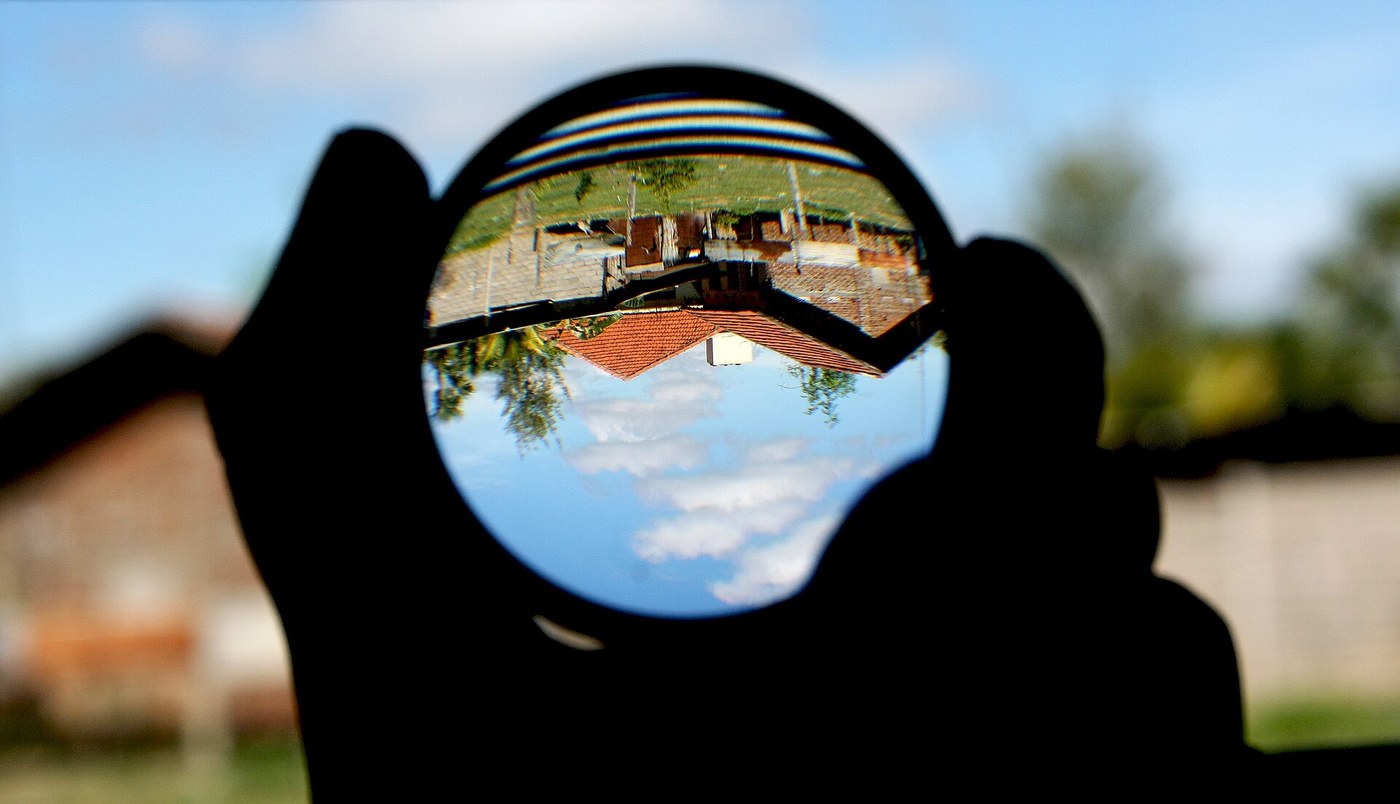


Convex and Concave Lenses Ground as a Pair
Rub one glass disc over another with wet grit and both change shape: the one on top goes hollow, the one beneath goes domed, and they stay a perfect fit. Grind both faces of a pair this way and the bottom disc becomes a double-convex lens, the top one a double-concave lens of the same curve. Longer work gives deeper curves and shorter focal lengths.
The picture: a double-convex lens held at arm's length shows the scene small and upside down.
Lanjutan
Several days per pair
Arahan
1
1
Cut two discs
Cut two discs
Score two equal circles on the glass sheet, snap them out and nibble the edges round with grozing pliers. Fix a short wooden handle to the back of each with warm pitch.
Bahan untuk langkah ini:
 Kepingan kaca1 keping
 Gam Damar Pain20 g
 Jalur kayu keras1 keping
Alatan diperlukan:
 Pemotong kaca
 Playar penggigit kaca
 Cermin mata keselamatan
2
2
Rough grind the first faces
Rough grind the first faces
Lay one disc face up on a firm table, wet it and sprinkle coarse grit. Push the other disc over it, face down, in short strokes, turning both a little all the time. The top one becomes concave, the bottom convex. Rinse and recharge as the grit wears.
Bahan untuk langkah ini:
 Air2 liter
Alatan diperlukan:
 Pembaris
 Grit silikon karbida
3
3
Check the curve
Check the curve
Lay a ruler across the hollow disc and measure the depth at the centre with the caliper. Keep the top disc on top to deepen the curve; swap them to flatten it.
Alatan diperlukan:
Pembaris Angkup Digital 6 Inci
4
4
Fine grind and polish
Fine grind and polish
Go through finer grits, washing everything clean between grits. Polish each face on a pitch lap pressed to the other disc's curve, with tin oxide (putty powder) and water, until clear.
Bahan untuk langkah ini:
 Timah oksida (stanik oksida)30 gGam Damar Pain100 g
Alatan diperlukan:
Grit silikon karbida5
5
Turn them over, do the second faces
Turn them over, do the second faces
Move the handles to the finished faces and grind the other sides the same way, the same disc on top, to the same depth. The bottom disc is now a double-convex lens, the top one double-concave.
Bahan untuk langkah ini:
Timah oksida (stanik oksida)20 gAlatan diperlukan:
Angkup Digital 6 InciGrit silikon karbida6
6
Find the focal length
Find the focal length
Hold the convex lens in sunlight over paper and move it until the spot is smallest; that distance is its focal length. Grind more pairs to different depths for a set of focal lengths.
Alatan diperlukan:
Pembaris7
7
Focal length from the curve
Focal length from the curve
Memuatkan buku nota Jupyter…
8
8
Limits
Limits
Which disc goes hollow is the mirror makers' rule (Sky & Telescope, Stellafane); the lens formula is from Wikipedia. Window glass is not optical glass: expect some colour fringes and bubbles.
Bahan
5- 1 kepingPemegang Tempat
- 120 gPemegang Tempat
- 1 kepingPemegang Tempat
- 2 literPemegang Tempat
- Pemegang Tempat
Blueprint ini membuat



Blueprint berkaitan
Blueprint ini berkongsi pengetahuan — teknik, bahan atau prinsip

CC0 Domain Awam
Blueprint ini dikeluarkan di bawah CC0. Anda bebas menyalin, mengubah, mengedar, dan menggunakan karya ini untuk sebarang tujuan, tanpa meminta kebenaran.
Sokong Pembuat dengan membeli produk melalui Blueprint mereka di mana mereka memperoleh Komisen Pembuat ditetapkan oleh Penjual, atau cipta iterasi baru Blueprint ini dan sertakan ia sebagai sambungan dalam Blueprint anda sendiri untuk berkongsi hasil.