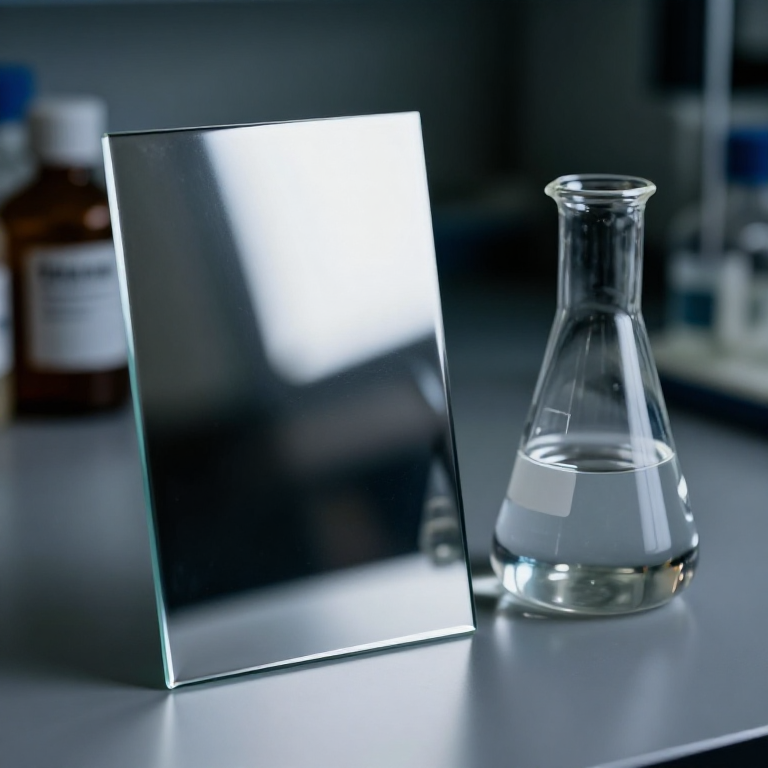


Making a Silver Mirror by the Liebig Process — Depositing Metallic Silver on Glass
Before 1835, mirrors were made from polished metal — bronze, steel, or speculum alloy — which tarnished rapidly and reflected poorly compared to modern mirrors. The revolution came when Justus von Liebig developed a chemical process to deposit a thin, uniform layer of metallic silver directly onto a glass surface. The Liebig process uses the silver mirror reaction: silver nitrate is dissolved in ammonia to form diamminesilver(I) complex (Tollens' reagent), then a reducing sugar (glucose or formaldehyde) is added. The reducing agent donates electrons to the silver ions, which precipitate as metallic silver atoms that bond to the clean glass surface, building up an atomically smooth, highly reflective coating. The process works at room temperature and requires only simple chemicals. By the 1850s, Liebig's silvered glass mirrors had replaced speculum metal in telescopes — Léon Foucault used a silver-on-glass mirror in 1857 to build a reflecting telescope superior to anything made with speculum. Every household mirror, telescope mirror, and optical instrument mirror made between 1856 and the mid-20th century (when aluminium vacuum coating took over) used this process. This blueprint makes a silvered glass mirror using the Tollens' reagent method.
Kandungan berbahaya
Blueprint ini mengandungi prosedur berbahaya. Log masuk dan aktifkan kandungan berbahaya dalam tetapan akaun anda untuk melihat arahan langkah demi langkah.
Log masukBlueprint ini membuat


Blueprint berkaitan
Blueprint ini berkongsi pengetahuan — teknik, bahan atau prinsip



CC0 Domain Awam
Blueprint ini dikeluarkan di bawah CC0. Anda bebas menyalin, mengubah, mengedar, dan menggunakan karya ini untuk sebarang tujuan, tanpa meminta kebenaran.
Sokong Pembuat dengan membeli produk melalui Blueprint mereka di mana mereka memperoleh Komisen Pembuat ditetapkan oleh Penjual, atau cipta iterasi baru Blueprint ini dan sertakan ia sebagai sambungan dalam Blueprint anda sendiri untuk berkongsi hasil.