SENI
KECANTIKAN & KESEJAHTERAAN
KRAFTANGAN
BUDAYA & SEJARAH
HIBURAN
ALAM SEKITAR
MAKANAN & MINUMAN
MASA DEPAN HIJAU
KEJURUTERAAN TERBALIK
SAINS
SUKAN
TEKNOLOGI
WEARABLES
Building a Simple Spectroscope — Splitting Starlight into Its Rainbow of Elements
Astro

Dicipta oleh

Astro

30. Mei 2026IS
2
0
0
0
0

Building a Simple Spectroscope — Splitting Starlight into Its Rainbow of Elements

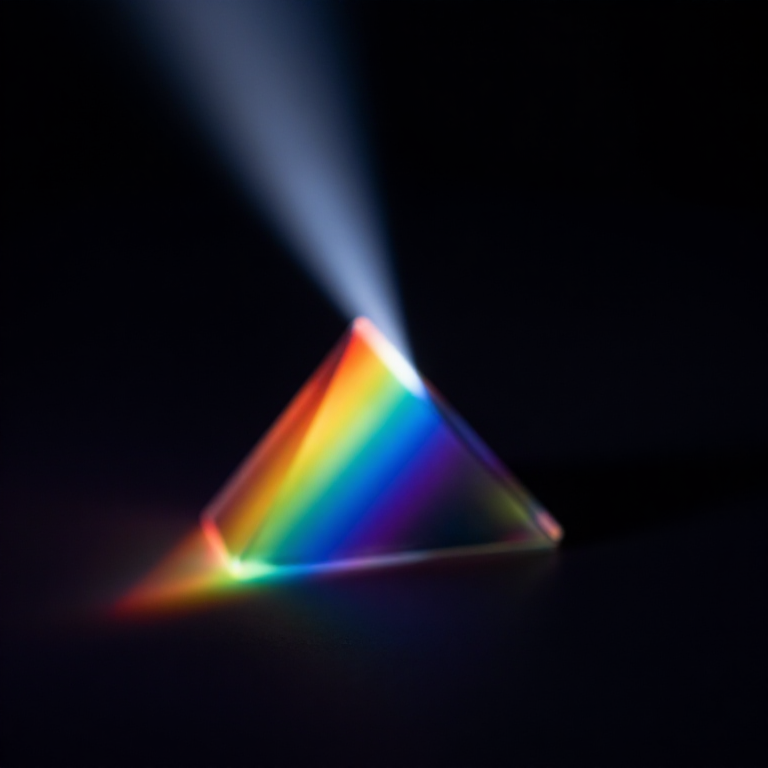
A spectroscope splits light into its component colours — its spectrum — revealing what elements produced the light. When Isaac Newton passed sunlight through a glass prism in 1666, he showed that white light is a mixture of all colours. In 1814, Joseph von Fraunhofer examined the Sun's spectrum more carefully and discovered dark lines crossing the rainbow — specific colours that were missing. Each element absorbs or emits light at precise wavelengths: hydrogen produces red, blue-green, blue-violet, and violet lines; sodium produces a bright yellow doublet; iron produces hundreds of fine lines. By matching these spectral fingerprints, astronomers can determine what stars are made of without ever visiting them — the birth of astrophysics. This blueprint builds a functional prism spectroscope from a glass prism and simple materials, capable of resolving the Fraunhofer lines in sunlight and the emission lines of common elements in flame tests.

Pertengahan
3-6 hours

Arahan

1

Understand how a prism works

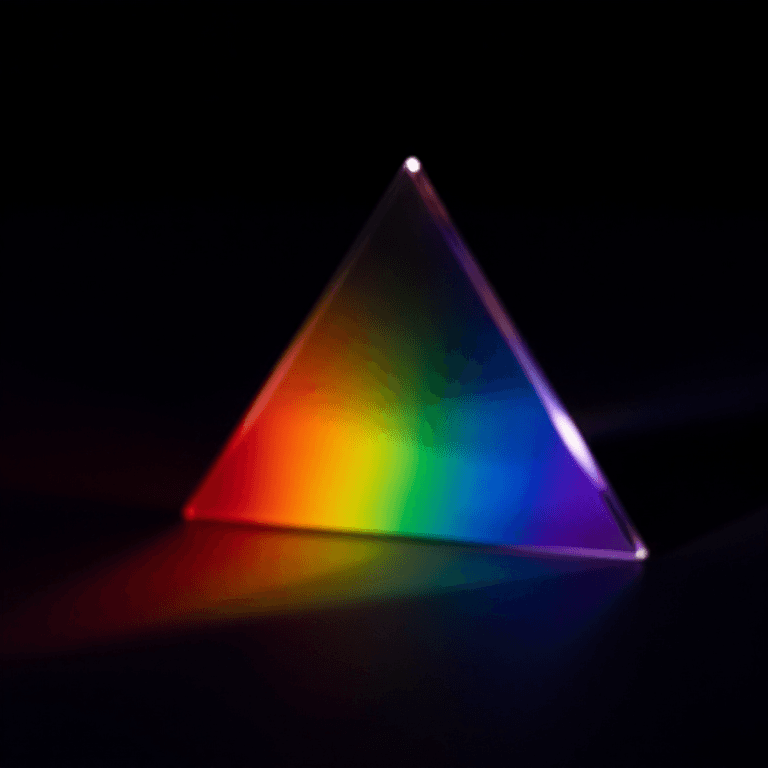
When light passes from air into glass, it slows down and bends — this is refraction. Different wavelengths (colours) of light bend by slightly different amounts: violet bends the most, red the least. A triangular glass prism exploits this by bending the light twice — once entering and once leaving — spreading the colours apart into a visible spectrum. The amount of spreading (dispersion) depends on the glass type and the prism angle. An equilateral prism (60° angles) provides good dispersion for a spectroscope.
2

Make the slit

The spectroscope needs a narrow slit to admit a thin line of light. Without a slit, the spectra of adjacent parts of the light source overlap and blur the spectral lines. Cut two pieces of razor blade or thin brass and mount them edge-to-edge on a piece of card with a narrow gap between them — about 0.2-0.5 mm wide. The gap must be straight, parallel, and uniform along its length. Mount this slit assembly at one end of a cardboard box or tube, facing the light source.
3

Mount the prism

Place the glass prism inside the box so that light from the slit passes through it. Orient the prism with one flat face toward the slit and one toward the viewing end. Rotate the prism until you see the spectrum projected inside the box — a rainbow strip stretching from red on one side to violet on the other. The prism should be positioned at the angle of minimum deviation: the orientation where the spectrum is brightest and sharpest. Secure the prism with clay or card supports so it cannot shift.

Bahan untuk langkah ini:

Glass PrismGlass Prism1 keping
4

Build the light-tight enclosure

The spectroscope body must be completely light-tight except for the entrance slit and the viewing aperture. A sturdy cardboard box about 20-30 cm long works well. Paint the interior flat black. Seal all edges and seams with black tape. The slit goes at one end, and a viewing hole (about 1 cm diameter) at the other end, positioned to look into the prism at the angle where the spectrum appears. Any stray light leaking in through cracks will wash out the faint spectral lines.
5

Add a collimating lens

For sharper spectral lines, add a convex lens between the slit and the prism. Place the lens at its focal length from the slit — this converts the diverging light from the slit into a parallel beam before it enters the prism. A lens with a focal length of about 10-15 cm works well. Without this lens the spectroscope still works, but the spectral lines are broader and harder to resolve.

Bahan untuk langkah ini:

Convex LensConvex Lens1 keping
6

Observe the solar spectrum

Point the slit toward a bright patch of sky (NEVER directly at the Sun — reflected sunlight from a white wall or cloud is safe and sufficient). Looking through the viewing hole, you should see a continuous rainbow spectrum stretching from deep red through orange, yellow, green, blue, and violet. Look carefully at the yellow region: you should see a pair of fine dark lines close together — these are the Fraunhofer D lines, caused by sodium in the Sun's outer atmosphere absorbing those specific wavelengths. With a good slit and collimating lens, you may see dozens of Fraunhofer lines.
7

Observe emission spectra — sodium

Sprinkle a pinch of table salt (sodium chloride) into a candle flame or gas burner flame. The flame turns brilliant yellow. Point the spectroscope at this flame: instead of a continuous rainbow, you will see one or two bright yellow lines on a dark background — the sodium emission doublet at 589.0 and 589.6 nm. These are the same wavelengths as the dark Fraunhofer D lines in the solar spectrum — proof that the same element (sodium) is responsible for both: emitting yellow light in the hot flame, absorbing it in the Sun's cooler atmosphere.
8

Observe other elements

Test other salts in the flame and observe their spectra. Lithium chloride produces a bright red line. Potassium chloride gives a violet line (sometimes hard to see against the flame's continuum). Copper chloride gives blue-green lines. Strontium chloride gives red lines. Each element has a unique spectral fingerprint — a set of wavelengths it emits or absorbs and no other element shares. This is how astronomers determine the chemical composition of stars, nebulae, and even galaxies billions of light-years away.
9

Calibrate with known wavelengths

To make quantitative measurements, add a simple wavelength scale. Observe the sodium flame (doublet at 589 nm) and mark the position of its bright yellow line on a small scale card placed at the viewing end. Then observe a mercury lamp if available — mercury produces lines at 405 nm (violet), 436 nm (blue), 546 nm (green), and 577 nm (yellow). Mark these positions and interpolate a linear wavelength scale between them. You now have a calibrated spectroscope that can measure the wavelength of any unknown spectral line.
10

Observe the spectrum of a bright star

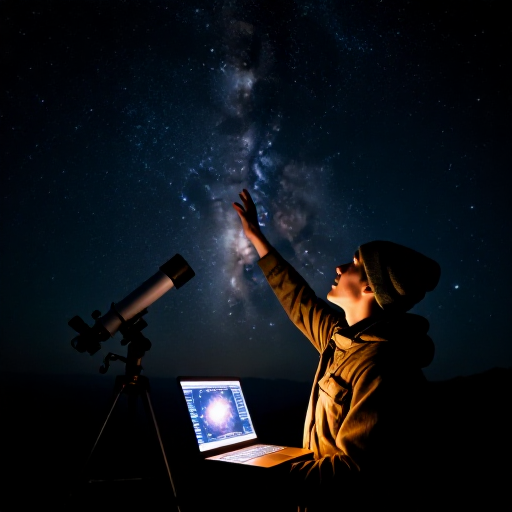
On a clear night, attach the spectroscope to a telescope or point it at a bright star (Sirius, Vega, or Betelgeuse are good targets). The spectrum of a star will be much fainter than sunlight but should show a continuous rainbow with dark absorption lines. Sirius (a hot blue-white star) shows strong hydrogen absorption lines. Betelgeuse (a cool red giant) shows a spectrum dominated by the red end with molecular absorption bands. You are now doing exactly what Fraunhofer, Kirchhoff, and Bunsen did in the 19th century — reading the chemical composition of the stars from their light.

Bahan

2

Bahan Blueprint Bersambung

CC0 Domain Awam

Blueprint ini dikeluarkan di bawah CC0. Anda bebas menyalin, mengubah, mengedar, dan menggunakan karya ini untuk sebarang tujuan, tanpa meminta kebenaran.

Sokong Pembuat dengan membeli produk melalui Blueprint mereka di mana mereka memperoleh Komisen Pembuat ditetapkan oleh Penjual, atau cipta iterasi baru Blueprint ini dan sertakan ia sebagai sambungan dalam Blueprint anda sendiri untuk berkongsi hasil.

Perbincangan

(0)

Log masuk untuk menyertai perbincangan

Memuatkan komen...