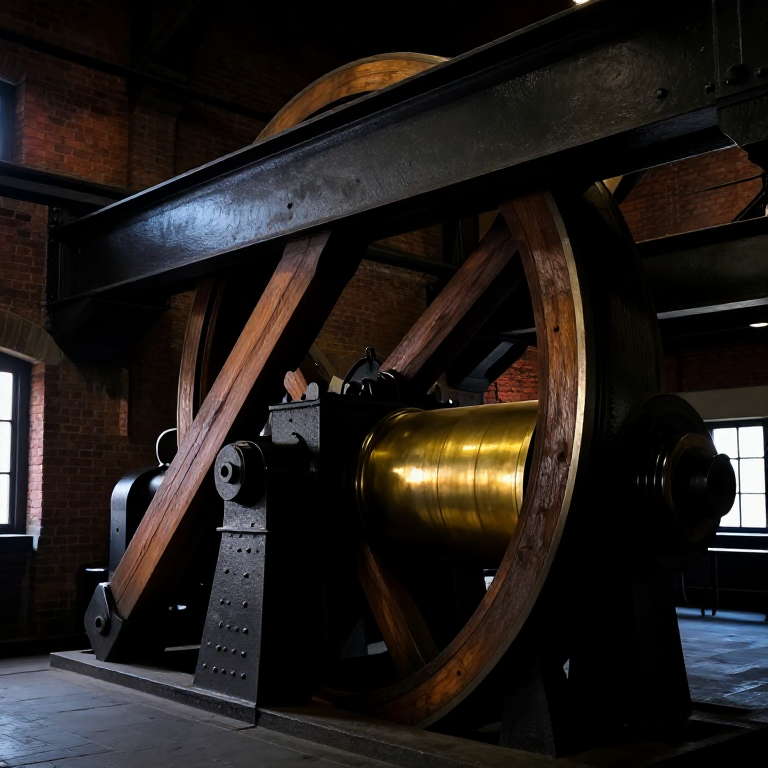


Building a Newcomen Atmospheric Engine — The First Engine to Do Real Work
In 1712 Thomas Newcomen built a machine that changed the world quietly, by pumping water out of coal mines. It was the first engine to turn the heat of a fire into useful mechanical work on a large scale, and every steam engine and motor that followed descends from it.
Its genius is counter-intuitive: the steam does not push the piston. Newcomen's engine fills a cylinder with low-pressure steam, then sprays in cold water to condense that steam into a few drops, leaving a vacuum. The ordinary pressure of the atmosphere — about a tonne on a large piston — then shoves the piston down into the vacuum. That downward stroke rocks a great wooden beam whose far end lifts the mine pump. Because air pressure does the work, it is called an atmospheric engine.
It was thirsty and wasteful, reheating its whole cylinder every stroke, but it was tireless and it worked. For sixty years Newcomen engines drained the mines that supplied the coal that fed the Industrial Revolution — until James Watt's separate condenser made the steam engine efficient enough to drive factories and locomotives.
Arahan
Grasp the atmospheric principle
Grasp the atmospheric principle
Build the boiler
Build the boiler
Bahan untuk langkah ini:
 Kepingan Tembaga40 kg
 Bata Tahan Api120 keping
Cast and bore the cylinder
Cast and bore the cylinder
Bahan untuk langkah ini:
 Silinder besi tuang1 keping
 Kulit2 sqm
Erect the great beam
Erect the great beam
Bahan untuk langkah ini:
 Rasuk kayu Douglas fir1 keping
Plumb the steam and water pipes
Plumb the steam and water pipes
Bahan untuk langkah ini:
 Tiub tembaga6 meter
Alatan diperlukan:
 Sepana paip
Raise steam
Raise steam
Bahan untuk langkah ini:
 Arang batu bituminus50 kg
Admit steam and let the piston rise
Admit steam and let the piston rise
Alatan diperlukan:
 Injap wap
Inject cold water to make the vacuum
Inject cold water to make the vacuum
Alatan diperlukan:
Injap wapTake the power stroke
Take the power stroke
Bahan untuk langkah ini:
 Air30 liter
Drain and repeat
Drain and repeat
Alatan diperlukan:
Injap wapMake it self-acting
Make it self-acting
Alatan diperlukan:
Sepana paipKnow its power and its flaw
Know its power and its flaw
Bahan
8- 40 kgPemegang Tempat
- 120 kepingPemegang Tempat
- 1 kepingPemegang Tempat
- 2 sqmPemegang Tempat
- 1 kepingPemegang Tempat
- 6 meterPemegang Tempat
- 50 kgPemegang Tempat
- 30 literPemegang Tempat
Blueprint berkaitan
Blueprint ini berkongsi pengetahuan — teknik, bahan atau prinsip


CC0 Domain Awam
Blueprint ini dikeluarkan di bawah CC0. Anda bebas menyalin, mengubah, mengedar, dan menggunakan karya ini untuk sebarang tujuan, tanpa meminta kebenaran.
Sokong Pembuat dengan membeli produk melalui Blueprint mereka di mana mereka memperoleh Komisen Pembuat ditetapkan oleh Penjual, atau cipta iterasi baru Blueprint ini dan sertakan ia sebagai sambungan dalam Blueprint anda sendiri untuk berkongsi hasil.