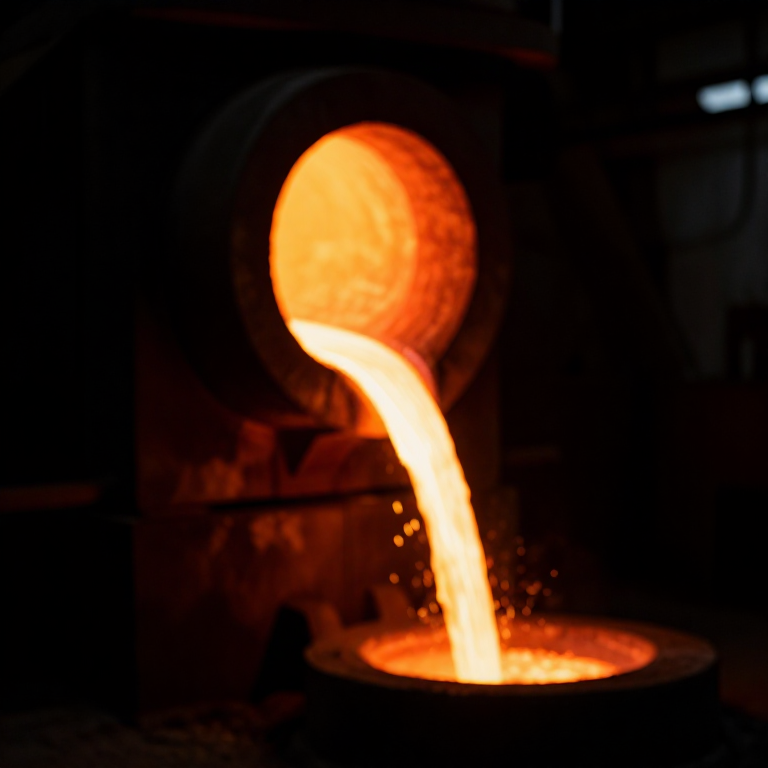


Smelting Pig Iron in a Coke Blast Furnace — Molten Iron at Industrial Scale
The bloomery gave the ancient world iron, but only in small spongy lumps, one slow batch at a time. The blast furnace changed everything: a tall shaft kept continuously charged and blown produces a steady river of molten iron. Where a bloomery never melts its metal, a blast furnace runs hot enough to liquefy iron entirely, letting it pool at the hearth and be tapped out by the tonne.
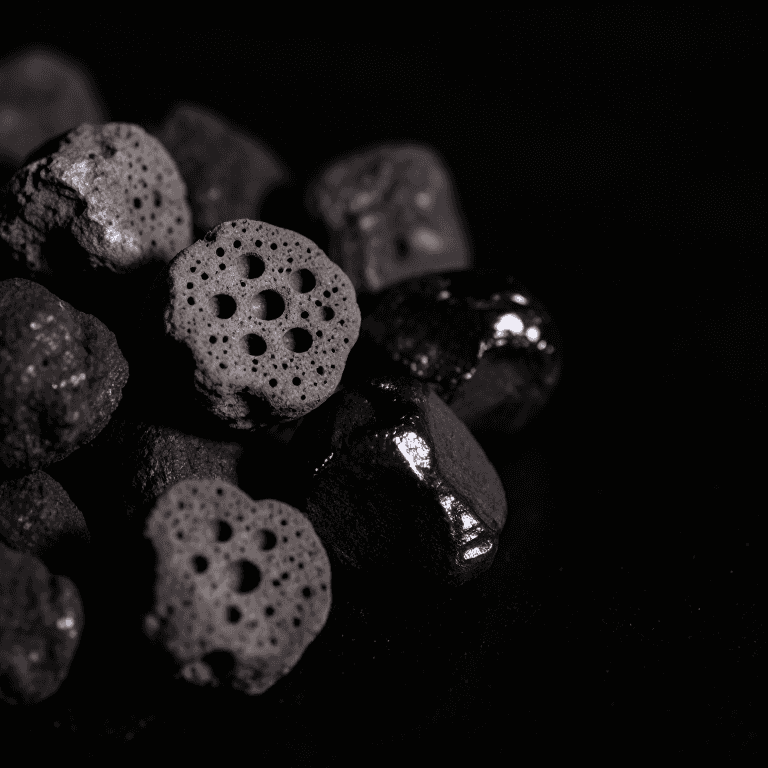
The key is heat and chemistry working together. A powerful air blast burns coke to carbon monoxide, which strips the oxygen from iron ore; meanwhile the descending iron soaks up carbon until it melts. Limestone added as flux carries off the stony impurities as a floating slag. What runs out of the tap hole is pig iron — iron saturated with about four percent carbon: hard, brittle, and perfect for casting or for refining into wrought iron and steel.
When coke replaced charcoal as the blast-furnace fuel in the early 1700s, iron could finally be made in unlimited quantity without consuming whole forests. Cheap pig iron became the raw material of the Industrial Revolution — the metal behind rails, bridges, engines, and machines.
Arahan
Understand pig iron
Understand pig iron
Build the shaft furnace
Build the shaft furnace
Bahan untuk langkah ini:
 Bata Tahan Api80 keping
Alatan diperlukan:
 Cangkul Tangan
Crush the ore and flux
Crush the ore and flux
Bahan untuk langkah ini:
 Bijih besi paya kering30 kg
 Kepingan batu kapur8 kg
Alatan diperlukan:
 Tukul
TukulSet up the air blast
Set up the air blast
Alatan diperlukan:
 Hembusan Angin
Light the coke bed
Light the coke bed
Bahan untuk langkah ini:
 Kok metalurgi40 kg
Charge in layers
Charge in layers
Bahan untuk langkah ini:
Kok metalurgi40 kgReduce the ore
Reduce the ore
Melt and carburize
Melt and carburize
Form and tap the slag
Form and tap the slag
Alatan diperlukan:
 Batang penebuk relau
Tap the molten iron
Tap the molten iron
Alatan diperlukan:
Batang penebuk relauCast the pigs
Cast the pigs
Bahan untuk langkah ini:
 Pasir tuangan50 kg
Cool, break, and identify
Cool, break, and identify
Alatan diperlukan:
TukulBahan
5- 80 kepingPemegang Tempat
- Pemegang Tempat
- Pemegang Tempat
- 40 kgPemegang Tempat
- 50 kgPemegang Tempat
Bahan Blueprint Bersambung

Blueprint berkaitan
Blueprint ini berkongsi pengetahuan — teknik, bahan atau prinsip


CC0 Domain Awam
Blueprint ini dikeluarkan di bawah CC0. Anda bebas menyalin, mengubah, mengedar, dan menggunakan karya ini untuk sebarang tujuan, tanpa meminta kebenaran.
Sokong Pembuat dengan membeli produk melalui Blueprint mereka di mana mereka memperoleh Komisen Pembuat ditetapkan oleh Penjual, atau cipta iterasi baru Blueprint ini dan sertakan ia sebagai sambungan dalam Blueprint anda sendiri untuk berkongsi hasil.