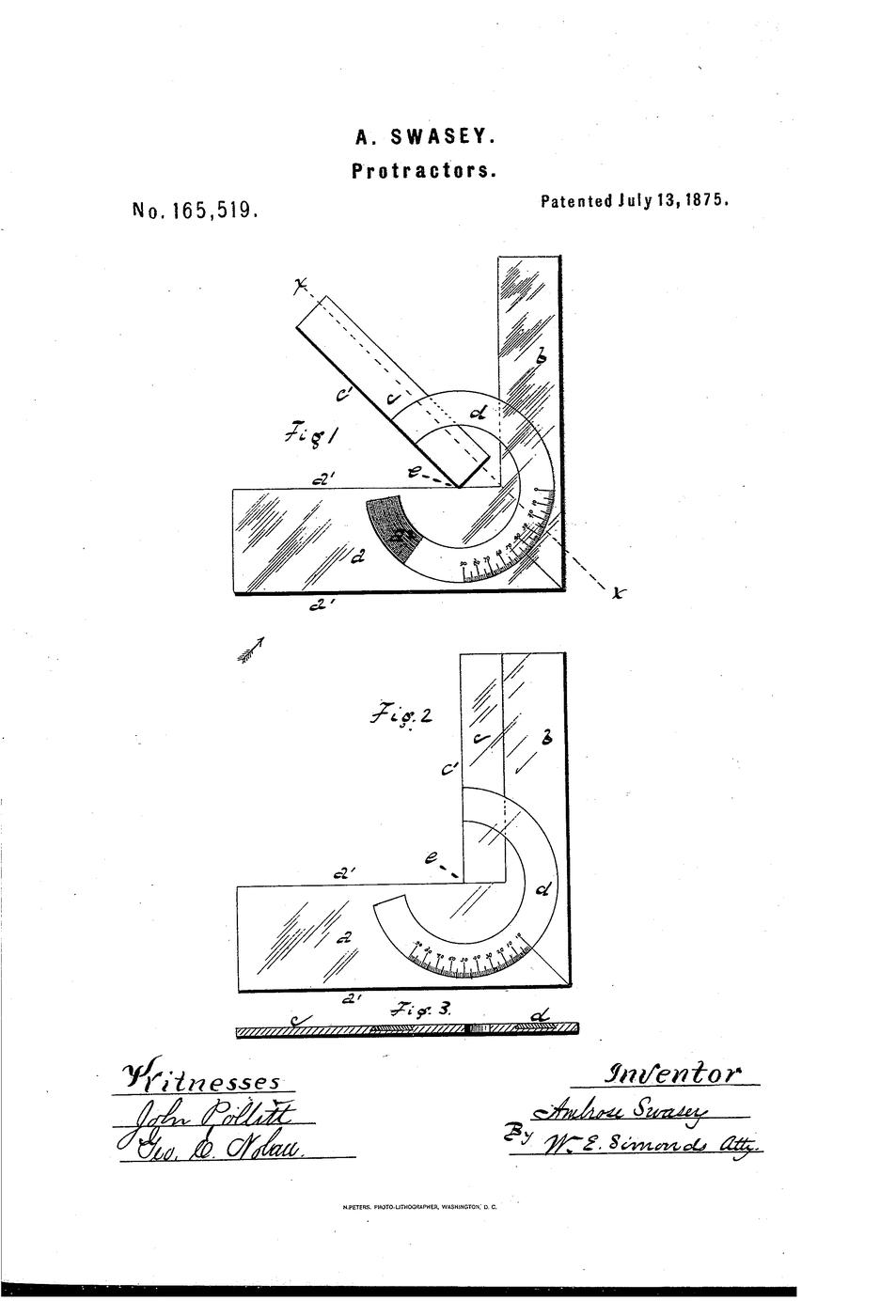


Bevel Protractor
Length has an obvious standard: a bar you can copy. Angle has none — you cannot keep a master 37° in a drawer. Angle must be divided out of the circle every time, which makes it the harder measurement.
US 165,519, “Protractor”, Ambrose Swasey of Hartford, Connecticut, granted 13 July 1875 — an instrument for draughtsmen, machinists and surveyors. Swasey's bevel protractor puts a vernier on a rotating blade, so the reading goes below the whole degree to minutes of arc.
Swasey was 29 and working at Pratt & Whitney. He later co-founded Warner & Swasey and built the mountings for some of the largest telescopes in the world — the same problem of dividing a circle precisely, at a very different scale.
Arahan
Read the claim before you build
Read the claim before you build
Swasey claims a vernier on a rotating blade. Write down why an angle cannot be stored as a physical master the way a length can.
Measure an angle with a plain protractor
Measure an angle with a plain protractor
Draw any angle on graph paper and read it with the plain protractor. Record your best estimate and how confident you are in the last digit.
Bahan untuk langkah ini:
 Kertas Graf1 helaian
Alatan diperlukan:
 Protraktor
Have someone else read the same angle
Have someone else read the same angle
Ask another person to read your angle. Compare. The disagreement is the problem Swasey is solving.
Alatan diperlukan:
ProtraktorUnderstand the vernier principle
Understand the vernier principle
A vernier scale has divisions slightly SMALLER than the main scale. Whichever pair of lines coincides tells you the fraction. Write that sentence out.
Bahan untuk langkah ini:
Kertas Graf1 helaianFind the coincidence on a real vernier
Find the coincidence on a real vernier
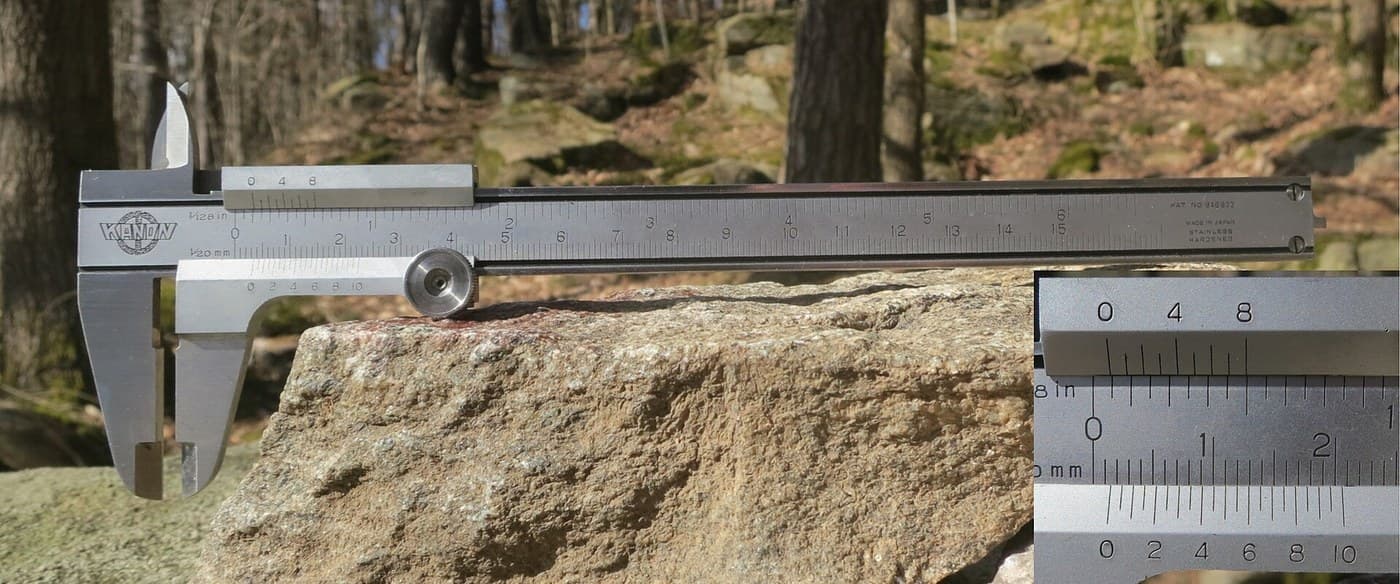
Open the vernier caliper to an arbitrary width. Find the one vernier line that aligns with a main line. That single alignment is the extra digit.
Alatan diperlukan:
 Angkup Vernier
 Kanta Pembesar
Draw a 12-division main scale
Draw a 12-division main scale
On graph paper draw 12 divisions at exactly 10 mm each along a line.
Bahan untuk langkah ini:
Kertas Graf1 helaianAlatan diperlukan:
 Pembaris
Draw a 10-division vernier
Draw a 10-division vernier
On a separate strip draw 10 divisions at 9 mm each. Cut it out. Ten of yours span nine of theirs.
Bahan untuk langkah ini:
Kertas Graf1 helaianAlatan diperlukan:
Pembaris Gunting
Read tenths with your paper vernier
Read tenths with your paper vernier
Slide the strip along the main scale. Whichever line coincides gives the tenth. You have added a digit with no finer engraving.
Build the rotating blade
Build the rotating blade
Cut a card blade 150 mm long, pin it through a card disc at the centre with a screw so it swings freely.
Bahan untuk langkah ini:
Kertas Graf1 helaian Skru mesin #6-321 keping
Alatan diperlukan:
GuntingGraduate the disc
Graduate the disc
Mark the disc every 5° using the protractor as the master. Every instrument is copied from a better one; the chain has to stop somewhere.
Alatan diperlukan:
Protraktor Penanda Kekal
Add the vernier arc
Add the vernier arc
Glue your 10-division strip, curved, to the blade so it rides against the disc graduations.
Bahan untuk langkah ini:
 Gam Kayu2 ml
Measure a real corner
Measure a real corner
Set the blade against a corner of the wooden board and read degrees plus vernier fraction.
Bahan untuk langkah ini:
 Papan Kayu Rata1 keping
Check against a known right angle
Check against a known right angle
Read a corner you believe is 90°. Any deviation is either the corner or your instrument — reverse the tool to find out which, as in the level blueprint.
Alatan diperlukan:
PembarisHistory & Context
History & Context
US 165,519, “Protractor”, Ambrose Swasey, Hartford, Connecticut, granted 13 July 1875.
Swasey was born on a New Hampshire farm in 1846 and was working at Pratt & Whitney when this issued. In 1880 he and Worcester Warner founded Warner & Swasey in Cleveland, which built turret lathes — and the mountings and telescopes for Lick, Yerkes and other great observatories. Dividing a circle accurately is the same problem whether the circle is 100 mm across on a machinist's bench or a telescope's setting circle tracking a star.
Why angle is genuinely harder than length. You can keep a metre bar in a vault and compare copies to it. You cannot keep an angle: an angle is a ratio, and the only physical master is a divided circle, which someone had to divide in the first place. Historically that was the dividing engine, and the accuracy of every protractor traces back to one.
The vernier's elegance. It adds a decimal digit using nothing but two scales of slightly different pitch — no gears, no optics, no power. Pierre Vernier published it in 1631. That a 1631 idea is still the readout on a 1875 patent, and on the caliper in step 5, says something about how rarely a genuinely good idea needs replacing.
Bahan
4- 1 helaianPemegang Tempat
- 1 kepingPemegang Tempat
- 2 mlPemegang Tempat
- 1 kepingPemegang Tempat
Bahan Blueprint Bersambung

Blueprint berkaitan
Blueprint ini berkongsi pengetahuan — teknik, bahan atau prinsip
CC0 Domain Awam
Blueprint ini dikeluarkan di bawah CC0. Anda bebas menyalin, mengubah, mengedar, dan menggunakan karya ini untuk sebarang tujuan, tanpa meminta kebenaran.
Sokong Pembuat dengan membeli produk melalui Blueprint mereka di mana mereka memperoleh Komisen Pembuat ditetapkan oleh Penjual, atau cipta iterasi baru Blueprint ini dan sertakan ia sebagai sambungan dalam Blueprint anda sendiri untuk berkongsi hasil.