SENI
KECANTIKAN & KESEJAHTERAAN
KRAFTANGAN
BUDAYA & SEJARAH
HIBURAN
ALAM SEKITAR
MAKANAN & MINUMAN
KEJURUTERAAN TERBALIK
SAINS
SUKAN
TEKNOLOGI
BOLEH PAKAI

The Steam Injector: Feeding a Boiler With Its Own Steam
A steam boiler boils its water away and must be fed more, against its own pressure. Early locomotives did it with pumps driven off the crossheads or the axles, so a locomotive standing still could not feed its boiler.
Henri Giffard's injector of 1858–60 does it with no moving parts at all. A jet of the boiler's own steam is blown through a nozzle into cold water; the steam condenses, and its speed is handed to the water; the fast water jet slows in a widening cone and its speed becomes pressure — enough to lift a check valve and enter the boiler the steam came from.
This rung explains why that is not a perpetual-motion trick, and what its one hard limit is. You do NOT build a steam injector here. You build its cold cousin — the water-jet aspirator — which uses the same jet physics without condensation, and you measure the limit that sits under both of them: the vapour pressure of water.
Pertengahan
About 4 hours
Arahan
1
1
Read the patent drawing part by part
Read the patent drawing part by part
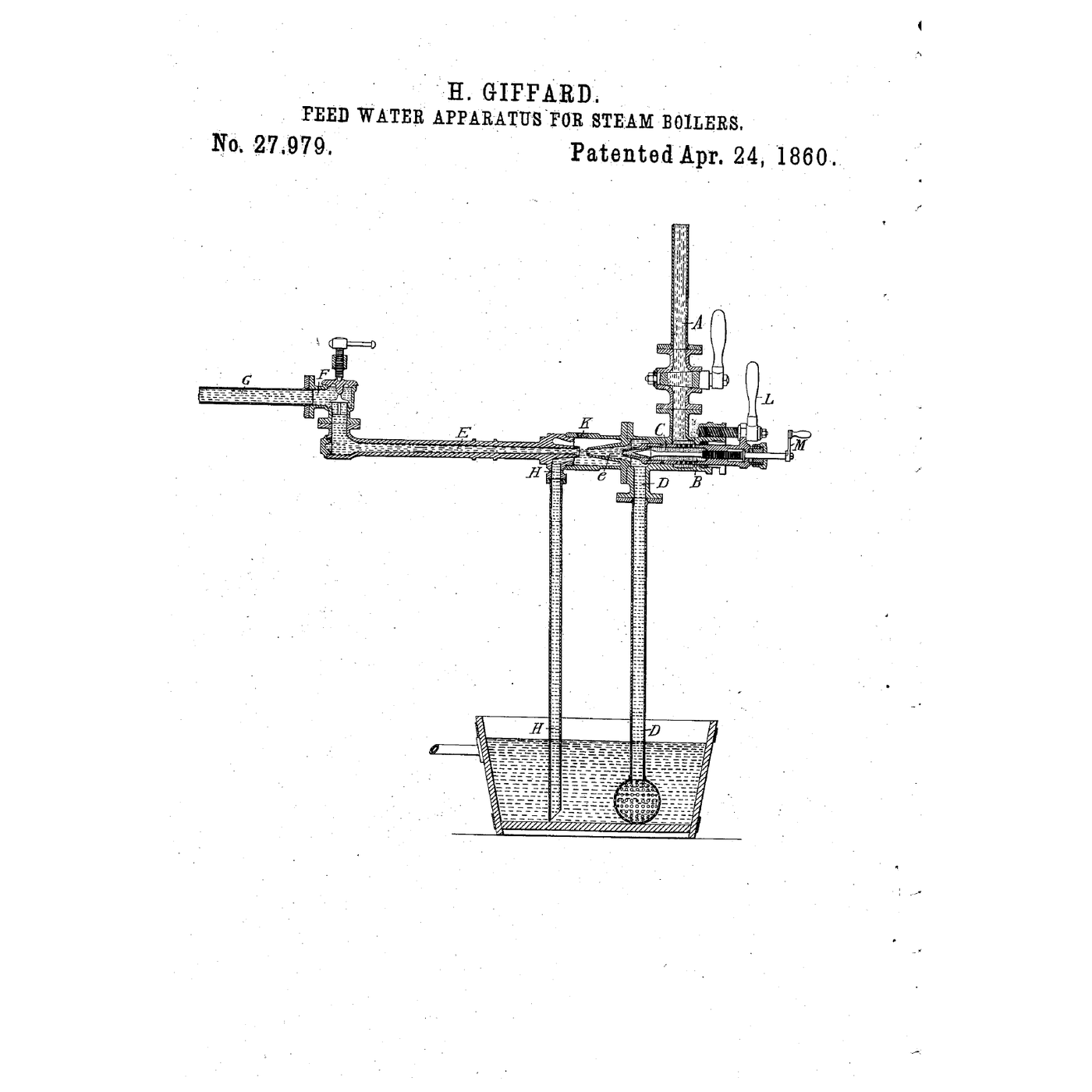
Giffard's US drawing shows the whole injector in section, and every part has one job:
- **The steam cone** — steam from the boiler enters and leaves through a converging nozzle as a fast jet. Its tip can be moved on guides by the handle, to regulate how much steam goes through.
- **The combining cone** — the jet passes through, surrounded by feed water that has been drawn up from the tank. Here the steam condenses into the water.
- **The gap and the overflow** — between the combining and delivery cones is an open gap. Giffard: *"H in the drawing represents the overflow pipe"*, and *"openings or windows K may be formed"*, covered with glass, to watch the state of the jet. While starting, water and steam spill out of the overflow; when the injector 'picks up', it falls silent.
- **The delivery cone** — a diverging passage in which the fast water slows down and its speed turns into pressure.
- **The check valve** — Giffard's *"small valve interposed between the boiler and the jet pipes"*, so the boiler cannot empty back when the injector is shut off.
Match each item to the lettered parts on the drawing. The same four passages — nozzle, mixing throat, diffuser, check valve — are in every jet pump, steam or not.
2
2
Why it works: energy, jet speed and momentum
Why it works: energy, jet speed and momentum
Memuatkan buku nota Jupyter…
3
3
Print a water-jet aspirator
Print a water-jet aspirator
The water-jet aspirator is the injector with cold water as the driving jet instead of steam. There is no condensation, so it cannot pump into a pressure higher than its own supply — but it has the same nozzle, the same throat and the same diffuser, and it makes a real vacuum.
Print it in PETG as one piece with three connections:
- a **hose inlet** leading to a converging nozzle with a 2 mm bore at its tip;
- a **side port** into the chamber around the nozzle tip — the suction;
- a **throat** of 3 mm bore starting 1–2 mm beyond the nozzle tip, 15 mm long, opening into a **diffuser** that widens at a shallow angle (about 7 degrees total) to 10 mm.
Print it vertically with the nozzle at the top, at a fine layer height, and ream the nozzle and throat with a drill bit held in the fingers. The throat must be smooth and concentric with the nozzle — a jet that strikes the throat wall off-centre makes no vacuum at all. Seal the threads with PTFE tape.
Bahan untuk langkah ini:
 Filamen PETG40 g
 Pita pengedap bebenang PTFE1 gulung
Alatan diperlukan:
 Pencetak 3D filamen (FDM)
 Set Mata Gerudi
 Angkup Digital 6 Inci
4
4
Measure the vacuum — and what stops it
Measure the vacuum — and what stops it
Connect the aspirator to a garden hose on a tap, with its diffuser discharging into a sink or bucket. Connect the side port to a vacuum gauge through a short length of clear vinyl tube, clamped at both ends.
Turn the tap fully on and read the gauge as it settles. Now close the tap part way and read again: the vacuum falls with the jet speed, the way the injector's delivery pressure does.
Then the important test. Run it once on cold water and once on warm water from the hot tap, with the thermometer in the discharge. The warm run cannot reach the same vacuum, however fast the jet. Near the limit the water in the suction line boils at room temperature: you will see bubbles form in the clear tube. **No water jet can pull a vacuum below the vapour pressure of the water it is made of** — about 2.3 kPa absolute at 20 °C, over 7 kPa at 40 °C.
Finally, use it as a pump: put the suction tube into a bucket set half a metre below the aspirator and watch it lift water. This is a jet pump, the injector's exact job, with a different driving fluid.
Bahan untuk langkah ini:
 Tiub vinil jernih1 meter
 Pelbagai pengapit hos1 set
 Air20 liter
Alatan diperlukan:
 Termometer dapur
 Baldi
Baldi Sepana boleh laras
 Tolok vakum
 Hos taman
5
5
Giffard's own limit: the feed water must be cold
Giffard's own limit: the feed water must be cold
Memuatkan buku nota Jupyter…
6
6
It will not pick up: the usual causes
It will not pick up: the usual causes
An injector that blows steam and water out of the overflow instead of feeding the boiler. The first cause is the limit the notebook just computed; the rest are the ways the jet loses the speed it needs.
Flow
Loading...
7
7
History and context
History and context
**US 27,979, 'Feed Water Apparatus for Steam Boilers', Henri Giffard of Paris, patented 24 April 1860.** Giffard was an engineer who had flown a steam-powered airship in 1852. The injector is widely dated to his French patent of 1858; the US patent that followed is the one verified here, and it prints its own operating limit — the sentence about water condensing steam only below 100 °C.
William Sellers & Co. of Philadelphia made injectors under licence in the United States from 1860, and it became standard equipment on locomotives: a fitting with no moving parts that fed the boiler whether the engine was running or not.
The same nozzle-throat-diffuser layout is the ejector used to pull vacuum on steam condensers and chemical plant, the jet pump down a water well, and the laboratory aspirator built in step 3.
**Honest limits.** Hot feed water defeats it, as the notebook shows. It is fussy to start and must be adjusted to the boiler pressure. As a pump it is inefficient — but on a boiler that does not matter, because the heat it seems to waste goes into the feed water, and so back into the boiler.
**Do not build a steam injector.** It works only with a pressurised boiler, which is a vessel that can kill; boilers are built, tested and inspected under regulation for that reason.
Bahan
5- 40 gPemegang Tempat
- 1 gulungPemegang Tempat
- 1 meterPemegang Tempat
- Pemegang Tempat
- 20 literPemegang Tempat
Alatan Diperlukan
8- Pemegang Tempat
- Pemegang Tempat
- Pemegang Tempat
- Pemegang Tempat
- Pemegang Tempat
- Pemegang Tempat
- Pemegang Tempat
- Hos taman10% komisenPemegang Tempat
Blueprint berkaitan
Blueprint ini berkongsi pengetahuan — teknik, bahan atau prinsip

Building a Newcomen Atmospheric Engine — The First Engine to Do Real Work
oleh Dwalin
Mekanik
62
0
0
0
0
0
Rotative Beam Engine
oleh Martin
TEKNOLOGI
42
0
0
0
1
0
Safety Relief Valve
oleh Penny
TEKNOLOGI
42
0
0
0
0
0
Venturi Meter
oleh Penny
Kejuruteraan
41
0
0
0
0
0
One Way Only: The Check Valve and the Bang It Makes
oleh Martin
Alat
38
0
0
0
0
0
The Centrifugal Pump: Speed Squared, and Why It Cannot Lift Air
oleh Emma
Mekanik
34
0
0
0
0
0
CC0 Domain Awam
Blueprint ini dikeluarkan di bawah CC0. Anda bebas menyalin, mengubah, mengedar, dan menggunakan karya ini untuk sebarang tujuan, tanpa meminta kebenaran.
Sokong Pembuat dengan membeli produk melalui Blueprint mereka di mana mereka memperoleh Komisen Pembuat ditetapkan oleh Penjual, atau cipta iterasi baru Blueprint ini dan sertakan ia sebagai sambungan dalam Blueprint anda sendiri untuk berkongsi hasil.