SENI
KECANTIKAN & KESEJAHTERAAN
KRAFTANGAN
BUDAYA & SEJARAH
HIBURAN
ALAM SEKITAR
MAKANAN & MINUMAN
KEJURUTERAAN TERBALIK
SAINS
SUKAN
TEKNOLOGI
BOLEH PAKAI
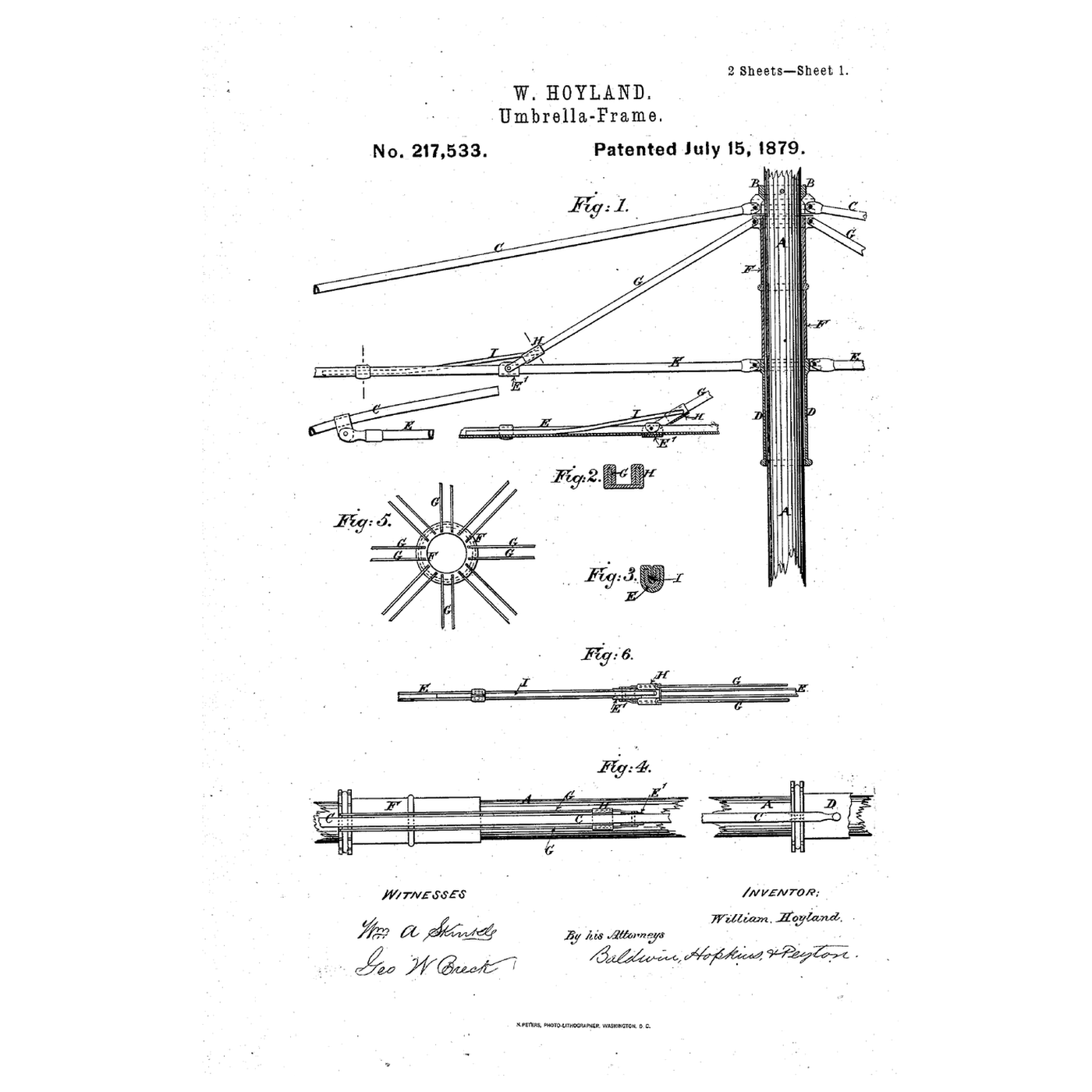


The Umbrella Frame: Springs That Hold It Open and Hold It Shut
An umbrella is a folding linkage: ribs hinged to a top notch on the stick, stretchers from a sliding runner to the middle of each rib, and a cover. Push the runner up and every rib swings out at once. Something must then hold it there.
William Hoyland of Eckland Bridge Works, near Penistone, Yorkshire, received US 217,533, dated 15 July 1879 (filed 8 April 1879; patented in England 2 August 1878), for umbrellas "of that kind which do not have catches to hold them open and closed." An intermediate runner, links to the stretchers and a spring on each stretcher make the frame tend "to keep open when open, and to keep shut when shut".
This rung models the two-way spring and the wind on a canopy. Then it measures an umbrella's runner force through its opening stroke.
Pemula
About 1 hour
Arahan
1
1
Two stable positions and the wind
Two stable positions and the wind
Memuatkan buku nota Jupyter…
2
2
A frame of hinged bars
A frame of hinged bars
An umbrella frame is a set of hinged bars that move together. The embedded blueprint shows how a linkage turns one motion into another.
3
3
Read US 217,533
Read US 217,533
"This invention has for its object improvements in umbrellas, parasols, and sun-shades of that kind which do not have catches to hold them open and closed." Hoyland employs "an additional or intermediate runner, sliding upon the stick between the ordinary runner which receives the ends of the stretchers and the top notch to which the ends of the ribs are jointed. This intermediate runner I connect by links to the stretchers."
The spring "bears upon a cross-bar, which connects the two links together at a short distance from the joint, and tends to press the cross-bar toward the stretcher". "As the umbrella, parasol, or sun-shade is opened by sliding the main runner up the stick, the links and the stretchers separate until they become perpendicular, and when the umbrella, parasol, or sun-shade is fully open they have passed this position and begun again to close together".
Closed, the springs keep "the stretchers and links parallel and closed together. This compels them, and also the ribs, to lie close in against the stick, so that no fastening is required to keep the umbrella closed." Open, "the intermediate runner is made of such a length that it serves as a stop or abutment for the main runner".
4
4
Opening an umbrella, stroke by stroke
Opening an umbrella, stroke by stroke
Ruang Kerja Blockly
Loading Blockly workspace...
5
5
Feel the runner force
Feel the runner force
Take a stick umbrella with a runner catch and one without, if you have both. Hook a spring scale to the runner and pull it up the stick slowly, reading the force every 2 cm, measured with a tape along the stick. Do the same closing.
Plot force against runner position. A frame that holds itself shows a peak and then a force that reverses sign near the end: it pulls itself open. A frame with a catch rises smoothly and needs the catch. Measure the angle between a stretcher and rib at the reversal with a protractor. Open umbrellas away from faces: rib tips are at eye height.
Alatan diperlukan:
 Payung
 Neraca Spring
 Pita Ukur
 Protraktor
6
6
An umbrella that will not stay open or shut
An umbrella that will not stay open or shut
Umbrella frame troubleshooting.
Flow
Loading...
7
7
History and honest limits
History and honest limits
**William Hoyland** of Eckland Bridge Works, near Penistone, Yorkshire, England, filed US 217,533 on 8 April 1879; it is dated 15 July 1879 and notes an English patent of 2 August 1878.
**Honest limits.** The patent gives no dimensions or spring strengths. The spring model is the simplest shape that shows two stable positions; the spring stiffness, lever, stop angle and drag coefficient are examples.
Blueprint berkaitan
Blueprint ini berkongsi pengetahuan — teknik, bahan atau prinsip



CC0 Domain Awam
Blueprint ini dikeluarkan di bawah CC0. Anda bebas menyalin, mengubah, mengedar, dan menggunakan karya ini untuk sebarang tujuan, tanpa meminta kebenaran.
Sokong Pembuat dengan membeli produk melalui Blueprint mereka di mana mereka memperoleh Komisen Pembuat ditetapkan oleh Penjual, atau cipta iterasi baru Blueprint ini dan sertakan ia sebagai sambungan dalam Blueprint anda sendiri untuk berkongsi hasil.