SENI
KECANTIKAN & KESEJAHTERAAN
KRAFTANGAN
BUDAYA & SEJARAH
HIBURAN
ALAM SEKITAR
MAKANAN & MINUMAN
KEJURUTERAAN TERBALIK
SAINS
SUKAN
TEKNOLOGI
BOLEH PAKAI

Understanding Praseodymium from Monazite — The Green Twin That Colors Glass
Pertengahan
Arahan
1
1
Understand the Didymium Separation
Understand the Didymium Separation
Carl Auer von Welsbach separated praseodymium from neodymium in 1885 after 40 years of failed attempts by other chemists. What Mosander had called 'didymium' (twin element) in 1841 was actually two elements so similar that ordinary chemical methods could not distinguish them. Von Welsbach used repeated fractional crystallization of double ammonium nitrate salts — over 100 recrystallizations — to obtain green praseodymium and pink neodymium salts.
2
2
Identify Praseodymium in Rare Earth Ores
Identify Praseodymium in Rare Earth Ores
Praseodymium comprises 4-5% of light rare earth concentrates from bastnasite and monazite — always accompanying cerium, lanthanum, and neodymium. Its name comes from Greek 'prasios' (green) and 'didymos' (twin) because Pr³⁺ salts are distinctly green, while Nd³⁺ salts are pink-violet. In solvent extraction cascades, praseodymium separates between lanthanum and neodymium. Annual production is approximately 7,000 tonnes of praseodymium oxide.
Bahan untuk langkah ini:
 Spesimen monazit
Alatan diperlukan:
 Kanta Tangan 10xKanta Tangan 10x
 Plat Coretan (Porselin Tidak Bersalut)
 Jarum Kekerasan Mohs
3
3
Examine Praseodymium Metal Properties
Examine Praseodymium Metal Properties
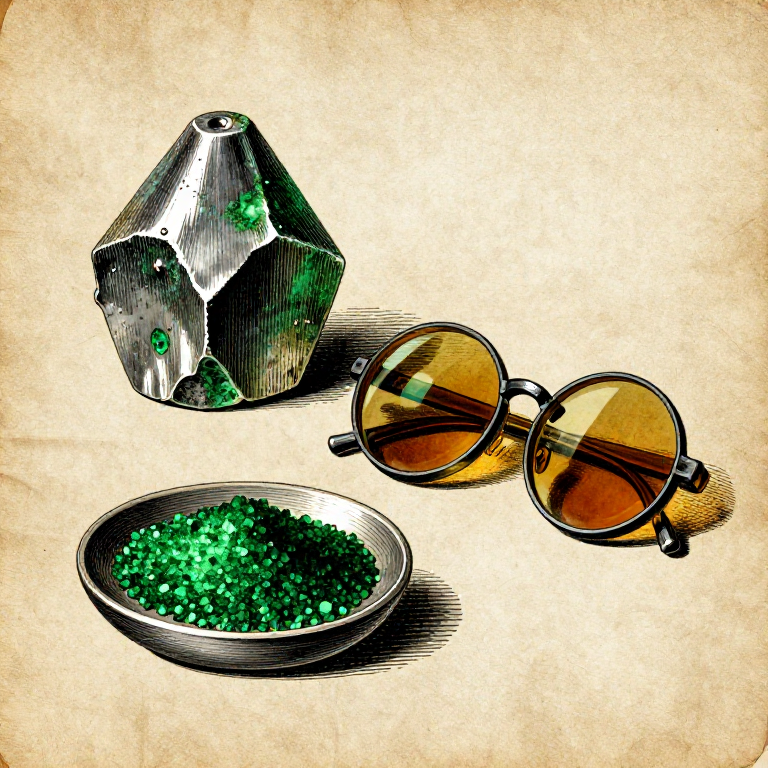
Praseodymium is a soft, silvery metal that develops a distinctive green oxide coating in air — the only lanthanide whose oxide is green rather than white. Melting point is 931°C, density 6.77 g/cm³. Praseodymium has a double-hexagonal close-packed crystal structure (DHCP), unusual among metals. It is paramagnetic and becomes antiferromagnetic below 20 K. The metal is obtained by molten salt electrolysis of PrCl₃ or reduction of PrF₃ with calcium.
4
4
Explore Didymium Glass for Welding
Explore Didymium Glass for Welding
Didymium glass containing praseodymium and neodymium oxides selectively absorbs the intense yellow sodium D-line emission at 589 nm while transmitting other wavelengths. This makes it essential for glassblowing and lampworking goggles — without it, the bright sodium flare from molten glass blinds the worker to the glass shape. Didymium filters are also used in photography to enhance autumn foliage colors by removing the yellow-green wavelengths that dull reds and oranges.
Alatan diperlukan:
 Gogal Keselamatan Tertutup
5
5
Understand Praseodymium in Permanent Magnets
Understand Praseodymium in Permanent Magnets
Praseodymium substitutes for neodymium in NdFeB permanent magnets at up to 25% without significant performance loss, creating (Nd,Pr)₂Fe₁₄B magnets. This is commercially important because praseodymium is cheaper and more abundant than neodymium, and the mixed didymium fraction avoids expensive separation. Most Chinese magnet producers use a mixed Nd-Pr oxide (typically 75:25) called 'didymium metal' as feedstock.
6
6
Discover Praseodymium Yellow Pigment
Discover Praseodymium Yellow Pigment
Praseodymium-doped zirconium silicate (Pr-ZrSiO₄) is a bright yellow ceramic pigment stable to 1,300°C — used in tiles, tableware, and architectural ceramics where organic dyes would decompose. This is one of the few yellow pigments that survives kiln firing. Praseodymium also creates green colors in glass and enamel, and a unique amber color when combined with cerium in automotive glass.
7
7
Explore Aircraft Engine Alloy Applications
Explore Aircraft Engine Alloy Applications
Praseodymium is added to magnesium alloys (with neodymium) to improve high-temperature creep resistance — essential for jet engine gearboxes and missile components. The MEL (magnesium-rare earth-lithium) alloy family uses praseodymium-rich mischmetal. Praseodymium also strengthens aluminum alloys for aerospace applications. These alloys maintain strength at temperatures where conventional magnesium alloys soften and deform.
8
8
Survey Fiber Optic Amplifier Uses
Survey Fiber Optic Amplifier Uses
Praseodymium-doped fluoride glass fibers amplify optical signals at 1,300 nm — the wavelength used in older fiber optic networks. While erbium-doped amplifiers dominate the 1,550 nm band, praseodymium amplifiers served the 1,300 nm window that remains in legacy telecommunications infrastructure. Praseodymium-doped crystals also find use in solid-state lasers operating in the visible spectrum, producing orange, red, and deep-red laser output.
9
9
Understand the Praseodymium-Neodymium Balance
Understand the Praseodymium-Neodymium Balance
Rare earth economics are governed by the 'balance problem' — mining for one element inevitably produces all others in fixed ratios. Bastnasite yields a Ce:La:Nd:Pr ratio of roughly 50:25:18:5. The explosive demand for neodymium magnets creates surpluses of cerium, lanthanum, and praseodymium. Using praseodymium alongside neodymium in magnets is not just cheaper — it helps solve the balance problem by creating demand for an otherwise surplus element.
Alatan diperlukan:
 Penimbang Jitu
10
10
Document Findings and Market Context
Document Findings and Market Context
Record praseodymium's key data: atomic number 59, density 6.77 g/cm³, melting point 931°C, silvery metal with green oxide. Praseodymium oxide is priced at $50-80 per kilogram — intermediate between cheap cerium/lanthanum and expensive neodymium/dysprosium. Its ability to substitute for neodymium in magnets makes praseodymium increasingly strategic. China dominates production, but new rare earth projects in Australia, Canada, and the US are diversifying supply.
11
11
Ore grade: how much monazite per kilogram
Ore grade: how much monazite per kilogram
Memuatkan buku nota Jupyter…
Bahan
1- 1 kepingPemegang Tempat
Alatan Diperlukan
5- Pemegang Tempat
- Pemegang Tempat
- Pemegang Tempat
- Pemegang Tempat
- Pemegang Tempat
Bahan Blueprint Bersambung

Berbahaya
10% Atribusi
Extracting Neodymium-Rich Rare Earth Oxide from Monazite — The Magnet Metal That Reshaped Technology
oleh Peter
Perlombongan
38
0
0
0
11
0
10% Atribusi
Understanding Cerium from Bastnasite — The Self-Cleaning Rare Earth
oleh Peter
Perlombongan
10
0
0
0
9
0
10% Atribusi
Understanding Lanthanum from Monazite — The Hidden Element That Bends Light
oleh Peter
Perlombongan
19
0
0
0
8
0
Berbahaya
10% Atribusi
Understanding Yttrium from Xenotime — The Rare Earth That Lights Red Screens
oleh Peter
Perlombongan
43
0
0
0
12
0
10% Atribusi
Extracting Iron from Hematite — Bloomery Smelting from Ore to Bloom
oleh Peter
Kerja Logam
159
0
0
0
12
0
Blueprint berkaitan
Blueprint ini berkongsi pengetahuan — teknik, bahan atau prinsip
Berbahaya
Extracting Cobalt from Cobaltite — The Goblin Metal That Colors Glass Blue
oleh Peter
Kerja Logam
72
0
0
0
4
0
Extracting Manganese from Pyrolusite — The Cave Painter's Black That Cleans Glass
oleh Peter
Kerja Logam
64
0
0
0
4
0
Berbahaya
Understanding Titanium Extraction from Ilmenite — The Impossible Metal to Smelt
oleh Peter
Perlombongan
61
0
0
0
3
0
CC0 Domain Awam
Blueprint ini dikeluarkan di bawah CC0. Anda bebas menyalin, mengubah, mengedar, dan menggunakan karya ini untuk sebarang tujuan, tanpa meminta kebenaran.
Sokong Pembuat dengan membeli produk melalui Blueprint mereka di mana mereka memperoleh Komisen Pembuat ditetapkan oleh Penjual, atau cipta iterasi baru Blueprint ini dan sertakan ia sebagai sambungan dalam Blueprint anda sendiri untuk berkongsi hasil.