

Beef Jerky
Jerky is lean meat dried until microbes can no longer grow in it — a light, protein-dense food that keeps for months with no fridge, made by every culture for thousands of years. Meat can be dried by warm dry air, over a low smoky fire, or in a dehydrator. The one rule that makes home jerky safe: bring the meat to 71 °C at some point to kill bacteria.
Ìlànà
Watch — preserving meat without refrigeration
Watch — preserving meat without refrigeration
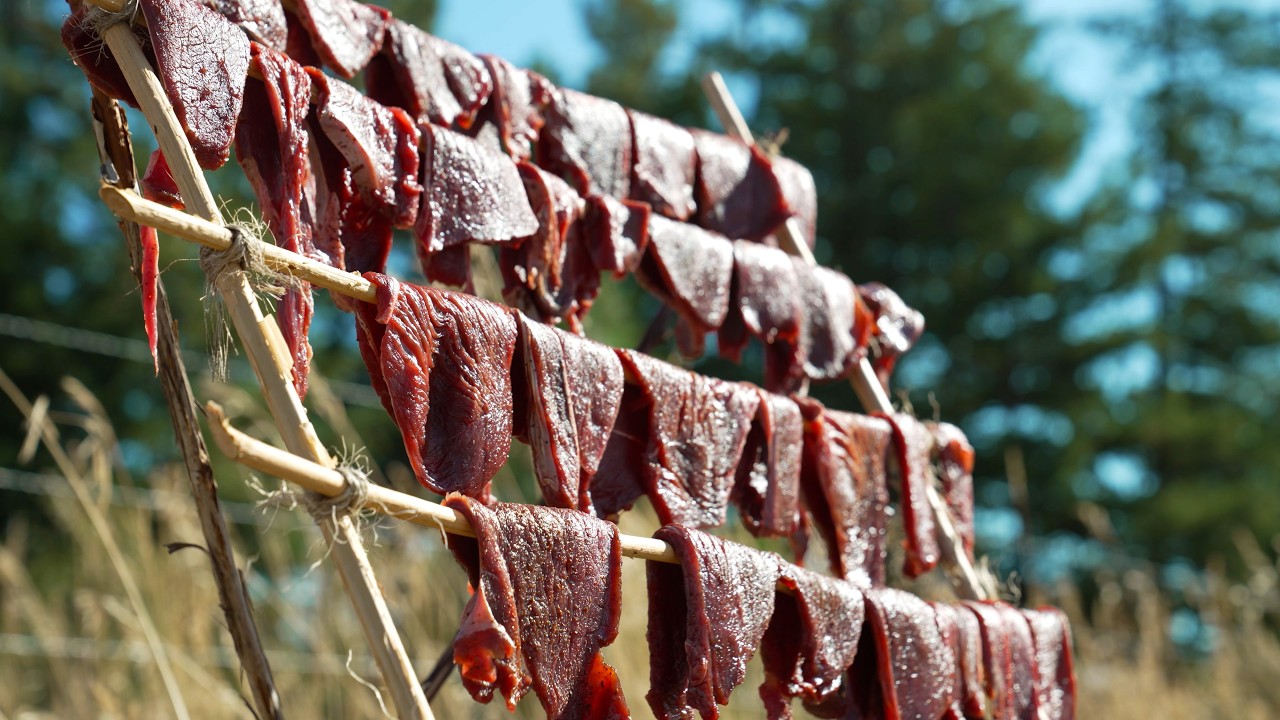
A wilderness walkthrough of drying lean meat into jerky by warm air and by smoke — how thin to slice, why to trim the fat, and how fast it dries in good conditions.
Slice thin and trim all fat
Slice thin and trim all fat
Use lean meat (beef, venison) and trim off ALL fat — fat doesn't dry and turns rancid. Slice into thin strips about 5 mm (¼ inch) or less; butterfly thicker cuts open to a big thin sheet. Thin, even strips are the single most important thing for drying that keeps.
Àwọn ohun èlò fún ìgbésẹ̀ yìí:
 Ẹran màlúù tí kò ní ọ̀rá1 kg
Heat-kill step — bring to 71 °C (home safety)
Heat-kill step — bring to 71 °C (home safety)
FOOD SAFETY for home use: bring the strips to 71 °C (160 °F) internal to kill Salmonella and E. coli — steam or roast them before drying, or oven-finish at 135 °C (275 °F) for 10 minutes after. The fast raw air-dry in the video relies on ideal fresh-kill wilderness conditions; the heat step is what makes home jerky safe.
Dry it — air, sun or smoke
Dry it — air, sun or smoke
Dry the strips until dark and leathery. In warm, dry, breezy weather (about 24 °C, 20 % humidity) hang them on a rack and they dry in under a day. In cool or damp weather, force-dry over a low smoky fire — the smoke also holds back bacteria and keeps flies off (use fruit or hardwood such as plum, never a resinous conifer, which tastes acrid). A solar dehydrator at 60–70 °C works too.
Àwọn irinṣẹ́ tí a nílò:
 Ẹ̀rọ ìgbẹ̀ ẹran gbígbẹ
Season and store
Season and store
Salt is optional — a little seasoning salt improves flavour but isn't needed for keeping if the meat is dried hard. For a longer, slower cure, salt-cure the strips first (see Salt Curing Meat). Store the jerky dry in an airtight jar or bag; kept dry it lasts months. Reconstitute in stews and soups. Discard if it ever feels moist or shows mould.
Àwọn ohun èlò fún ìgbésẹ̀ yìí:
 Iyọ̀ Òkun Rúkèrúdò10 g
 Àkójọ Ìgò Gíláàsì1 ìtò
Àwọn ohun-èlò
3- Àyè
- Àyè
- 1 ìtòÀyè
Àwọn irinṣẹ́ tó nílò
1Ìtọ́nisọ́nà yìí ń ṣe

Blueprint tó jọra
Àwọn blueprint wọ̀nyí pín ìmọ̀ — ọ̀nà, ohun-èlò tàbí ìlànà


CC0 Àgbègbè Gbogbogbò
Blueprint yìí ti jáde lábẹ́ CC0. O lè ṣe àdàkọ, yí padà, pín, àti lò láìsí ìyọ̀ǹda.
Ṣàtìlẹ́yìn Olùṣẹ́dá nípa rírà àwọn ọjà nipasẹ̀ Blueprint wọn Ẹ̀san Olùṣẹ́dá tí àwọn Olùtajà gbé kalẹ̀, tàbí ṣẹ̀dá àtúnṣe tuntun ti Blueprint yìí kí o sì fi sínú Blueprint rẹ gẹ́gẹ́ bí ìsopọ̀ láti pín owó-wíwọlé.