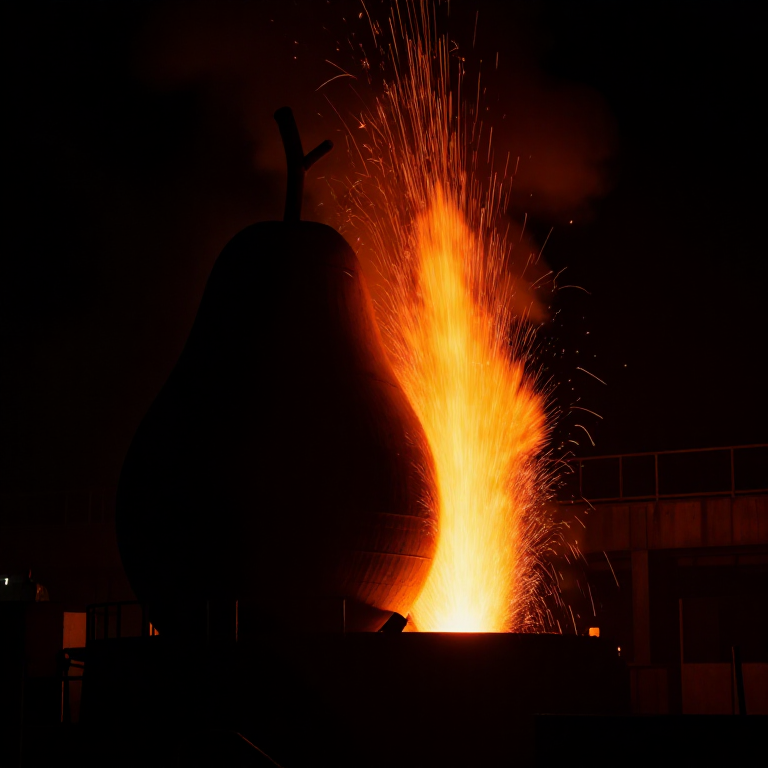


Making Steel in a Bessemer Converter — Mass Steel by Blowing Air Through Iron
Crucible steel was superb but slow, made a few kilograms at a time. In 1856 Henry Bessemer found a way to make steel by the tonne in about twenty minutes, and the price of steel collapsed from a luxury to a commodity. Rails, ships, bridges, and the first steel-framed buildings all became possible almost overnight.
His method sounds reckless: blow cold air straight up through a vessel of molten pig iron. The oxygen in the blast burns out the silicon, manganese, and carbon that make pig iron brittle — and because those reactions give off enormous heat, the metal does not cool but actually gets hotter, staying liquid with no added fuel. A volcano of flame and sparks roars from the converter's mouth while the carbon burns away.
The trick is knowing when to stop. The operator reads the flame, and the instant the carbon is gone, halts the blow and adds back a precise dose of carbon-rich spiegeleisen to hit the exact steel he wants. Tilt, pour, and there is a ladle of molten steel where minutes before there was crude pig iron.
Ìlànà
Understand the converter
Understand the converter
Build and line the converter
Build and line the converter
Àwọn ohun èlò fún ìgbésẹ̀ yìí:
 Bíríkì Tí Ń Kojú Iná120 ẹyọ
Àwọn irinṣẹ́ tí a nílò:
 Ọkọ́ Ọwọ́
Charge molten pig iron
Charge molten pig iron
Àwọn ohun èlò fún ìgbésẹ̀ yìí:
 Àwọn ìdì irin aláìwẹ̀mọ́100 kg
Start the blast
Start the blast
Àwọn irinṣẹ́ tí a nílò:
 Ẹ̀rọ afẹ́fẹ́
Burn out the impurities
Burn out the impurities
Read the flame
Read the flame
Àwọn irinṣẹ́ tí a nílò:
 Gílásì Ààbò Tí Ó Sé
Stop at the drop
Stop at the drop
Recarburise with spiegeleisen
Recarburise with spiegeleisen
Àwọn ohun èlò fún ìgbésẹ̀ yìí:
 Spiegeleisen8 kg
Handle phosphoric iron
Handle phosphoric iron
Àwọn ohun èlò fún ìgbésẹ̀ yìí:
 Ẹ̀fun tí a kò tíì pa10 kg
Pour into the ladle
Pour into the ladle
Àwọn irinṣẹ́ tí a nílò:
 Ìmọ̀ ìdà ìṣù irin
Strip and roll
Strip and roll
Àwọn irinṣẹ́ tí a nílò:
 Ẹ̀rọ ìtẹ̀ irin
Appreciate the impact
Appreciate the impact
Àwọn ohun-èlò
4- 120 ẹyọÀyè
- 100 kgÀyè
- 8 kgÀyè
- 10 kgÀyè
Àwọn irinṣẹ́ tó nílò
5- Àyè
- Àyè
Àwọn Ohun Èlò Ìtọ́nisọ́nà Tí A So Pọ̀

Ìtọ́nisọ́nà yìí ń ṣe
Blueprint tó jọra
Àwọn blueprint wọ̀nyí pín ìmọ̀ — ọ̀nà, ohun-èlò tàbí ìlànà


CC0 Àgbègbè Gbogbogbò
Blueprint yìí ti jáde lábẹ́ CC0. O lè ṣe àdàkọ, yí padà, pín, àti lò láìsí ìyọ̀ǹda.
Ṣàtìlẹ́yìn Olùṣẹ́dá nípa rírà àwọn ọjà nipasẹ̀ Blueprint wọn Ẹ̀san Olùṣẹ́dá tí àwọn Olùtajà gbé kalẹ̀, tàbí ṣẹ̀dá àtúnṣe tuntun ti Blueprint yìí kí o sì fi sínú Blueprint rẹ gẹ́gẹ́ bí ìsopọ̀ láti pín owó-wíwọlé.