IṢẸ́ ỌNÀ
ẸWÀ ÀTI ÌLERA
IṢẸ́ ỌWỌ́
ÀṢÀ ÀTI ÌTÀN
ÌṢERÉ
ÀYÍKÁ
OÚNJẸ ÀTI OHUN MÍMU
REVERSE ENGINEERING
SÁYẸ́ǸSÌ
ERÉ ÌDÁRAYÁ
ÌMỌ̀-Ẹ̀RỌ
ÀWỌN OHUN WÍWỌ̀
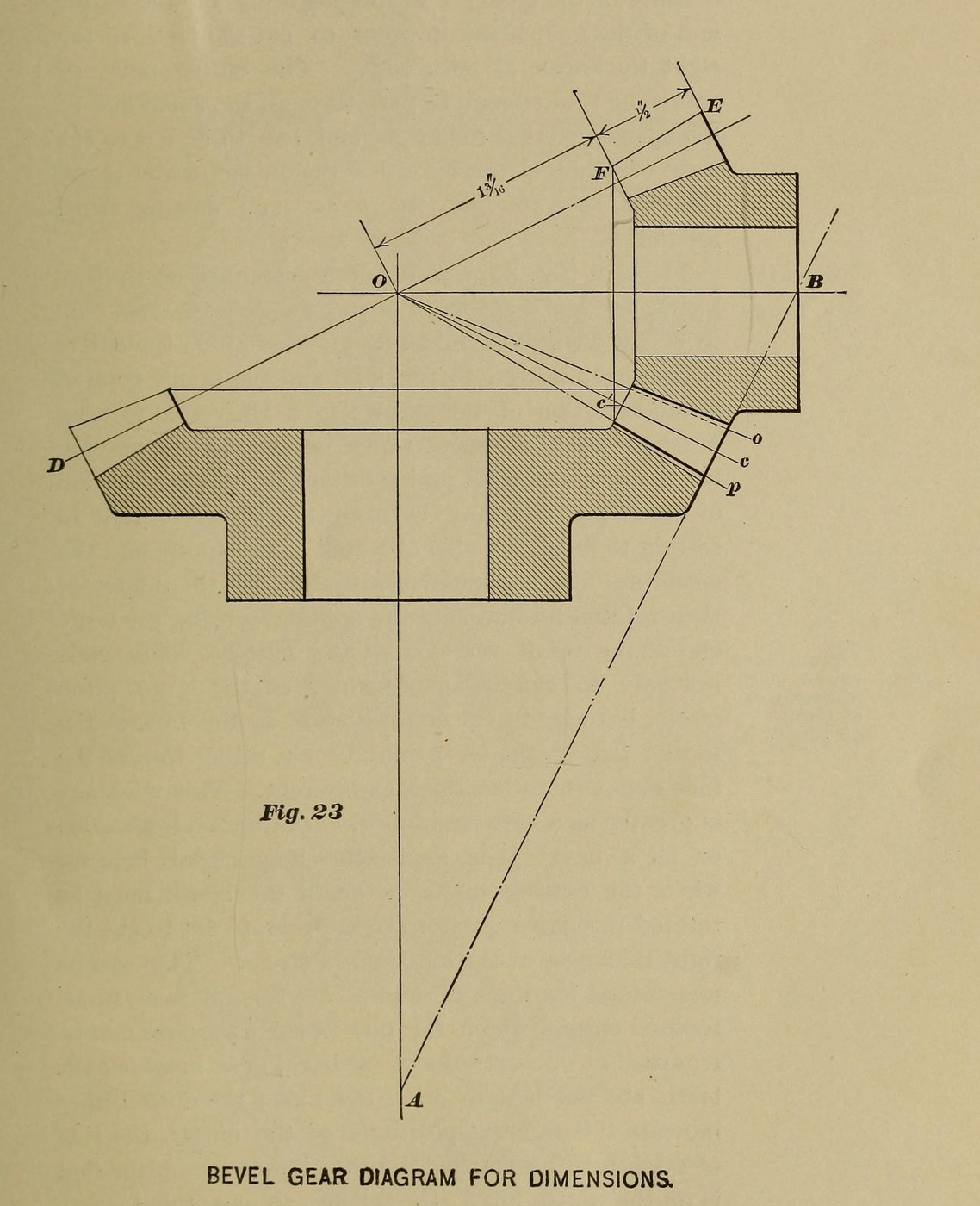


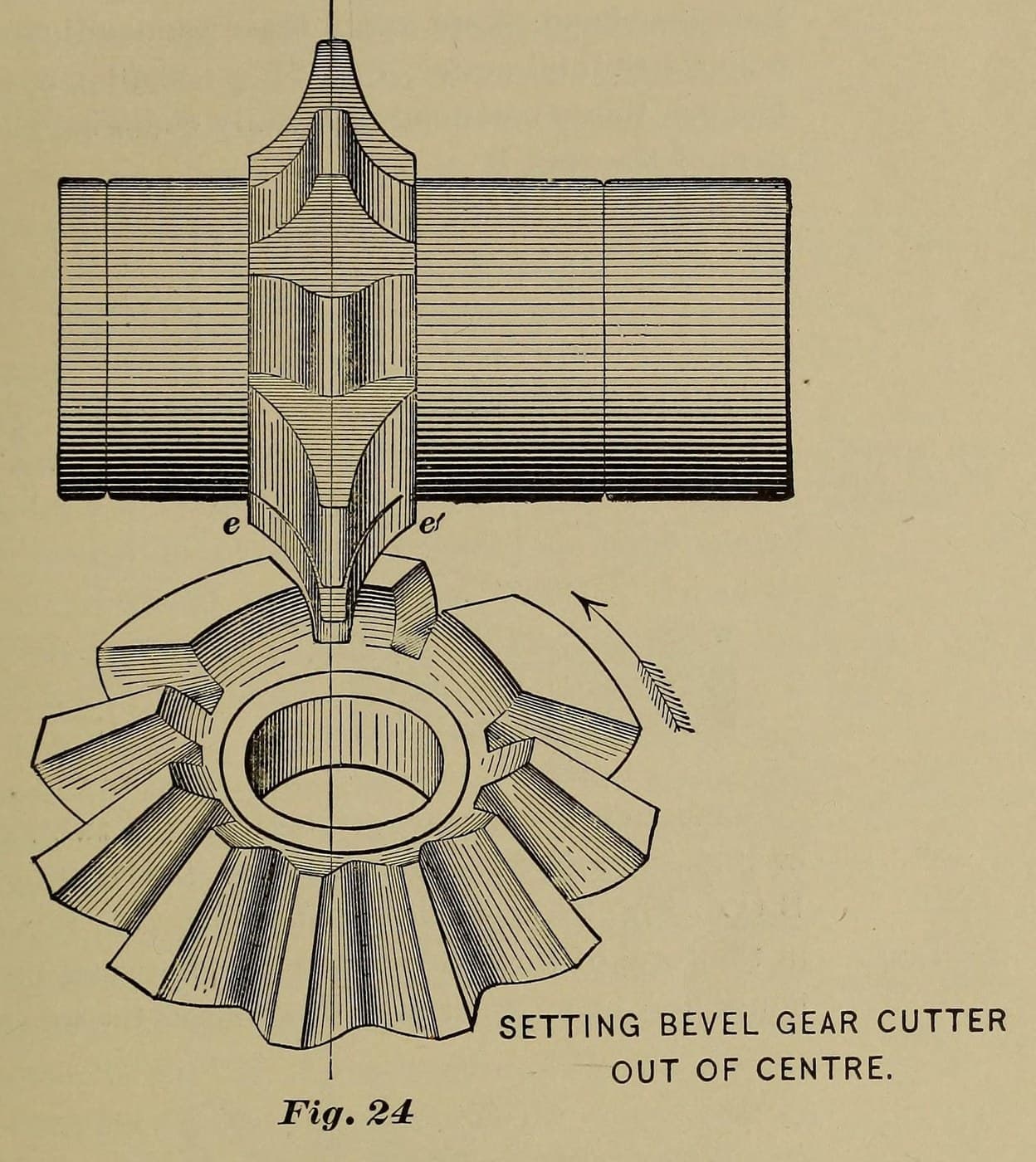
Bevel Pinion: 12 Teeth, 8 Pitch, for a 24-Tooth Gear (Brown & Sharpe 1911)
Brown & Sharpe's own worked example: the small gear of a 12 and 24 tooth bevel pair, 8 pitch, shafts at right angles, cut with the No. 8 cutter they send to anyone who orders one for this pinion. The method is the same as for mitre gears: set off centre, cut each side, file the small ends.
Source: Brown & Sharpe, Practical Treatise on Gearing (1911), Fig. 23 example, Part I ch. IX–X, Part II ch. III and the set-over table p. 58. The blank sizes are our arithmetic with their rules; the steel and bore are ours. Picture: their Fig. 23.
Ilọsíwájú
1 day
Ìlànà
1
1
Work out and turn the blank
Work out and turn the blank
Pitch diameter 12 ÷ 8 = 1.500 in. Angle of edge 26° 34′ and angle of face 59° 11′ (Brown & Sharpe's figures for every 12 and 24 tooth pair). Diameter increment = cos 26° 34′ × 0.250 = 0.224 in, so turn the steel blank to 1.72 in outside diameter. Face ½ in long. Try both angles with a protractor against the end of the hub.
Àwọn ohun èlò fún ìgbésẹ̀ yìí:
 Ọ̀pá irin rírọ̀1 length for one blank
Àwọn irinṣẹ́ tí a nílò:
 Ẹ̀rọ Ìyí Irin
 Ohun ìgé ẹ̀rọ ìyí
 Ẹ̀rọ Ìwọ̀n Igun
 Máíkírómítà
2
2
Choose the cutter
Choose the cutter
Twice the back cone radius × 8 comes to about 13, so a No. 8, 8-pitch bevel gear cutter. Measure its thickness Tc at the pitch line, 0.145 in from its tip.
Àwọn irinṣẹ́ tí a nílò:
 Ẹ̀rọ ìgé gíà onígun
 Kálípà fẹ́níà fún eyín gíà
3
3
Set the head at 22° 18′
Set the head at 22° 18′
Apex distance = sec 26° 34′ × 1.5 = 1.677 in. Angle increment: tan = sin 26° 34′ ÷ 6, giving 4° 16′. Set the dividing head to the cutting angle 26° 34′ − 4° 16′ = 22° 18′ and index 12 spaces. Depth at the large end 0.270 in.
Àwọn irinṣẹ́ tí a nílò:
 Ẹ̀rọ Ìgégé Irin
 Orí ÌpínyàẸ̀rọ ìgé gíà onígun
4
4
Set over and cut one side
Set over and cut one side
Apex distance ÷ face = 3.35; we take the nearest column, 3¼, where a No. 8 cutter has the factor .286. Set-over = Tc ÷ 2 − .286 ÷ 8 = Tc ÷ 2 − 0.036 in. Set off centre by that amount, take up backlash, and cut round all 12 spaces.
Àwọn irinṣẹ́ tí a nílò:
Ẹ̀rọ Ìgégé IrinOrí ÌpínyàẸ̀rọ ìgé gíà onígun5
5
Set over the other way and trim
Set over the other way and trim
Set over the same amount the other side, line the cutter up with the space at the small end, take a trial cut, and rotate toward the cutter until the tooth is 0.196 in thick at the large end and 0.138 in at the small end. Check with the gear tooth vernier, then cut round.
Àwọn irinṣẹ́ tí a nílò:
Ẹ̀rọ Ìgégé IrinOrí ÌpínyàẸ̀rọ ìgé gíà onígunKálípà fẹ́níà fún eyín gíà6
6
File the small ends
File the small ends
File the teeth rounder at the small ends, where the cutter could not, without filing them thinner at the pitch line. The cutting angle is under 30°, so the spaces may come out narrower at the face than the cutter suggests; Brown & Sharpe's own shop used a No. 6 cutter here instead.
Àwọn irinṣẹ́ tí a nílò:
 Ìfá eléyín kékeré
Àwọn ohun-èlò
1- 1 length for one blankÀyè
Àwọn irinṣẹ́ tó nílò
9- Àyè
- Àyè
Ìtọ́nisọ́nà yìí ń ṣe

Blueprint tó jọra
Àwọn blueprint wọ̀nyí pín ìmọ̀ — ọ̀nà, ohun-èlò tàbí ìlànà
CC0 Àgbègbè Gbogbogbò
Blueprint yìí ti jáde lábẹ́ CC0. O lè ṣe àdàkọ, yí padà, pín, àti lò láìsí ìyọ̀ǹda.
Ṣàtìlẹ́yìn Olùṣẹ́dá nípa rírà àwọn ọjà nipasẹ̀ Blueprint wọn Ẹ̀san Olùṣẹ́dá tí àwọn Olùtajà gbé kalẹ̀, tàbí ṣẹ̀dá àtúnṣe tuntun ti Blueprint yìí kí o sì fi sínú Blueprint rẹ gẹ́gẹ́ bí ìsopọ̀ láti pín owó-wíwọlé.