IṢẸ́ ỌNÀ
ẸWÀ ÀTI ÌLERA
IṢẸ́ ỌWỌ́
ÀṢÀ ÀTI ÌTÀN
ÌṢERÉ
ÀYÍKÁ
OÚNJẸ ÀTI OHUN MÍMU
REVERSE ENGINEERING
SÁYẸ́ǸSÌ
ERÉ ÌDÁRAYÁ
ÌMỌ̀-Ẹ̀RỌ
ÀWỌN OHUN WÍWỌ̀
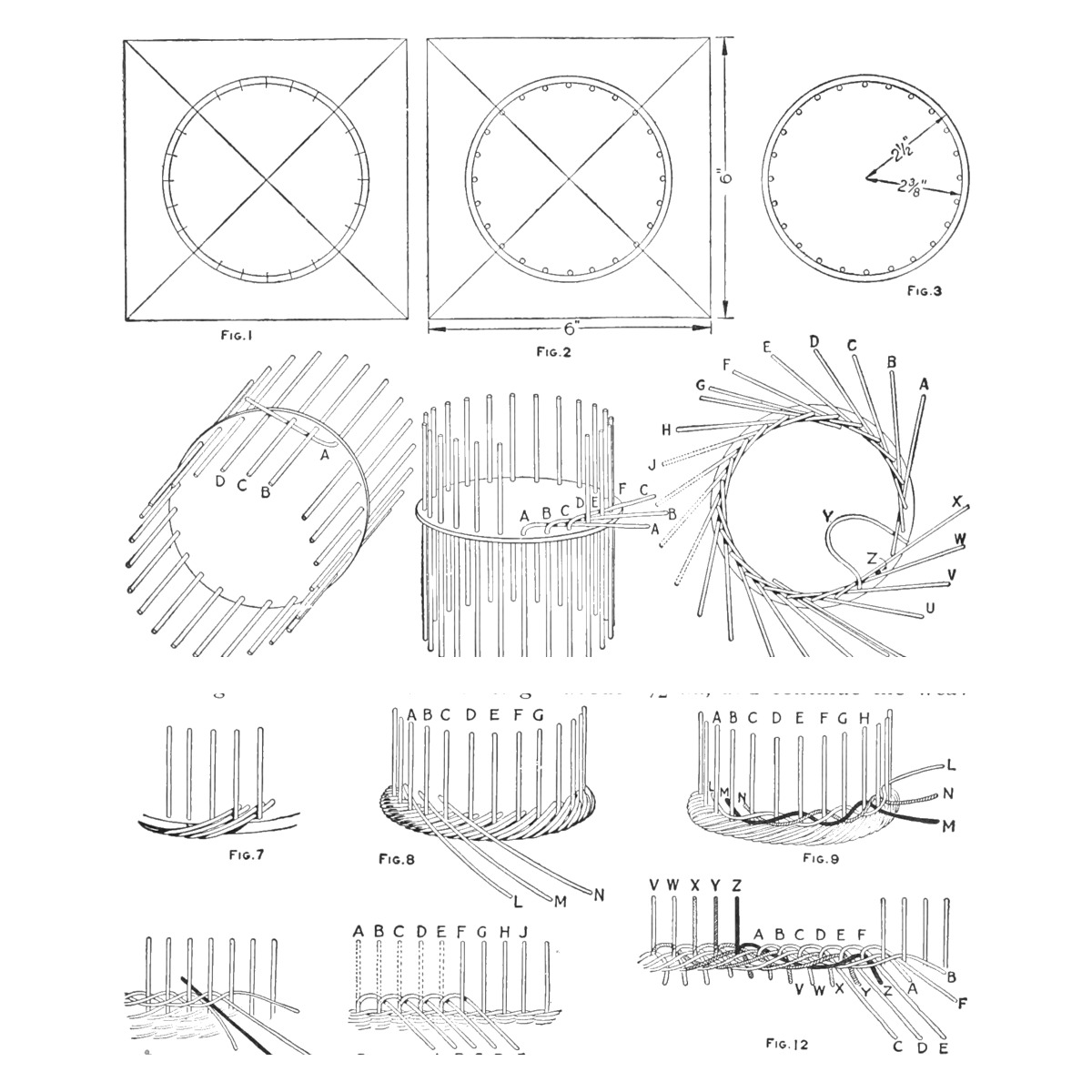


Reed Basket on a Wood Bottom: 24 Spokes, Rolled Edge, Triple Weave and Break-Down Border (Boy Mechanic, 1915)
The first lesson of Chas. M. Miller's reed-furniture series in The Boy Mechanic, Book 2 (1915): a basket 5 in across and 3 in high, woven on a bored basswood bottom. The spoke ends are turned into a roll that hides the wooden edge, the side is triple-woven, and the top is finished with a break-down border.
Olùbẹ̀rẹ̀
About 3 hours
Ìlànà
1
1
His sizes, and the spoke spacing
His sizes, and the spoke spacing
Ń ṣí ìwé Jupyter…
2
2
Read The Boy Mechanic, Book 2
Read The Boy Mechanic, Book 2
"The center is the most difficult part of the basket making, and it is best to begin with wood bottoms." The reeds placed vertically are called spokes, the horizontal ones weavers.
3
3
Make the bottom
Make the bottom
On a board about 6 in square, 1/4 in thick (basswood is best, pine or cedar will do), draw the diagonals and two circles from their crossing, 5 in and 4-3/4 in across. Step off 24 points on the inner circle with the compass set about 5/8 in apart, adjusting until they come out even. Bore 1/8 in holes just inside the inner circle at the points, then saw out the 5 in circle (bore first, or the disk may split).
Àwọn ohun èlò fún ìgbésẹ̀ yìí:
 Pákó igi pine1 ẹyọ
Àwọn irinṣẹ́ tí a nílò:
 Kọ́mpasi
 Gègé
 Ìlù ọwọ́
 Ayùn Kópìngì
4
4
Set the spokes and roll the edge
Set the spokes and roll the edge
Push dry No. 4 reed spokes through the holes, about 5-1/2 in projecting below. Soak bottom and spokes about 15 minutes. Bend each spoke below the bottom down behind the two nearest spokes and out between the third and fourth; force the last two under the first two, making a pinwheel. Then bend them up across the edge of the wood, in front of three spokes and behind the fourth, inserting a short spoke about 4 in long in front of each first so the doubles cover the edge; press them flat and trim any that are too long.
Àwọn ohun èlò fún ìgbésẹ̀ yìí:
 Rattan1 ẹyọ
Àwọn irinṣẹ́ tí a nílò:
 Bàkẹ́ẹ̀tì Lítà 20
 Ọ̀bẹ awọ
 Àwọn ìgbẹ́ igi
5
5
Triple-weave the side
Triple-weave the side
Put in three soaked No. 3 reed weavers between spokes A-B, B-C and C-D. Each time take the weaver farthest behind in front of the two nearest spokes, behind the third and out in front of the next two. Use weavers no longer than 8 ft; when one runs out, press it back a little and push a new reed in about 1-1/2 in. Press every throw down, and weave to 3 in high.
Àwọn ohun èlò fún ìgbésẹ̀ yìí:
Rattan1 ẹyọÀwọn irinṣẹ́ tí a nílò:
Bàkẹ́ẹ̀tì Lítà 20Ọ̀bẹ awọ6
6
Make the border
Make the border
Break-down-tight border: bend spoke A behind B and out between B and C, B behind C, and so on to E; then lay the end of A over B to E, in front of F, behind G and out between G and H, and bring F down behind A's end; continue round, leaving the first ends loose so the last spokes can be worked under them. Or use the simple break-down: each spoke behind the next, in front of the one after, and behind the next, not out again.
Àwọn irinṣẹ́ tí a nílò:
Ọ̀bẹ awọ7
7
Finish
Finish
When dry, cut the long ends off close with a knife, without cutting a weaver. Singe off hairy fibres over a flame that will not smut. Do not leave reeds in water longer than needed, as they turn dark; dampen them often while weaving so they pack down closer. He also mentions bleaching with chloride of lime in water set in sunlight, but warns too much gives a whitish look; it is not part of this blueprint.
Àwọn irinṣẹ́ tí a nílò:
Ọ̀bẹ awọ Ọ̀pá Iná Pùróféènì
8
8
Troubleshooting
Troubleshooting
Reed basket troubleshooting.
Flow
Loading...
9
9
History and honest limits
History and honest limits
From "Reed Furniture: A Reed Basket" by Chas. M. Miller, in **The Boy Mechanic, Book 2**, Popular Mechanics, 1915 (Project Gutenberg 44585; checked on the archive.org scan boymechanicbook200chic2, pp. 257-260). Reed sizes are his trade numbers (No. 3, No. 4). Bleaching is described in his text but left out here. The tools and metric figures are ours.
Ìtọ́nisọ́nà yìí ń ṣe

Blueprint tó jọra
Àwọn blueprint wọ̀nyí pín ìmọ̀ — ọ̀nà, ohun-èlò tàbí ìlànà
CC0 Àgbègbè Gbogbogbò
Blueprint yìí ti jáde lábẹ́ CC0. O lè ṣe àdàkọ, yí padà, pín, àti lò láìsí ìyọ̀ǹda.
Ṣàtìlẹ́yìn Olùṣẹ́dá nípa rírà àwọn ọjà nipasẹ̀ Blueprint wọn Ẹ̀san Olùṣẹ́dá tí àwọn Olùtajà gbé kalẹ̀, tàbí ṣẹ̀dá àtúnṣe tuntun ti Blueprint yìí kí o sì fi sínú Blueprint rẹ gẹ́gẹ́ bí ìsopọ̀ láti pín owó-wíwọlé.