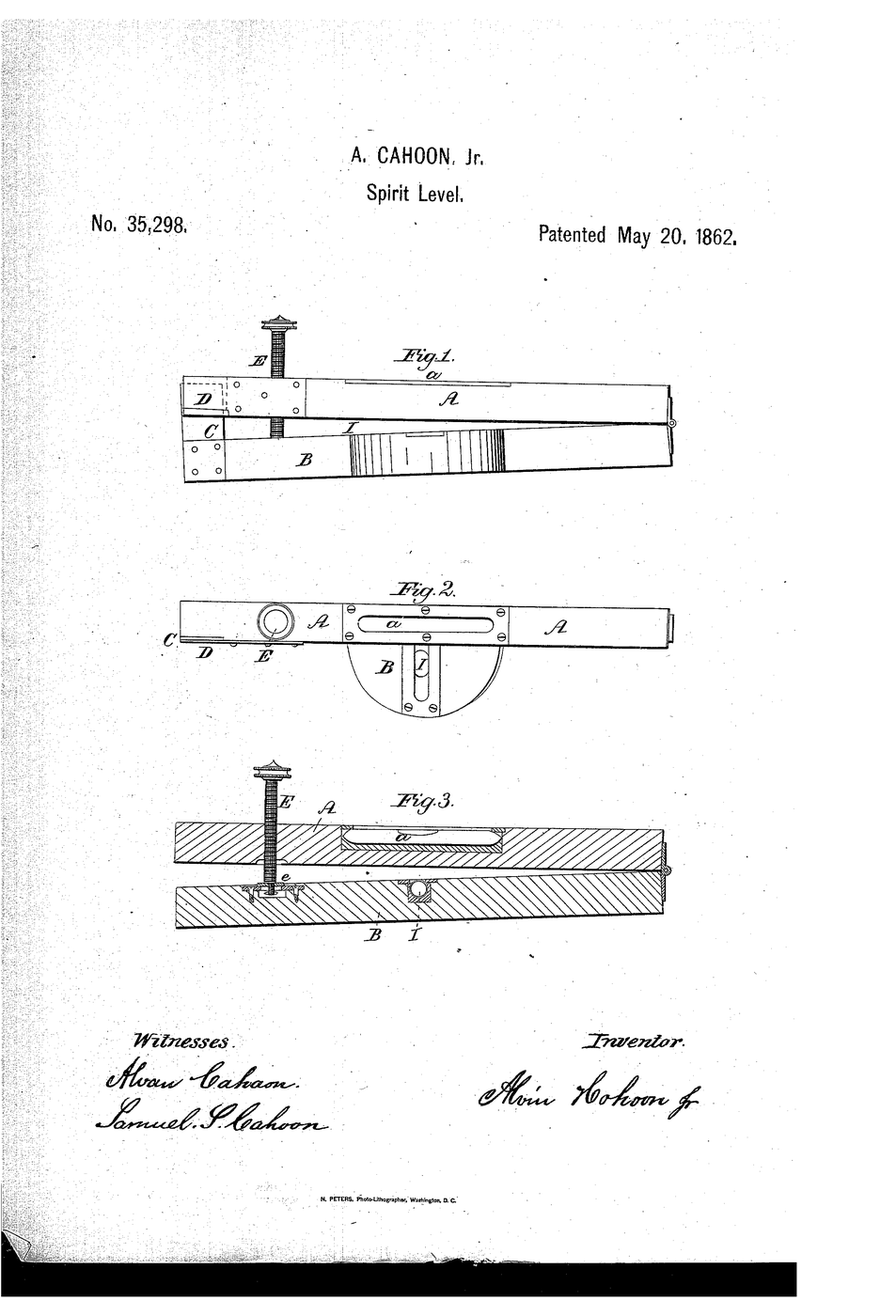


Spirit Level
Every other tool in this batch measures a distance against a man-made standard. The spirit level is the odd one out: it measures against gravity, which needs no calibration and never drifts.
US 35,298, Alvin Cahoon Jr. of Harwich, Massachusetts, granted 20 May 1862. The drawing sheet is headed simply “Spirit Level”; the patent indexes catalogue it as “Improvement in Combined Spirit-Levels”. Both are given here. The word combined is the claim: not one vial but a set, arranged so a single tool reads level AND plumb without being taken apart and re-set.
The physics is a bubble of air trapped in a barely-curved glass tube of spirit. The bubble rises to the highest point of the curve. Alcohol rather than water because it stays liquid below freezing and wets the glass evenly instead of sticking in droplets.
Ìlànà
Read the claim before you build
Read the claim before you build
Cahoon claims a combination of vials in one stock, not a vial. Write down the two readings a combined level must give without being reset: level, and plumb.
Find a true reference edge
Find a true reference edge
Lay the steel ruler on the board and look along it against the light. Any gap is error. You cannot build a level on a bent stock.
Àwọn ohun èlò fún ìgbésẹ̀ yìí:
 Pátákó Igi Pẹrẹsẹ1 ẹyọ
Àwọn irinṣẹ́ tí a nílò:
 Ìdíwọ̀n
Check the board with a real level
Check the board with a real level
Rest the workshop level on the board. Note which way the bubble sits. This is your baseline.
Àwọn irinṣẹ́ tí a nílò:
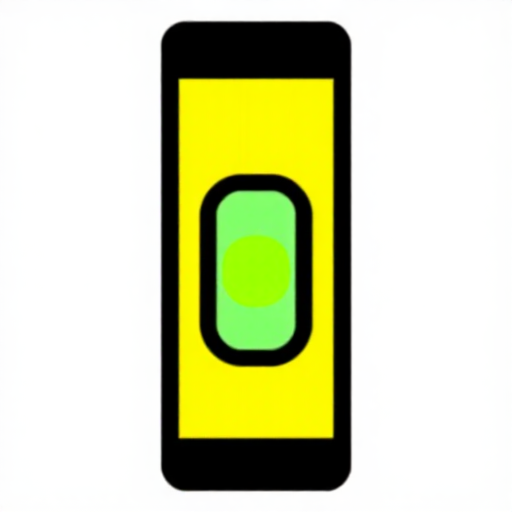 Ìwọ̀n Ìtẹ́jú
Mark the vial seat
Mark the vial seat
Mark a 100 mm seat along the centre of the board's top edge, square to the face.
Àwọn irinṣẹ́ tí a nílò:
Ìdíwọ̀n Ààmì Tí Kò Ní Parẹ́
Understand why the tube must curve
Understand why the tube must curve
A perfectly straight tube gives a bubble that slams end to end with no middle position. The slight curve is what makes the reading proportional. Sketch both cases.
Àwọn ohun èlò fún ìgbésẹ̀ yìí:
 Bébà Àwòrán1 ewé
Bend a wire gauge to the curve
Bend a wire gauge to the curve
Bend a 120 mm steel wire into a very shallow arc, rise about 1 mm over its length. This is the curvature a vial needs.
Àwọn ohun èlò fún ìgbésẹ̀ yìí:
 Okùn Irin Tí A Fi Sinkì Bò0.2 mítà
Àwọn irinṣẹ́ tí a nílò:
Ìdíwọ̀nSet the level on a known-flat surface
Set the level on a known-flat surface
Place the surface plate down and rest the workshop level on it. Record the bubble position. A surface plate is the flattest thing in the workshop.
Àwọn irinṣẹ́ tí a nílò:
 Àwo ojú ìtọ́kasíÌwọ̀n Ìtẹ́jú
Reverse the level end for end
Reverse the level end for end
Turn the level 180° in place and read again. If the bubble reads differently, the level is out of true, not the surface. This reversal test is the whole art.
Àwọn irinṣẹ́ tí a nílò:
Ìwọ̀n Ìtẹ́júÀwo ojú ìtọ́kasíShim a measured tilt
Shim a measured tilt
Slide one 0.10 mm feeler leaf under one end of the plate. Read the bubble shift.
Àwọn irinṣẹ́ tí a nílò:
 Ìdìpọ̀ òǹwọ̀n àyèÀwo ojú ìtọ́kasí
Build a sensitivity table
Build a sensitivity table
Add leaves in 0.10 mm steps to 0.50 mm, recording bubble travel each time. Plot it on graph paper. The slope IS the instrument's sensitivity.
Àwọn ohun èlò fún ìgbésẹ̀ yìí:
Bébà Àwòrán1 ewéÀwọn irinṣẹ́ tí a nílò:
Ìdìpọ̀ òǹwọ̀n àyèConvert the reading to an angle
Convert the reading to an angle
Angle = rise over run. 0.10 mm over a 300 mm plate is 0.0003 radians, about 166 minutes of a degree — sorry, 1.1 minutes of arc. Compute yours and check it with the protractor sketch.
Àwọn ohun èlò fún ìgbésẹ̀ yìí:
Bébà Àwòrán1 ewéÀwọn irinṣẹ́ tí a nílò:
 Ẹ̀rọ Ìwọ̀n Igun
Test the plumb reading
Test the plumb reading
Stand the level against a door frame. A combined level must read plumb from the same stock — that is Cahoon's claim in use.
Àwọn irinṣẹ́ tí a nílò:
Ìwọ̀n Ìtẹ́júWarm one end and watch it lie
Warm one end and watch it lie
Cup a hand over one end of the vial for a minute. The spirit expands and the bubble shrinks and moves. Temperature is a real error source, not a footnote.
Àwọn irinṣẹ́ tí a nílò:
Ìwọ̀n Ìtẹ́júHistory & Context
History & Context
US 35,298, “Improvement in Combined Spirit-Levels”, Alvin Cahoon Jr., Harwich, Massachusetts, granted 20 May 1862.
The spirit level itself is far older — it is generally credited to Melchisédech Thévenot in the 1660s, and this blueprint does not claim Cahoon invented it. What the 1862 patent addresses is the practical nuisance of nineteenth-century site work: carrying several single-purpose levels, or stopping to re-seat a vial to check plumb after checking level.
Why alcohol. ‘Spirit’ is literal. Ethanol has a much lower freezing point than water, so the tool survives an unheated workshop, and its low surface tension lets the bubble slide cleanly instead of sticking — a water bubble jerks and lies.
The reversal test in step 8 is the important idea, and it generalises far beyond levels. It is a way to separate the error of the instrument from the error of the work using nothing but the instrument itself. The same trick calibrates straightedges, squares and, in Whitworth's three-plate method, the surface plate this blueprint stands on. When you cannot appeal to a higher standard, you appeal to symmetry.
Note that the level needs no reference object at all. Every other instrument in this batch is ultimately traceable to a physical artefact kept in a vault somewhere. The level is traceable to the planet.
Àwọn ohun-èlò
3- 1 ẹyọÀyè
- 1 ewéÀyè
- 0.2 mítàÀyè
Àwọn Ohun Èlò Ìtọ́nisọ́nà Tí A So Pọ̀
CC0 Àgbègbè Gbogbogbò
Blueprint yìí ti jáde lábẹ́ CC0. O lè ṣe àdàkọ, yí padà, pín, àti lò láìsí ìyọ̀ǹda.
Ṣàtìlẹ́yìn Olùṣẹ́dá nípa rírà àwọn ọjà nipasẹ̀ Blueprint wọn Ẹ̀san Olùṣẹ́dá tí àwọn Olùtajà gbé kalẹ̀, tàbí ṣẹ̀dá àtúnṣe tuntun ti Blueprint yìí kí o sì fi sínú Blueprint rẹ gẹ́gẹ́ bí ìsopọ̀ láti pín owó-wíwọlé.