IṢẸ́ ỌNÀ
ẸWÀ ÀTI ÌLERA
IṢẸ́ ỌWỌ́
ÀṢÀ ÀTI ÌTÀN
ÌṢERÉ
ÀYÍKÁ
OÚNJẸ ÀTI OHUN MÍMU
REVERSE ENGINEERING
SÁYẸ́ǸSÌ
ERÉ ÌDÁRAYÁ
ÌMỌ̀-Ẹ̀RỌ
ÀWỌN OHUN WÍWỌ̀
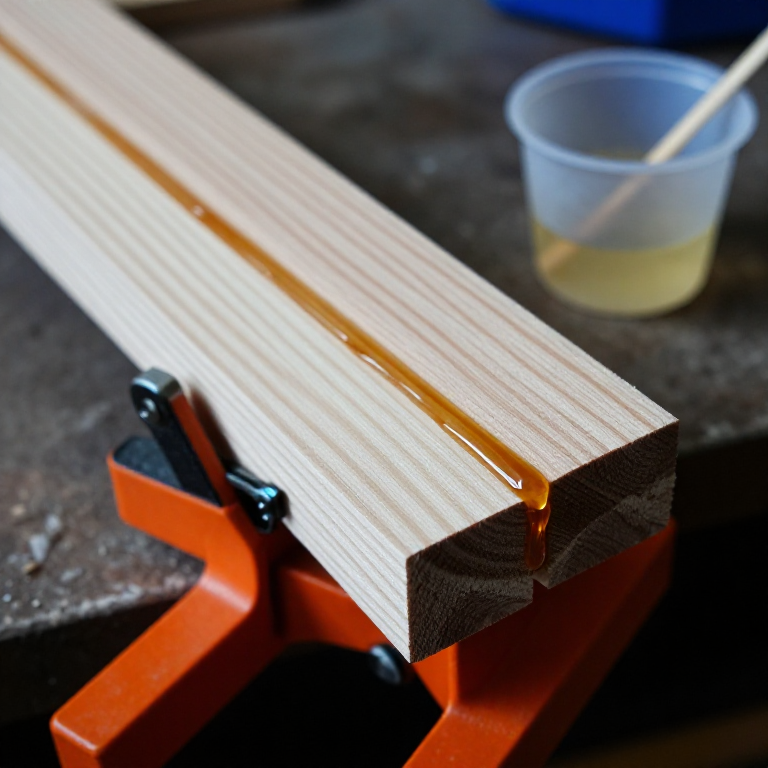


Epoxy Resin
Pierre Castan, a Swiss chemist at the dental firm De Trey Frères, was looking for a resin for dentures. He reacted a phenol carrying two hydroxy groups with epichlorohydrin, then hardened the product with an acid anhydride, and got a hard, clear, unusually adherent solid. Ciba licensed it and sold it as Araldite; in the US Sylvan Greenlee developed epoxies independently.
**US 2,324,483**, "Process of preparing synthetic resins", Castan, granted 20. July 1943, claims condensing "a polybasic carboxylic acid anhydride" with the product of "a phenol having at least two phenolic hydroxy groups and of an epichlorhydrine". It does not single out bisphenol A, the phenol most epoxies use today.
**Epichlorohydrin is a carcinogen; you start from a two-part kit.** You glue pine lap joints at the right ratio and four wrong ones, then test hardness and break the joints.
Olùbẹ̀rẹ̀
2 hours plus 24 h cure
Ìlànà
1
1
Cut the joint pieces
Cut the joint pieces
Saw ten pine strips 100 x 25 mm. Sand one face of each end with 120 grit and dust off. Label five pairs 1:1, 1.25:1, 1:1.25, 1.5:1 and 1:1.5.
Àwọn ohun èlò fún ìgbésẹ̀ yìí:
 Pákó igi pine1 ẹyọ
 Bébà Ìfá1 ewé
 Tépù ìbòmọ́lẹ̀1 ìyípo
Àwọn irinṣẹ́ tí a nílò:
 Ayùn Ọwọ́
 Ìdíwọ̀n
2
2
Measure by syringe
Measure by syringe
Gloves on. For each ratio draw resin and hardener in separate syringes (1:1 = 2 ml + 2 ml; 1.25:1 = 2.5 + 2; and so on) into its own cup. This assumes a 1:1-by-volume kit - scale to your label.
Àwọn ohun èlò fún ìgbésẹ̀ yìí:
 Ẹpọ́ksì Ẹ̀yà Méjì25 ml
Àwọn irinṣẹ́ tí a nílò:
 Ìbọ̀wọ́ Nítírílì
 Ìdìpọ̀ abẹ́rẹ́ àfàyọ̀
 Àwọn kọ́ọ̀bù ìdàpọ̀ onípín
 Gílásì Ààbò Tí Ó Mọ́
3
3
Mix thoroughly
Mix thoroughly
Stir each cup 2 minutes, scraping the walls and bottom. Unmixed streaks behave like a wrong ratio.
Àwọn irinṣẹ́ tí a nílò:
 Ọ̀pá Ìrúwé
4
4
Glue and pour
Glue and pour
Spread each mix on the sanded ends of its pair, overlap them 25 mm and spring-clamp over wax paper. Pour the rest as a coin-sized puddle on wax paper beside it.
Àwọn ohun èlò fún ìgbésẹ̀ yìí:
 Bébà oníìdà1 ewé
Àwọn irinṣẹ́ tí a nílò:
 Ìdìmú oníkọ́rọ̀
5
5
Cure 24 hours
Cure 24 hours
Leave everything at room temperature, 20 °C or warmer, for 24 hours. Cold slows the cure.
6
6
Pencil hardness
Pencil hardness
Sharpen pencils 6B to 6H and flatten the tips on 400 grit. Push each at 45° across a puddle, from hard down, until one no longer scratches. Record that grade.
Àwọn irinṣẹ́ tí a nílò:
 Àkójọ Pénsùlù Gíráfáìtì
 Lúpù Ìgbéga
7
7
Break the joints
Break the joints
Clamp one strip of a joint in the vise and tap the free end sideways with the mallet until it breaks. Estimate how much of the bond face is torn wood.
Àwọn irinṣẹ́ tí a nílò:
 Ìdìmú Tábìlì
 Òòlù rọ́bàGílásì Ààbò Tí Ó Mọ́
8
8
Ratio, leftovers, results
Ratio, leftovers, results
Ń ṣí ìwé Jupyter…
9
9
History & Context
History & Context
**What the patent specifies:** a resin from a two-hydroxy phenol and epichlorohydrin, hardened by a polybasic acid anhydride. **Modern build (derived):** a two-part kit, most with an amine hardener that cures at room temperature.
Epoxy became the glue that holds metal, the matrix of fibreglass and carbon-fibre parts, and the boat-builder's resin. Its limits: it yellows in sunlight, softens with heat, and uncured resin and hardener sensitise skin - which is why the gloves stay on every time.
Àwọn ohun-èlò
5- 1 ẹyọÀyè
- 1 ewéÀyè
- 1 ìyípoÀyè
- 25 mlÀyè
- 1 ewéÀyè
Àwọn irinṣẹ́ tó nílò
12- Àyè
- Àyè
- Àyè
- Àyè
- Àyè
- Àyè
Blueprint tó jọra
Àwọn blueprint wọ̀nyí pín ìmọ̀ — ọ̀nà, ohun-èlò tàbí ìlànà



CC0 Àgbègbè Gbogbogbò
Blueprint yìí ti jáde lábẹ́ CC0. O lè ṣe àdàkọ, yí padà, pín, àti lò láìsí ìyọ̀ǹda.
Ṣàtìlẹ́yìn Olùṣẹ́dá nípa rírà àwọn ọjà nipasẹ̀ Blueprint wọn Ẹ̀san Olùṣẹ́dá tí àwọn Olùtajà gbé kalẹ̀, tàbí ṣẹ̀dá àtúnṣe tuntun ti Blueprint yìí kí o sì fi sínú Blueprint rẹ gẹ́gẹ́ bí ìsopọ̀ láti pín owó-wíwọlé.