IṢẸ́ ỌNÀ
ẸWÀ ÀTI ÌLERA
IṢẸ́ ỌWỌ́
ÀṢÀ ÀTI ÌTÀN
ÌṢERÉ
ÀYÍKÁ
OÚNJẸ ÀTI OHUN MÍMU
REVERSE ENGINEERING
SÁYẸ́ǸSÌ
ERÉ ÌDÁRAYÁ
ÌMỌ̀-Ẹ̀RỌ
ÀWỌN OHUN WÍWỌ̀
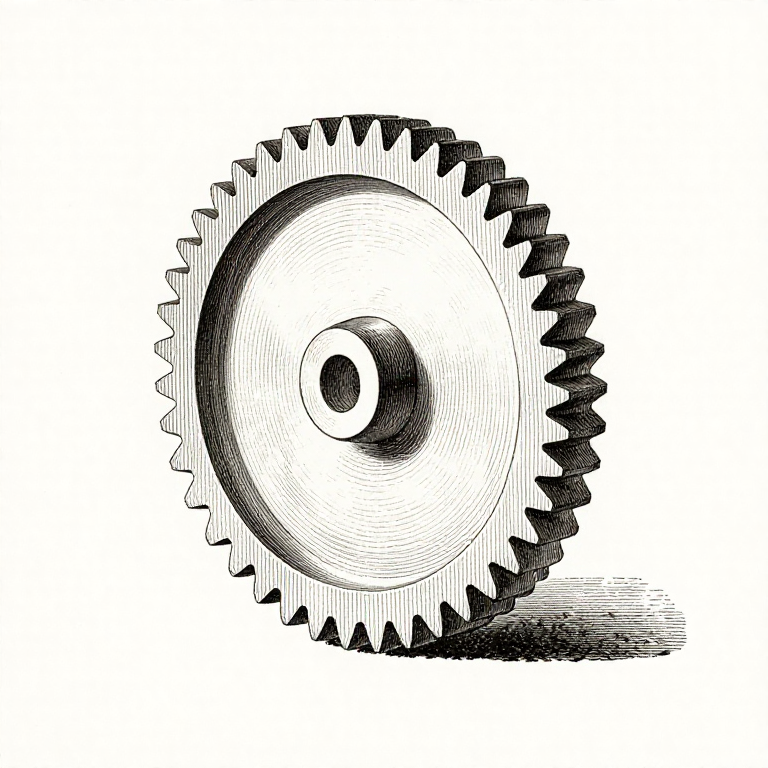


Choosing a Gear Type: Spur, Helical, Bevel, Worm or Rack
The shafts decide most of it. Parallel shafts take spur or helical gears; shafts that cross take bevels; shafts that neither meet nor are parallel take a worm or a crossed helical pair; and a shaft that must drive something in a straight line takes a rack.
What is left to choose is bought and paid for. A helix angle buys quiet running and costs an axial thrust that did not exist before, which the bearings must now carry. A worm buys a large ratio in one stage and costs efficiency — sometimes more than half of it — and it may or may not hold a load when the power is off, depending on a lead angle and a friction coefficient that changes as the box warms up.
This rung is the comparison with the numbers attached, so the choice is made on thrust, efficiency and ratio rather than on what is in the drawer.
Àárín
3 hours
Ìlànà
1
1
Start from the shafts
Start from the shafts
**Parallel shafts.**
*Spur* — teeth straight along the axis. The cheapest to make and to inspect, no axial thrust, and noisy at speed because each tooth pair takes up the load all at once. The default for anything slow, and for anything that must slide in and out of mesh.
*Helical* — teeth on a helix. Quieter, stronger for the same size because more teeth share the load, and it generates an axial thrust the bearings must carry.
*Herringbone or double helical* — two opposite hands on one blank. The thrusts cancel, so a large helix angle becomes usable. Expensive to cut.
*Internal* — teeth on the inside of a ring. Compact, does not reverse direction, and is the outer member of every epicyclic train.
**Intersecting shafts.**
*Straight bevel* — the spur gear of the bevel family, for shafts that cross, usually at 90°. Both members are thrust loaded and both must be located axially, because the mesh position sets the tooth contact.
*Spiral bevel* — the helical equivalent: quieter, stronger, more thrust.
**Shafts that neither intersect nor are parallel.**
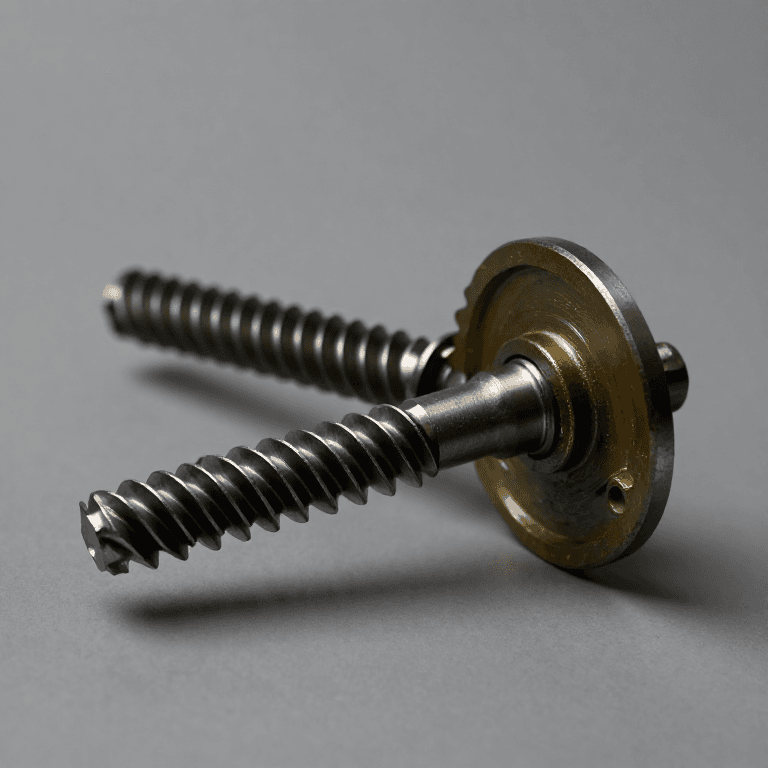
*Worm and wheel* — a large ratio in one stage, in a right angle, quietly, with a sliding contact that costs efficiency and needs the right oil.
*Hypoid* — a spiral bevel with the axes offset. The rear axle of a car.
*Crossed helical* — two ordinary helical gears on skew shafts. Point contact, so it carries very little; useful for light drives.
**Rotation to straight line.**
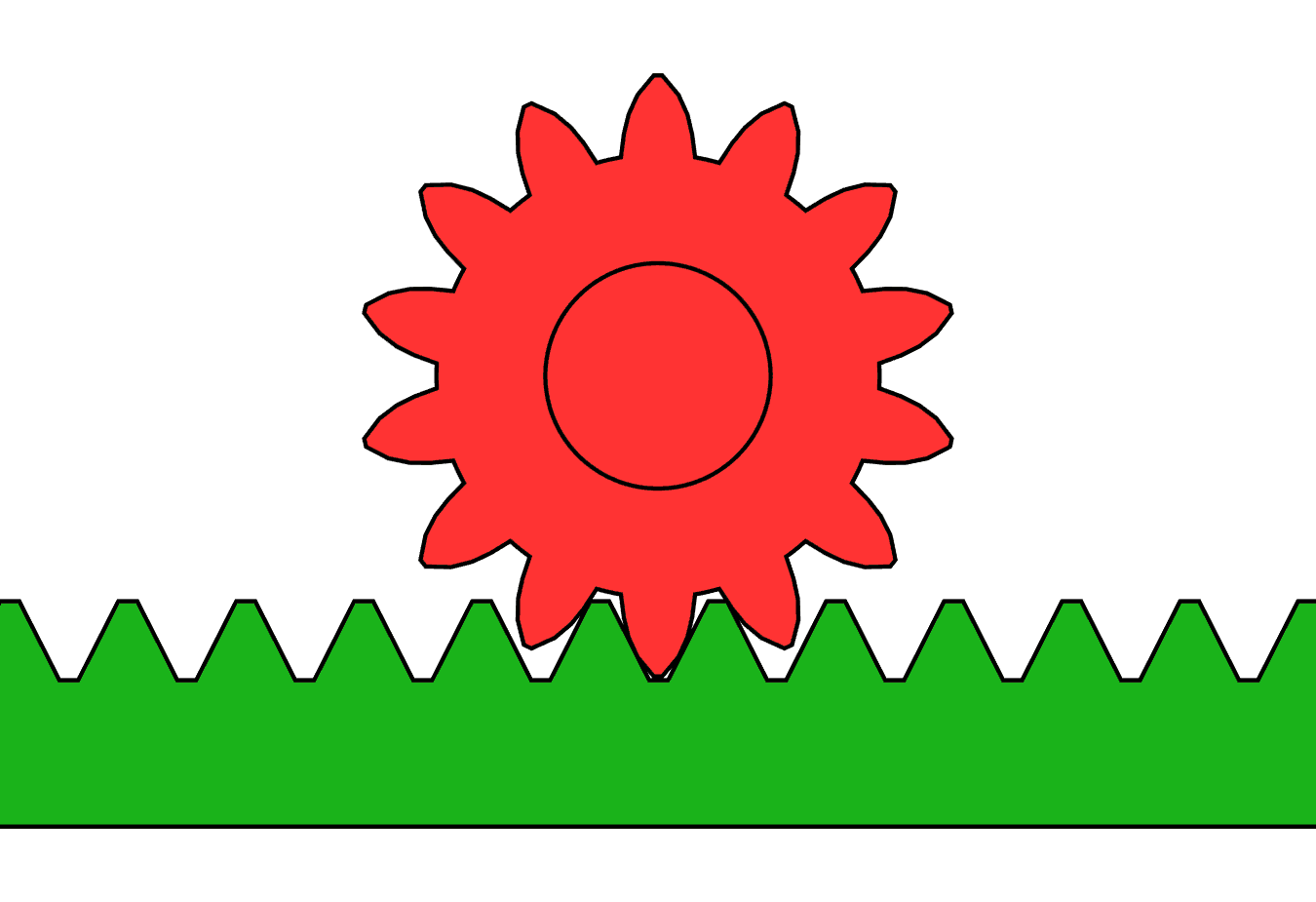
*Rack and pinion* — a rack is a gear of infinite diameter. Same module, same pressure angle, and the tooth flanks are straight.
Àwọn ohun èlò fún ìgbésẹ̀ yìí:
 Àkójọ eyín ẹ̀rọ tààrà (irin, eyín 20)1 ẹyọ
 Ìdì gear bevel (irin, 1:1)1 ẹyọ
 Ìdìpọ̀ ìdábùú àti kẹ̀kẹ́ rẹ̀ (irin àti idẹ)1 ẹyọ
Àwọn irinṣẹ́ tí a nílò:
 Òṣùwọ̀n Kálípà Díjítà Ìnṣì 6
 Ẹ̀rọ Ìwọ̀n Igun
2
2
Thrust, efficiency and self-locking, with numbers
Thrust, efficiency and self-locking, with numbers
Ń ṣí ìwé Jupyter…
Àwọn irinṣẹ́ tí a nílò:
 Kọ̀ǹpútà Tábìlì
3
3
What each type costs to make and to hold
What each type costs to make and to hold
**Spur.** Cut with a hob or a shaper cutter, one setup, inspected with a caliper and a pin. Held by any pair of bearings; no axial location needed beyond keeping the gear on the shaft. Cheapest by a wide margin.
**Helical.** Same hob, the machine's differential set to generate the helix. A little more setup, the same cutter. The cost is downstream: a thrust bearing, or a pair of angular contact bearings, and a housing stiff enough to take the thrust without opening up.
**Bevel.** Cut on a dedicated machine, and made and lapped **in pairs** — bevels are not interchangeable, and replacing one means replacing both. Both members need axial adjustment, usually shims, and the mounting distance is a dimension on the drawing that must be held.
**Worm.** The worm is ground like a thread; the wheel is hobbed with a hob that is a copy of the worm, so again they come as a pair. Bronze wheel against a hardened steel worm, because the contact slides rather than rolls. The worm takes a large axial thrust equal to the wheel's tangential force, which in a reduction is the big one.
**Rack.** Cut on a bar and supplied in lengths that are butted end to end — the joint has to be set with a spare tooth pitch gauge or the pitch error at the joint is permanent. The pinion must be held against the rack at a fixed centre distance along its whole travel, which usually means a stiff rail, not the rack itself.
Àwọn ohun èlò fún ìgbésẹ̀ yìí:
Àkójọ eyín ẹ̀rọ tààrà (irin, eyín 20)1 ẹyọ Gear pinion bevel (irin)1 ẹyọÌdìpọ̀ ìdábùú àti kẹ̀kẹ́ rẹ̀ (irin àti idẹ)1 ẹyọ
 Bearing Bọ́ọ̀lù2 ẹyọ
Àwọn irinṣẹ́ tí a nílò:
Òṣùwọ̀n Kálípà Díjítà Ìnṣì 6 Máíkírómítà
 Ìdìpọ̀ òǹwọ̀n àyè
4
4
The choice, made out loud
The choice, made out loud
**Slow, cheap, parallel, and noise does not matter.** Spur. Do not pay for anything else.
**Parallel and it will be heard.** Helical, 8° to 15°, and budget the thrust bearing at the same time. Pitch line velocities above roughly 5 m/s are where spur noise becomes the complaint.
**A right angle, and efficiency matters.** Bevel. A bevel stage runs at 97–98%; a worm of the same ratio will not.
**A right angle and a ratio above about 10:1 in one stage.** Worm — that is the thing it does that nothing else does. Accept 50–80% efficiency, provide for the heat, and use an oil made for worm drives.
**It must hold when the power is off.** Fit a brake. Choose the worm for ratio and efficiency, and treat any self-locking as a bonus, not a mechanism — the friction coefficient that provides it is not a design value you control.
**Straight line motion.** Rack and pinion for long travel and moderate accuracy; a ball screw when the accuracy matters more than the length.
**In every case, check what the ratio does to the bearings, not just to the speed.** A reduction multiplies torque, and torque on the output shaft is radial load on the output bearings. The gear is rarely the part that fails first.
Àwọn ohun èlò fún ìgbésẹ̀ yìí:
 Mọ́tò oníhámọ̀1 ẹyọBearing Bọ́ọ̀lù4 ẹyọ
Àwọn irinṣẹ́ tí a nílò:
Kọ̀ǹpútà TábìlìÀwọn ohun-èlò
6- Àyè
- Àyè
- Àyè
- Àyè
Àwọn irinṣẹ́ tó nílò
5- Àyè
Blueprint tó jọra
Àwọn blueprint wọ̀nyí pín ìmọ̀ — ọ̀nà, ohun-èlò tàbí ìlànà

CC0 Àgbègbè Gbogbogbò
Blueprint yìí ti jáde lábẹ́ CC0. O lè ṣe àdàkọ, yí padà, pín, àti lò láìsí ìyọ̀ǹda.
Ṣàtìlẹ́yìn Olùṣẹ́dá nípa rírà àwọn ọjà nipasẹ̀ Blueprint wọn Ẹ̀san Olùṣẹ́dá tí àwọn Olùtajà gbé kalẹ̀, tàbí ṣẹ̀dá àtúnṣe tuntun ti Blueprint yìí kí o sì fi sínú Blueprint rẹ gẹ́gẹ́ bí ìsopọ̀ láti pín owó-wíwọlé.