IṢẸ́ ỌNÀ
ẸWÀ ÀTI ÌLERA
IṢẸ́ ỌWỌ́
ÀṢÀ ÀTI ÌTÀN
ÌṢERÉ
ÀYÍKÁ
OÚNJẸ ÀTI OHUN MÍMU
REVERSE ENGINEERING
SÁYẸ́ǸSÌ
ERÉ ÌDÁRAYÁ
ÌMỌ̀-Ẹ̀RỌ
ÀWỌN OHUN WÍWỌ̀
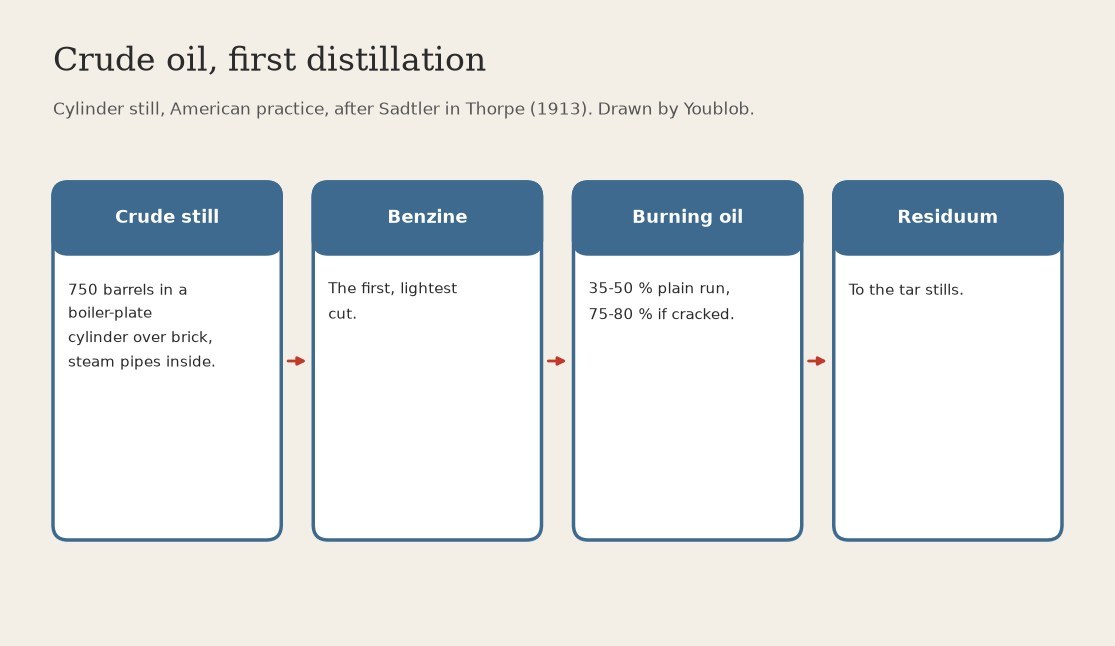


Crude Oil Distilled in a Cylinder Still: Benzine, Burning Oil and Residuum (Sadtler, in Thorpe 1913)
The first step of an American refinery around 1910: crude oil is boiled in a huge horizontal still and split into a light benzine cut, the burning oil that becomes kerosene, and a heavy residuum for the tar stills.
Variable: how hard you run the end of the distillation. Run as a plain fractional distillation, Pennsylvania crude gives 35 to 50 % burning oil and 20 to 30 % lubricating oils. Let the heavy vapours fall back on the hot oil and they crack: burning oil rises to 75 to 80 % and the residuum drops to 6 %.
Source: Sadtler, American Petroleum, in Thorpe's Dictionary of Applied Chemistry, vol. 4 (1913). Not given: the temperature or gravity at which each cut is switched. Crude oil vapour is highly flammable. Picture drawn by Youblob.
Ilọsíwájú
2 days
Ìlànà
1
1
Charge 750 barrels into the cylinder still
Charge 750 barrels into the cylinder still
The still is a boiler-plate cylinder, its lower half usually steel, 30 ft long and 12 ft 6 in across, lying in a brick furnace with its upper half open to the air. Charge it with crude oil: usually 750 barrels, often 1000. It carries closed and perforated steam pipes.
Àwọn ohun èlò fún ìgbésẹ̀ yìí:
 Epo rọ̀bì750 barrel
Àwọn irinṣẹ́ tí a nílò:
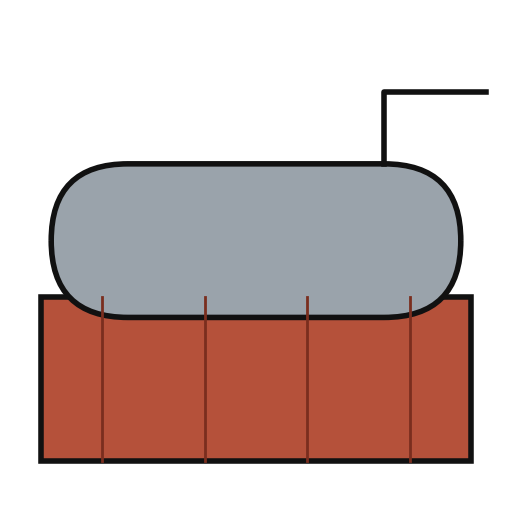 Ìkòkò ìdáná sílíndà dídùbúlẹ̀
 Táńkì ìtọ́jú epo
2
2
Fire it, blow steam, condense in water-cooled coils
Fire it, blow steam, condense in water-cooled coils
Fire the furnace. Steam jetting from the perforated pipe helps carry the oil vapours over. The vapours condense in long pipe coils standing in tanks of flowing water, and run to the receiving house. A trap near each pipe end carries off the gas that will not condense; it can be burned under the boilers or stills to save fuel.
Àwọn irinṣẹ́ tí a nílò:
Ìkòkò ìdáná sílíndà dídùbúlẹ̀ Bọ́ìlà èéfín omi
 Ìyípo ẹ̀rọ ìtutù
 Omi
3
3
Watch the run and switch receivers
Watch the run and switch receivers
The condenser pipes end in boxes with plate-glass sides, so you can see each run and take test portions to control the process. First comes the benzine distillate, then the burning oil distillate. Sadtler gives no temperatures or gravities for the switch. Ours: check test portions with a hydrometer.
Àwọn irinṣẹ́ tí a nílò:
 Òǹwọ̀n ìwúwo omiTáńkì ìtọ́jú epo
4
4
Choose: plain run or cracking run
Choose: plain run or cracking run
Plain fractional distillation: 35 to 50 % burning oil and 20 to 30 % lubricating oils from Pennsylvania crude. Cracking: let the heavy vapours drop back on the hot oil, which the open upper half of the still helps late in the run; burning oil rises to 75 to 80 % and the residuum falls to 6 %.
Àwọn irinṣẹ́ tí a nílò:
Ìkòkò ìdáná sílíndà dídùbúlẹ̀5
5
Send the residuum to the tar stills
Send the residuum to the tar stills
When the burning oil is off, run the fluid residuum out to the tar stills, of about 260 barrels, for the paraffin and lubricating oils. Benzine and burning oil go to their own tanks for refining.
Àwọn irinṣẹ́ tí a nílò:
Táńkì ìtọ́jú epoÌtọ́nisọ́nà yìí ń ṣe
Blueprint tó jọra
Àwọn blueprint wọ̀nyí pín ìmọ̀ — ọ̀nà, ohun-èlò tàbí ìlànà

CC0 Àgbègbè Gbogbogbò
Blueprint yìí ti jáde lábẹ́ CC0. O lè ṣe àdàkọ, yí padà, pín, àti lò láìsí ìyọ̀ǹda.
Ṣàtìlẹ́yìn Olùṣẹ́dá nípa rírà àwọn ọjà nipasẹ̀ Blueprint wọn Ẹ̀san Olùṣẹ́dá tí àwọn Olùtajà gbé kalẹ̀, tàbí ṣẹ̀dá àtúnṣe tuntun ti Blueprint yìí kí o sì fi sínú Blueprint rẹ gẹ́gẹ́ bí ìsopọ̀ láti pín owó-wíwọlé.