IṢẸ́ ỌNÀ
ẸWÀ ÀTI ÌLERA
IṢẸ́ ỌWỌ́
ÀṢÀ ÀTI ÌTÀN
ÌṢERÉ
ÀYÍKÁ
OÚNJẸ ÀTI OHUN MÍMU
REVERSE ENGINEERING
SÁYẸ́ǸSÌ
ERÉ ÌDÁRAYÁ
ÌMỌ̀-Ẹ̀RỌ
ÀWỌN OHUN WÍWỌ̀
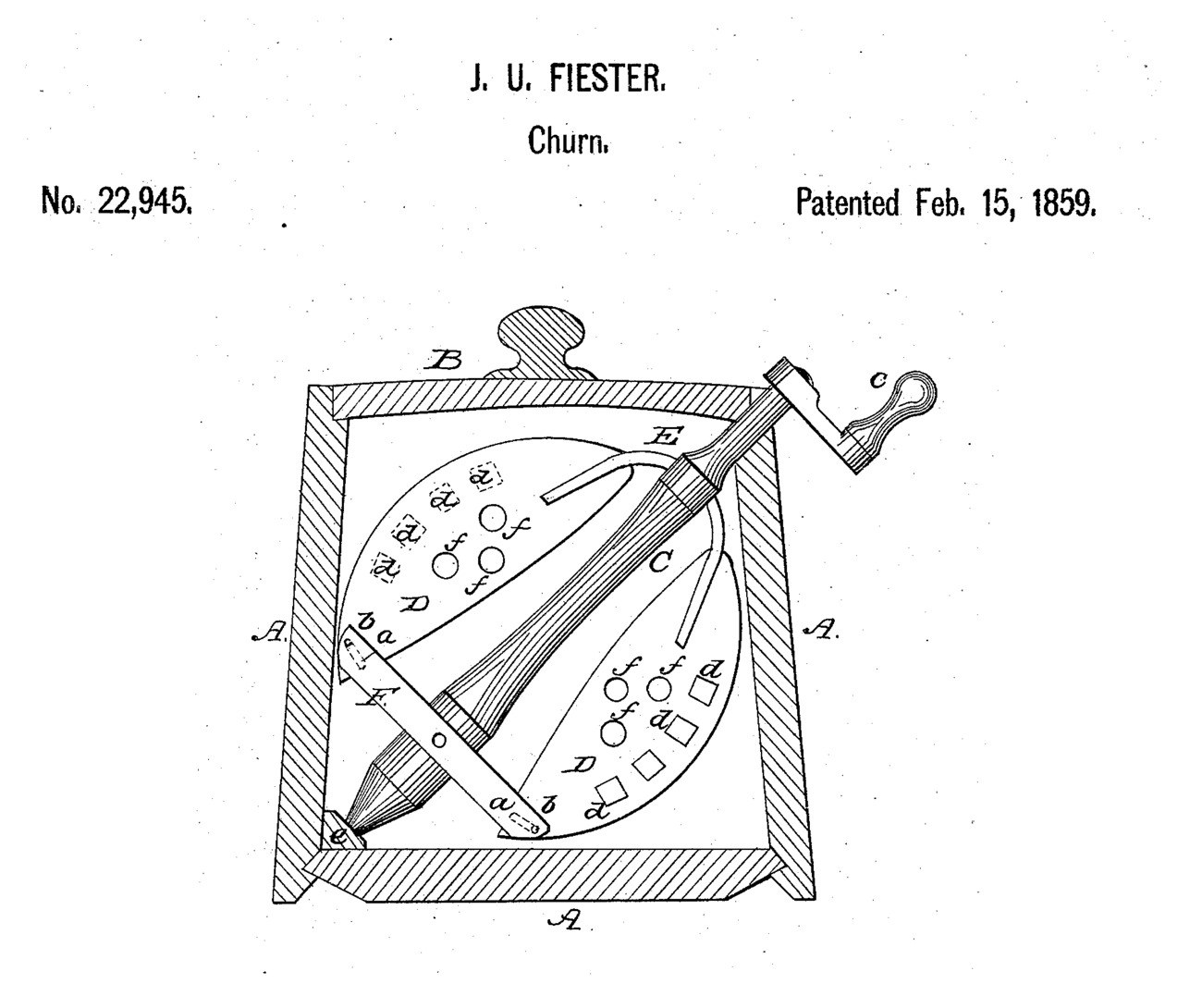


Sprung-Blade Inclined-Dasher Churn: The Blades Close to Pass the Narrow Top and Spread to Fill the Wide Bottom
John U. Fiester of Winchester, Ohio, received US 22,945 in February 1859 for a churn with a slanting dasher in a tub wider at the bottom than the top, so it is hard to tip over. The dasher's two blades are held to the spindle by a yoke spring and guided by pins in the slots of a cross tie: they close to pass the narrow top and spread to fill the wide bottom. Holes let the cream through the blades, and square pockets cut part way in carry air down into it.
This rung builds it in pine and hardwood with a crank.
Àárín
About 8 hours, plus printing
Ìlànà
1
1
Tub, fill and the blades' reach
Tub, fill and the blades' reach
Ń ṣí ìwé Jupyter…
2
2
Holed beaters, before it
Holed beaters, before it
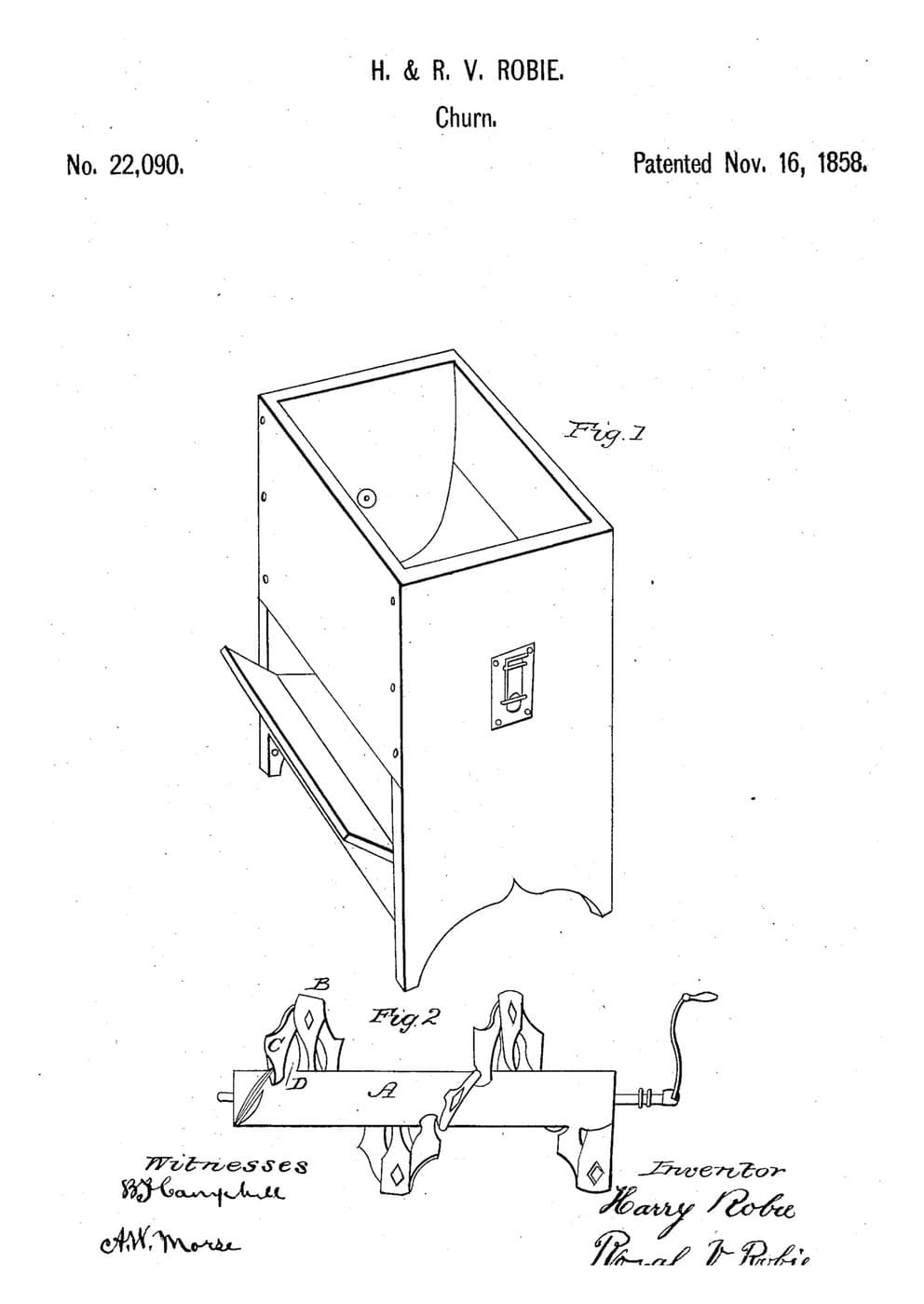
The Robies' beaters pass the cream through holes. Fiester's blades also have pockets that carry air down.
3
3
Read US 22,945
Read US 22,945
"... the yoke spring E and slots (a) allow the dasher blades to be forced easily into the smaller opening in the top of the tub, and when in to expand and fill the larger space at the bottom."
4
4
Print the journal box e
Print the journal box e
The block with the seat for the spindle's point. PETG, 0.2 mm layers, 40 % infill, 4 walls; wash before first use.
5
5
Print the yoke collar
Print the yoke collar
The collar on the spindle that holds the yoke spring. PETG, 0.2 mm layers, 40 % infill, 4 walls; wash before first use.
6
6
Tub A and lid B
Tub A and lid B
From 18 mm pine cut a floor 460 x 336 mm, two ends 400 mm wide at the foot, 320 mm at the top and 400 mm tall, and two sloping sides 336 mm wide that join them. Glue and screw the ends and sides on the floor so the tub is 400 mm wide inside at the floor and 320 mm at the top, 300 mm front to back. Cut a lid 374 x 336 mm with a turned dowel knob. Drill a 42 mm hole through the right side where the spindle meets it, about 345 mm above the inside floor.
Àwọn ohun èlò fún ìgbésẹ̀ yìí:
 Pákó igi pine3 ẹyọ
 Ìdìpọ̀ Igi1 ẹyọ
 Ìṣó igi40 ẹyọ
 Àwọn dowel igi líle1 ẹyọ
Àwọn irinṣẹ́ tí a nílò:
 Ayùn Ọwọ́
 Ayùn Jígísò
 Ẹ̀rọ Ìlùkòkò Aláìlókùn
 Ìṣètò ayùn ihò
 Àwọn clamp
 Ẹ̀rọ Ìwọ̀n Igun
 Bébà Ìfá
 Ìṣù àwọn ohun ìyí skurú
 Okùn Ìdíwọ̀n
7
7
Spindle C and journal e
Spindle C and journal e
Cut a 40 mm hardwood dowel 641 mm long and whittle or plane one end to a point over 30 mm. Screw the journal box in the left corner of the floor, against the sloping side. Cut a half-lap notch 30 mm wide and 12 mm deep across the spindle 85 mm from its point for the cross tie.
Àwọn ohun èlò fún ìgbésẹ̀ yìí:
 Okùn PETG1 ẹyọÀwọn dowel igi líle1 ẹyọÌṣó igi4 ẹyọ
Àwọn irinṣẹ́ tí a nílò:
 Ẹ̀rọ ìtẹ̀ 3D oníwàyà (FDM)Ayùn Ọwọ́
 Àwọn ìgbẹ́ igi
 Àwọn Ìfá (Ìfá Ọwọ́)Ìṣù àwọn ohun ìyí skurú
8
8
Blades D, tie F and yoke E
Blades D, tie F and yoke E
Draw an oval 340 x 220 mm on 16 mm hardwood and cut it in two along its length, then take 4 mm off each straight edge so the halves clear the spindle. Drill four 20 mm holes f in each blade and chisel four 20 mm square pockets d, 8 mm deep with bevelled sides, facing the same way. Glue a 9 mm dowel pin b into each blade 31 mm from its straight edge, 30 mm from its lower end. Cut a hardwood cross tie F 190 x 30 x 16 mm with a 10 mm slot 30 mm long near each end, glue it into the spindle's notch, and drop the pins into its slots. Slide the collar onto the spindle above the blades and screw two spring steel strips 15 x 1.5 mm, 42 mm long, from the collar to each blade's top end.
Àwọn ohun èlò fún ìgbésẹ̀ yìí:
 Pátákó Igi Líle1 ẹyọÀwọn dowel igi líle1 ẹyọÌdìpọ̀ Igi1 ẹyọ
 Ọ̀pá irin orísun1 ẹyọ
 Skurú ẹ̀rọ8 ẹyọ
 Ẹ̀kù Ìdìmú Onínáílọ́ọ̀nù8 ẹyọ
Àwọn irinṣẹ́ tí a nílò:
Ayùn JígísòẸ̀rọ Ìlùkòkò Aláìlókùn Àkójọ orí kànnàkànnàÀwọn ìgbẹ́ igi
 Ayùn IrinÀwọn Ìfá (Ìfá Ọwọ́)Bébà ÌfáÌṣù àwọn ohun ìyí skurú
9
9
Fit the dasher and crank
Fit the dasher and crank
Pass the spindle's top out through the hole in the right side, squeeze the blades together through the tub's top and let them spread, and seat the point in the journal box. Fix a hardwood crank arm 130 mm long on the spindle outside the tub with a screw across, and glue in a 24 mm dowel handle 100 mm long.
Àwọn ohun èlò fún ìgbésẹ̀ yìí:
Pátákó Igi Líle1 ẹyọÀwọn dowel igi líle1 ẹyọÌdìpọ̀ Igi1 ẹyọÌṣó igi1 ẹyọÀwọn irinṣẹ́ tí a nílò:
Ayùn Ọwọ́Ẹ̀rọ Ìlùkòkò AláìlókùnÀkójọ orí kànnàkànnàÌṣù àwọn ohun ìyí skurú10
10
The build in 3D
The build in 3D
FreeCAD model of this build, the near half of the tub cut away: the sloping tub, the journal box, the slanting spindle with its two holed blades, the cross tie with its slots and pins, the yoke collar and springs, and the crank outside.
11
11
Churn
Churn
Pour in about 12 litres of heavy cream at about 15 °C, checked with the thermometer, and put the lid on. Turn the crank steadily and time it: the blades dip in and out of the cream, the pockets carrying air down. When the butter comes, pour off the buttermilk, wash the butter in cold water until it runs clear, work in a pinch of salt and weigh it.
Àwọn ohun èlò fún ìgbésẹ̀ yìí:
 Ọ̀rá wàrà tó nípọn12 l
 Iyọ̀ Òkun Rúkèrúdò1 ẹyọ
 Omi1 ẹyọ
Àwọn irinṣẹ́ tí a nílò:
 Ẹ̀rọ ìwọ̀n ooru oníhun tí ó dúró sí inú
 Aago Ìdúró
 Òṣùwọ̀n Díjítà Ilé Ìdáná
 Àwo ìdàpọ̀ ńlá ti irin tí kò ń yá
12
12
Troubleshooting
Troubleshooting
Sprung-blade churn troubleshooting.
Flow
Loading...
13
13
History and honest limits
History and honest limits
**John U. Fiester** of Winchester, Guernsey County, Ohio, US 22,945, "Churn": the drawing reads 15 February 1859, the text 25 February 1859. A tub wider at the top can be overset; his is wider at the bottom, and the sprung, guided blades still fill it. He claimed the adjustable dasher with its yoke spring, slotted cross tie and pins, holes and air pockets. He gave no sizes or materials: ours are a pine tub, hardwood dasher and steel springs.
Àwọn ohun-èlò
12- 3 ẹyọÀyè
- 3 ẹyọÀyè
- 45 ẹyọÀyè
- 1 ẹyọÀyè
- 1 ẹyọÀyè
- 1 ẹyọÀyè
- 1 ẹyọÀyè
- 8 ẹyọÀyè
- Àyè
- Àyè
- 1 ẹyọÀyè
- 1 ẹyọÀyè
Àwọn irinṣẹ́ tó nílò
18- Àyè
- 1 vendor sell this, none ship to you yetÀyè
- 1 vendor sell this, none ship to you yetÀyè
- Àyè
- Àyè
- 1 vendor sell this, none ship to you yetÀyè
- Àyè
- Àyè
Àwọn fáìlì àpẹrẹ
3Ìtọ́nisọ́nà yìí ń ṣe

Blueprint tó jọra
Àwọn blueprint wọ̀nyí pín ìmọ̀ — ọ̀nà, ohun-èlò tàbí ìlànà



CC0 Àgbègbè Gbogbogbò
Blueprint yìí ti jáde lábẹ́ CC0. O lè ṣe àdàkọ, yí padà, pín, àti lò láìsí ìyọ̀ǹda.
Ṣàtìlẹ́yìn Olùṣẹ́dá nípa rírà àwọn ọjà nipasẹ̀ Blueprint wọn Ẹ̀san Olùṣẹ́dá tí àwọn Olùtajà gbé kalẹ̀, tàbí ṣẹ̀dá àtúnṣe tuntun ti Blueprint yìí kí o sì fi sínú Blueprint rẹ gẹ́gẹ́ bí ìsopọ̀ láti pín owó-wíwọlé.