IṢẸ́ ỌNÀ
ẸWÀ ÀTI ÌLERA
IṢẸ́ ỌWỌ́
ÀṢÀ ÀTI ÌTÀN
ÌṢERÉ
ÀYÍKÁ
OÚNJẸ ÀTI OHUN MÍMU
REVERSE ENGINEERING
SÁYẸ́ǸSÌ
ERÉ ÌDÁRAYÁ
ÌMỌ̀-Ẹ̀RỌ
ÀWỌN OHUN WÍWỌ̀
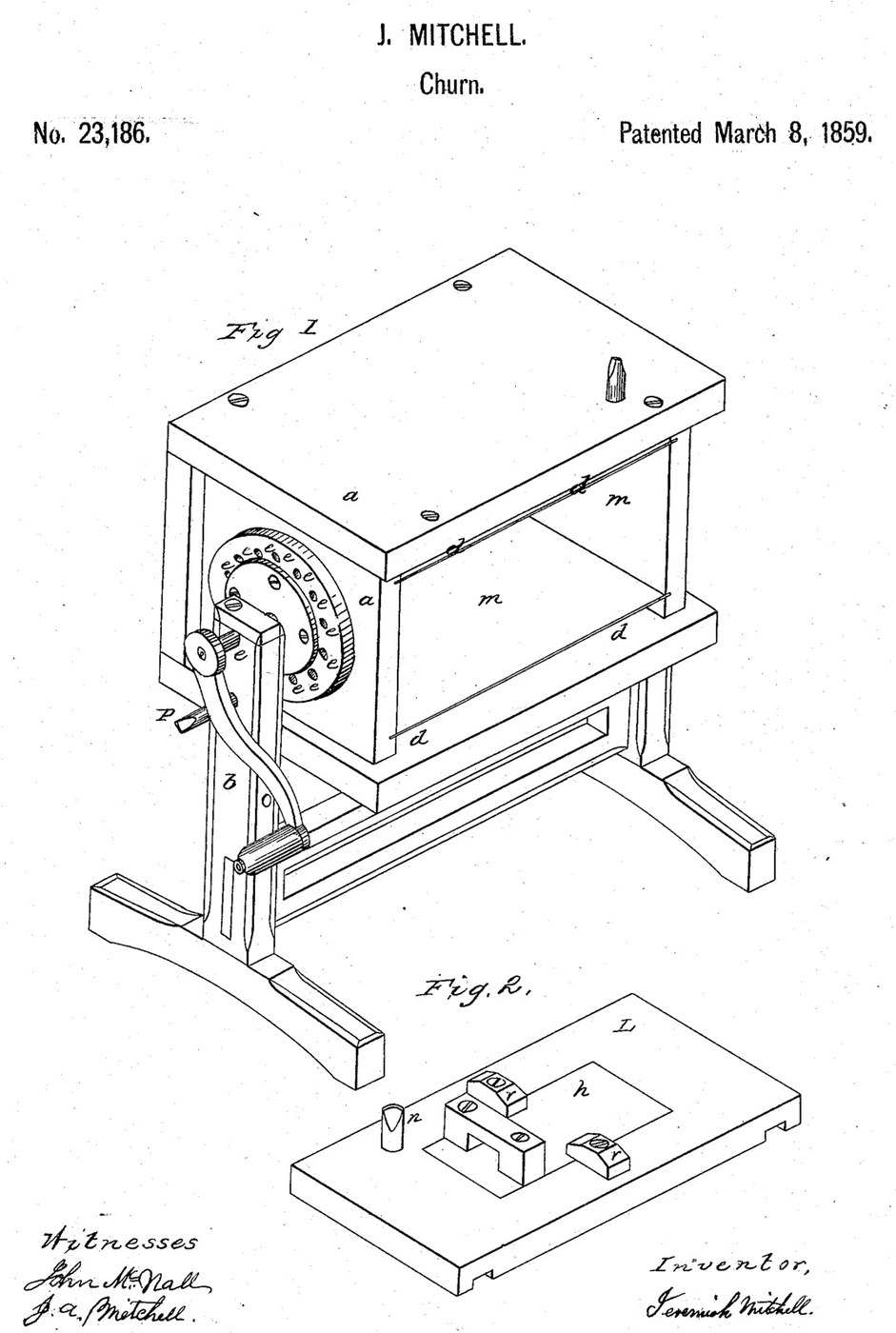


Water-Jacket Revolving Box Churn: A Box With No Dasher Turns on Stub Axles Inside Warm or Cold Water
Jeremiah Mitchell of Gasport, New York, received US 23,186, dated 8 March 1859, for a churn with no paddles or dashers: a square-cornered box turned end over end on stub axles that do not pass through it. Its lining is surrounded by a water space, filled warm or cold and checked with a thermometer. The cream goes in through a door held by buttons, the buttermilk comes out of a tap, and a pin through one standard into a ring of holes holds the box still.
This rung builds it with two nested food containers in a plywood box on timber standards.
Àárín
About 8 hours
Ìlànà
1
1
Water space and weight
Water space and weight
Ń ṣí ìwé Jupyter…
2
2
Warming or cooling the cream, before it
Warming or cooling the cream, before it
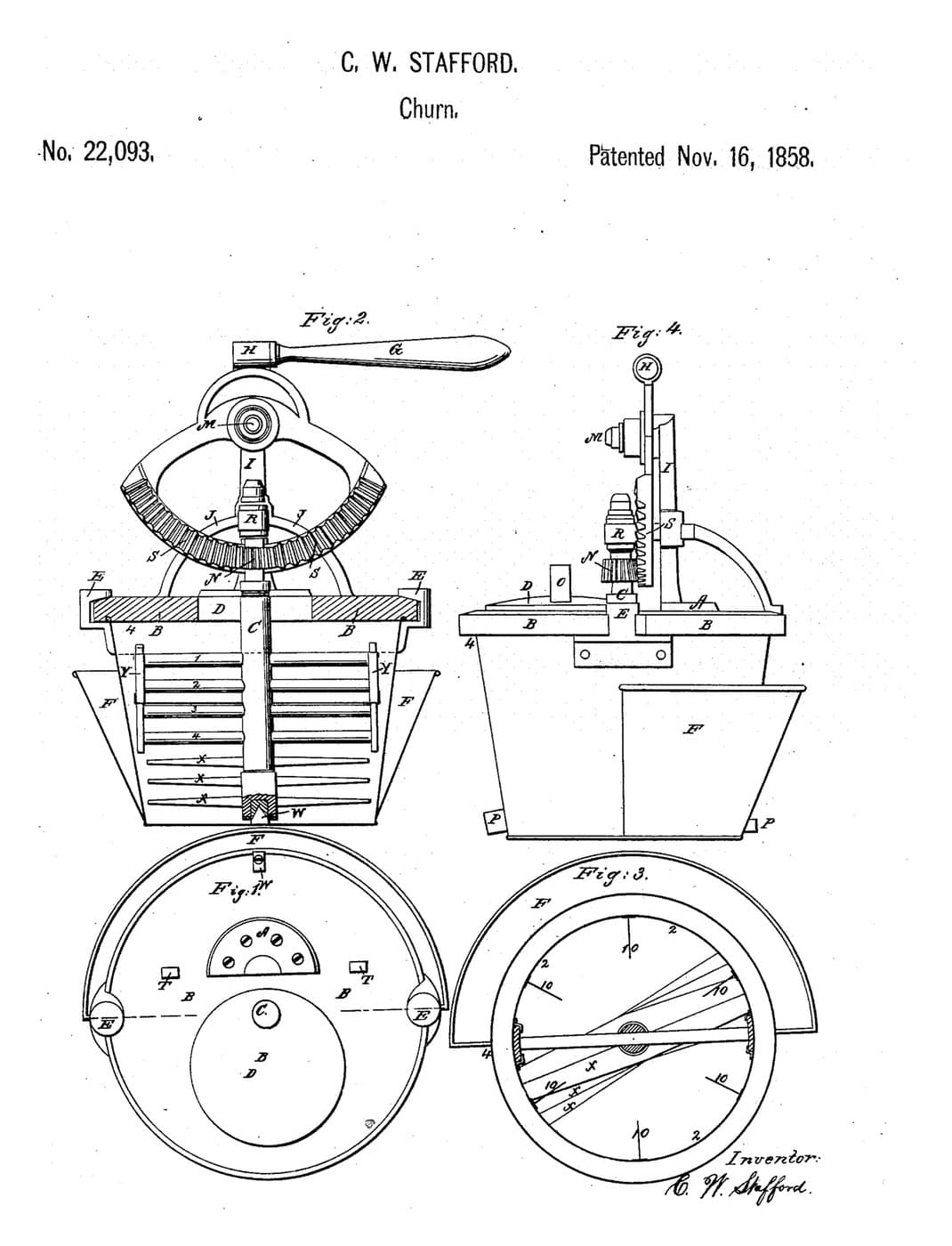
Stafford stood his churn in warm or cold water. Mitchell builds the water round the lining and drops the dasher.
3
3
Read US 23,186
Read US 23,186
"The nature of my invention consists in the employment of a revolving box, partially surrounded by a warm or cold water jacket, into which the cream is introduced, and butter made expeditiously without the use of the paddles or dashers as in ordinary churns."
4
4
Print the spacer
Print the spacer
A block that holds the lining off the jacket's floor. Print four. PETG, 0.2 mm layers, 100 % infill; wash before fitting.
5
5
Lining and water space
Lining and water space
Use two food-grade containers with rims: a lining 300 x 200 x 220 mm outside, with its snap-on lid, and a jacket 380 x 280 x 260 mm outside. Stand the lining on the four spacers in the jacket so their rims are level and the gap is 37 mm all round. Drill a 19 mm hole in the jacket's end low down for the brass spigot and a 7 mm hole in the other end for the thermometer probe, and drill the lining's lid for the PVC spigot n.
Àwọn ohun èlò fún ìgbésẹ̀ yìí:
 Àgọ́ ìtọ́jú ti ìpele oúnjẹ2 ẹyọ
 Okùn PETG1 ẹyọ
Àwọn irinṣẹ́ tí a nílò:
 Ẹ̀rọ ìtẹ̀ 3D oníwàyà (FDM)
 Ẹ̀rọ Ìlùkòkò Aláìlókùn
 Àkójọ Orí Ìlùkòkò
 Àkójọ orí kànnàkànnà
 Okùn Ìdíwọ̀n
6
6
Box a and face L
Box a and face L
From 18 mm plywood make box a round the jacket: a back 416 x 316 mm, two sides 380 x 260 mm and two ends 316 x 260 mm. Cut face L 416 x 316 mm from 12 mm plywood with a 310 x 210 mm opening for the lining's rim. Bed L on silicone on both rims and screw it to the box, so the water space is sealed and only the lining opens. Screw two hardwood turn buttons r on L to hold the lid (door h) down. Fit the brass spigot through the box end into the water space and the PVC spigot through the lid, each sealed with silicone, and push the thermometer probe through its hole in silicone.
Àwọn ohun èlò fún ìgbésẹ̀ yìí:
 Àwo igi tí a lẹ̀ pọ̀2 ẹyọ
 Ìdìpọ̀ Igi1 ẹyọ
 Ìṣó igi40 ẹyọ
 Ìdílẹ̀ Silikoni1 ẹyọ
 Pátákó Igi Líle1 ẹyọ
 Kọ́kọ́rọ́ omi ti idẹ1 ẹyọ
 Kánrán PVC1 ẹyọ
Àwọn irinṣẹ́ tí a nílò:
 Ayùn Ọwọ́
 Ayùn Jígísò
 Ìṣètò ayùn ihòẸ̀rọ Ìlùkòkò AláìlókùnÀkójọ Orí Ìlùkòkò
 Àwọn clamp
 Ìṣù àwọn ohun ìyí skurúOkùn Ìdíwọ̀n
7
7
Axles, standards and crank
Axles, standards and crank
Screw a hardwood hub 100 x 100 x 30 mm to the middle of each end, bore it 30 mm and cross-bolt a 30 mm steel stub axle in it; the axles do not pass through the box. Drill twelve 10.5 mm holes e in a circle 80 mm out from the axle on one end. Stand two 70 mm posts 500 mm to the axle line on 600 mm feet, 540 mm apart, joined by a low rail, and bolt a flange bearing on each post's outer face. Drill the post on the holes' side for pin p, a 10 mm dowel. Fix a hardwood crank arm 270 mm long on the other axle and glue in a 28 mm dowel handle.
Àwọn ohun èlò fún ìgbésẹ̀ yìí:
Pátákó Igi Líle1 ẹyọ Ọ̀pá irin 30 mm1 ẹyọ
 Ìkójọpọ̀ bọ́ọ̀tì onígun mẹ́fà M103 ẹyọ
 Igi rírọ̀ 70x70 mm4 ẹyọ
 Ìṣó igi #10 x 3"16 ẹyọ
 Bẹ́ríìngì onífíláǹjì2 ẹyọ
 Àwọn dowel igi líle1 ẹyọÌdìpọ̀ Igi1 ẹyọ
Àwọn irinṣẹ́ tí a nílò:
Ayùn Ọwọ́Ẹ̀rọ Ìlùkòkò AláìlókùnÀkójọ Orí ÌlùkòkòÀkójọ orí kànnàkànnà Kọ́kọ́rọ́ tí a lè ṣàtúnṣeOkùn Ìdíwọ̀n
8
8
The build in 3D
The build in 3D
FreeCAD model of this build, the near half of the box cut away: the lining on its spacers in the jacket, box a with face L, door h, buttons and spigots, the stub axles in their hubs, the standards with flange bearings, pin p and the crank.
9
9
Churn
Churn
Pin the box still, face L up. Fill the water space through the brass spigot with warm water in cold weather or ice water in warm weather, watching the thermometer, until the probe reads about 15 °C. Open the door and pour in about 8 litres of heavy cream, then snap the lid on and turn the buttons over it. Pull the pin and turn the crank steadily; time it. When the butter has come, pin the box face up, draw off the buttermilk through spigot n, open the door, lift the butter out, wash it in cold water until the water runs clear, work in a pinch of salt and weigh it.
Àwọn ohun èlò fún ìgbésẹ̀ yìí:
 Ọ̀rá wàrà tó nípọn8 l
 Omi1 ẹyọ
 Yìnyín tí a gún2 kg
 Iyọ̀ Òkun Rúkèrúdò1 ẹyọ
Àwọn irinṣẹ́ tí a nílò:
 Ẹ̀rọ ìwọ̀n ooru oníhun tí ó dúró sí inú
 Aago Ìdúró
 Òṣùwọ̀n Díjítà Ilé Ìdáná
 Àwo ìdàpọ̀ ńlá ti irin tí kò ń yá
10
10
Troubleshooting
Troubleshooting
Water-jacket churn troubleshooting.
Flow
Loading...
11
11
History and honest limits
History and honest limits
**Jeremiah Mitchell** of Gasport, Niagara County, New York, US 23,186, 8 March 1859, "Churn". He held his churn simple, quick to clean for want of dashers, and tight, spattering no cream, and claimed the revolving box made and worked as described. His lining was tin and his water space ran round three faces and behind the back; ours is a food container with water on all five faces. He gave no sizes: every size and material is ours.
Àwọn ohun-èlò
19- Àyè
- 1 ẹyọÀyè
- 2 ẹyọÀyè
- 2 ẹyọÀyè
- 40 ẹyọÀyè
- 1 ẹyọÀyè
- 1 ẹyọÀyè
- 1 ẹyọÀyè
- 1 ẹyọÀyè
- 1 ẹyọÀyè
- 4 ẹyọÀyè
- 16 ẹyọÀyè
- 2 ẹyọÀyè
- 1 ẹyọÀyè
- Àyè
- 1 ẹyọÀyè
- 2 kgÀyè
- 1 ẹyọÀyè
Àwọn irinṣẹ́ tó nílò
15- 1 vendor sell this, none ship to you yetÀyè
- 1 vendor sell this, none ship to you yetÀyè
- Àyè
- 1 vendor sell this, none ship to you yetÀyè
- Àyè
- Àyè
Àwọn fáìlì àpẹrẹ
2Ìtọ́nisọ́nà yìí ń ṣe

Blueprint tó jọra
Àwọn blueprint wọ̀nyí pín ìmọ̀ — ọ̀nà, ohun-èlò tàbí ìlànà


CC0 Àgbègbè Gbogbogbò
Blueprint yìí ti jáde lábẹ́ CC0. O lè ṣe àdàkọ, yí padà, pín, àti lò láìsí ìyọ̀ǹda.
Ṣàtìlẹ́yìn Olùṣẹ́dá nípa rírà àwọn ọjà nipasẹ̀ Blueprint wọn Ẹ̀san Olùṣẹ́dá tí àwọn Olùtajà gbé kalẹ̀, tàbí ṣẹ̀dá àtúnṣe tuntun ti Blueprint yìí kí o sì fi sínú Blueprint rẹ gẹ́gẹ́ bí ìsopọ̀ láti pín owó-wíwọlé.