IṢẸ́ ỌNÀ
ẸWÀ ÀTI ÌLERA
IṢẸ́ ỌWỌ́
ÀṢÀ ÀTI ÌTÀN
ÌṢERÉ
ÀYÍKÁ
OÚNJẸ ÀTI OHUN MÍMU
REVERSE ENGINEERING
SÁYẸ́ǸSÌ
ERÉ ÌDÁRAYÁ
ÌMỌ̀-Ẹ̀RỌ
ÀWỌN OHUN WÍWỌ̀
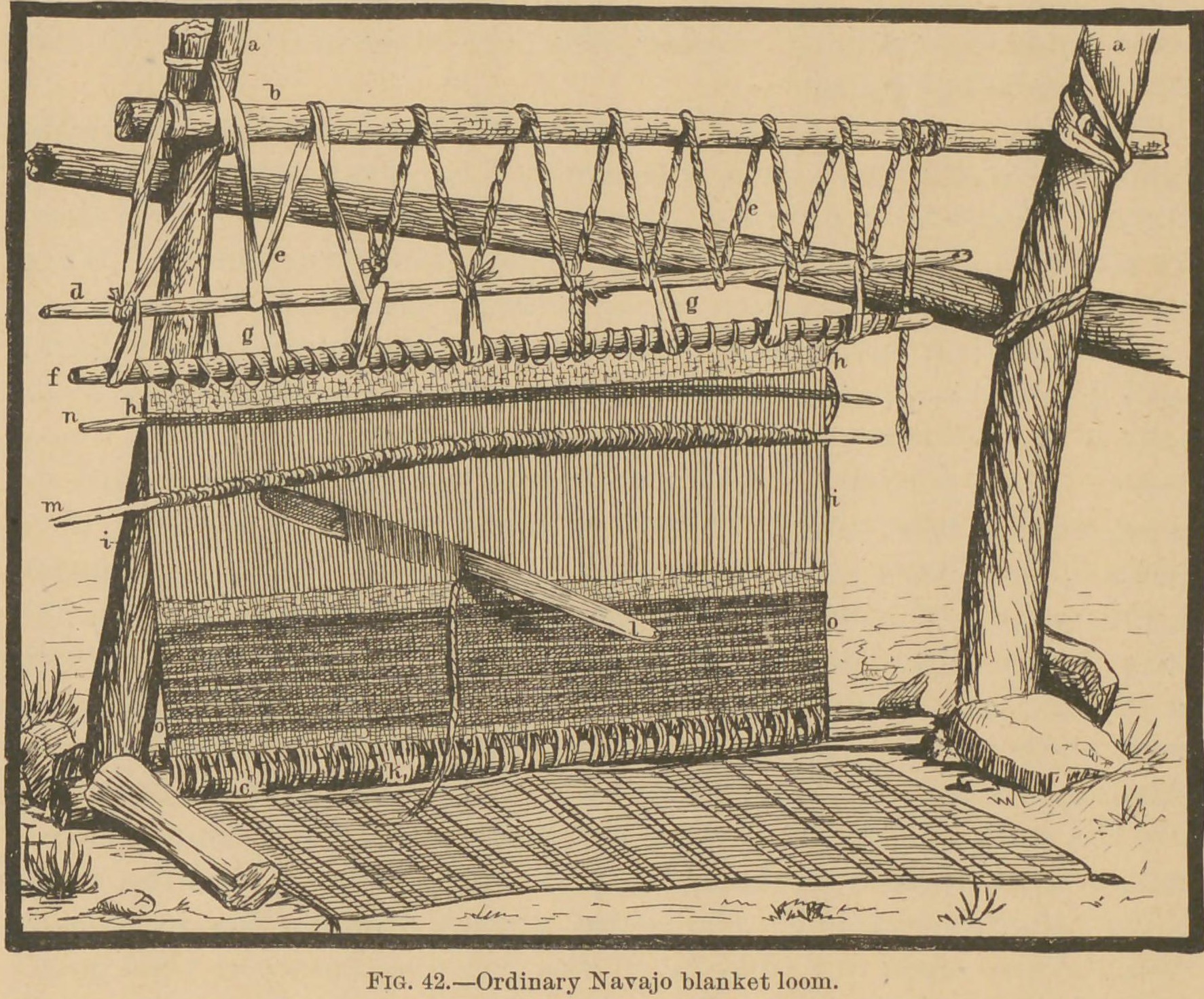


Navajo Blanket Loom: Two Posts, Lashed Braces, Hanging Yarn-Beam, Oak Batten, Heald-Rod and Shed-Rod (Matthews, 1884)
The ordinary Navajo (Diné) blanket loom as Washington Matthews drew it: two posts in the ground with lashed braces, a yarn-beam hung by loops from a pole roped spirally to the top brace so the warp can be tightened, a cloth-beam tied to the bottom brace, a broad thin oak batten, a heald-rod with cord healds for the lower shed and a plain shed-rod for the upper.
Àárín
A day
Ìlànà
1
1
Read Matthews
Read Matthews
"The original distance between the two beams is the length of the blanket."
2
2
Set the frame
Set the frame
Set two posts firmly in the ground (or use two slender trees standing a convenient distance apart). Lash a brace across near the top and one near the bottom.
Àwọn ohun èlò fún ìgbésẹ̀ yìí:
 Ọ̀pá igi tútù1 ẹyọ
 Okùn1 ẹyọ
Àwọn irinṣẹ́ tí a nílò:
 Ohun èlò gbígbẹ́ ihò òpó
 Àáké
3
3
Hang the beams
Hang the beams
Rope a horizontal pole (the supplementary yarn-beam) to the top brace with a rope wound spirally round both. Hang the yarn-beam parallel to it, about 2-3 in. (5-8 cm) below, by a row of loops. Tie the cloth-beam firmly to the bottom brace. Ours: winding the spiral rope tighter or looser sets the warp tension.
Àwọn ohun èlò fún ìgbésẹ̀ yìí:
Ọ̀pá igi tútù1 ẹyọOkùn1 ẹyọ Okùn1 ẹyọ
Àwọn irinṣẹ́ tí a nílò:
 Ọ̀bẹ
4
4
Mount the warp
Mount the warp
Bind the warp's upper border cord to the yarn-beam with a spiral cord, and its lower border cord to the cloth-beam. The space between the beams is the length of the blanket.
Àwọn ohun èlò fún ìgbésẹ̀ yìí:
 Okùn irun àgùntàn tí a kò dá aró sí1 ẹyọOkùn1 ẹyọ
Àwọn irinṣẹ́ tí a nílò:
Ọ̀bẹ5
5
Make the batten and rods
Make the batten and rods
Shape a broad, thin oak stick as the batten (size ours: about 75 x 7 cm, edges rounded). Tie cord or yarn healds round alternate warp threads onto a heald-rod, for the lower shed; put a stout plain shed-rod through the other shed. A wooden fork serves as the reed.
Àwọn ohun èlò fún ìgbésẹ̀ yìí:
 Pátákò oak funfun1 ẹyọỌ̀pá igi tútù1 ẹyọOkùn1 ẹyọ
Àwọn irinṣẹ́ tí a nílò:
 Ọ̀bẹ Ìfàsẹ́yìnỌ̀bẹ
6
6
Troubleshooting
Troubleshooting
Loom troubleshooting.
Flow
Loading...
7
7
History and honest limits
History and honest limits
From Washington Matthews, "Navajo Weavers", **3rd Annual Report of the Bureau of Ethnology** (1884), pp. 377-378 and Fig. 42 (checked on the archive.org scan 101714660.nlm.nih.gov). The Navajo had no true shuttle: weft went through on a slender twig, or for fine patterns in small balls pushed with the finger. Post and pole sizes, the batten size and the tools are ours.
Àwọn ohun-èlò
5- 1 ẹyọÀyè
- 2 ẹyọÀyè
- 3 ẹyọÀyè
- 1 ẹyọÀyè
Ìtọ́nisọ́nà yìí ń ṣe

Blueprint tó jọra
Àwọn blueprint wọ̀nyí pín ìmọ̀ — ọ̀nà, ohun-èlò tàbí ìlànà



CC0 Àgbègbè Gbogbogbò
Blueprint yìí ti jáde lábẹ́ CC0. O lè ṣe àdàkọ, yí padà, pín, àti lò láìsí ìyọ̀ǹda.
Ṣàtìlẹ́yìn Olùṣẹ́dá nípa rírà àwọn ọjà nipasẹ̀ Blueprint wọn Ẹ̀san Olùṣẹ́dá tí àwọn Olùtajà gbé kalẹ̀, tàbí ṣẹ̀dá àtúnṣe tuntun ti Blueprint yìí kí o sì fi sínú Blueprint rẹ gẹ́gẹ́ bí ìsopọ̀ láti pín owó-wíwọlé.