IṢẸ́ ỌNÀ
ẸWÀ ÀTI ÌLERA
IṢẸ́ ỌWỌ́
ÀṢÀ ÀTI ÌTÀN
ÌṢERÉ
ÀYÍKÁ
OÚNJẸ ÀTI OHUN MÍMU
REVERSE ENGINEERING
SÁYẸ́ǸSÌ
ERÉ ÌDÁRAYÁ
ÌMỌ̀-Ẹ̀RỌ
ÀWỌN OHUN WÍWỌ̀
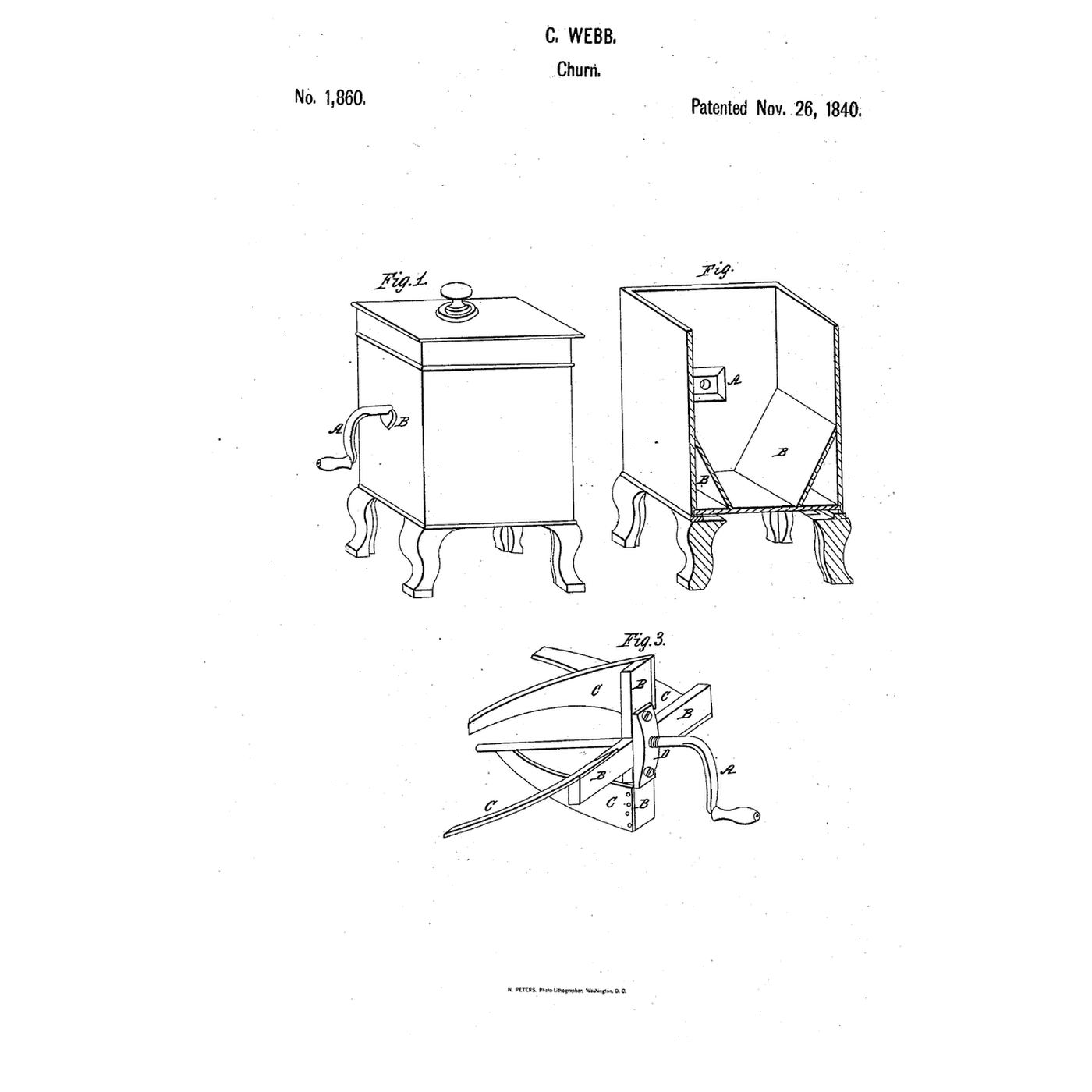


Oblique-Wing Reel Churn: Four Wings Across the Line of the Axle
Webb set out "to agitate the liquid mass, more universally, more expeditiously, and with greater facility and less labor, than by any churn heretofore used."
Constant Webb of Wallingford, Connecticut, received US 1,860, dated 26 November 1840, for "Webb's Economical Churn": a box about twelve inches square and fourteen deep with an iron arbor turned by a crank. On it a cross carries, on each arm, "an agitating wing, made fast to the arm at one end, and passing obliquely to the left across the line of the axle" at about 30°. Slanting boards cut off the bottom corners, and the reel comes off the arbor by reversing its screw so the churn can be scalded clean.
This rung works out the wings' reach, then prints the reel and bearings, fits them to a box, and makes butter.
Àárín
About 4 hours, plus printing
Ìlànà
1
1
Wing reach and chamber size
Wing reach and chamber size
Ń ṣí ìwé Jupyter…
2
2
A crank-turned reel in a box before it
A crank-turned reel in a box before it
The embedded blueprint carries float boards parallel to the shaft on crossed arms. Webb sets his wings across the line of the axle at about 30°.
3
3
Read US 1,860
Read US 1,860
"The angles at the bottom of the chamber opposite to the edges of the agitating wings are cut off by a slanting board on each side, inclining from the bottom to the side at an angle of about 40 or 45 degrees, nicely fitted and made water tight, giving the same play for the wings as they have from the bottom and sides."
4
4
Print the reel and bearings
Print the reel and bearings
Print the reel standing on its cross (/uploads/blueprints/oblique-wing-reel-churn-reel.stl): the wings rise at 30° to the axis and print without supports. Print the front bearing with its drip lip (/uploads/blueprints/oblique-wing-reel-churn-front-bearing.stl), the rear socket (/uploads/blueprints/oblique-wing-reel-churn-rear-socket.stl) and the crank arm (/uploads/blueprints/oblique-wing-reel-churn-crank-arm.stl). Print in PETG at 0.2 mm layers, 30 % infill, 4 walls; wash before first use.
Àwọn ohun èlò fún ìgbésẹ̀ yìí:
 Okùn PETG1 ẹyọ
Àwọn irinṣẹ́ tí a nílò:
 Ẹ̀rọ ìtẹ̀ 3D oníwàyà (FDM)
5
5
Fit the box
Fit the box
Take a food-safe box about 150 mm square. Drill the front and back on one line 80 mm up, a little below the centre as he set it. Screw the front bearing over the front hole, lip downward, and the rear socket inside the back. Glue two plywood strips into the bottom corners at 45° and seal them with silicone.
Àwọn ohun èlò fún ìgbésẹ̀ yìí:
 Àgọ́ ìtọ́jú ti ìpele oúnjẹ1 ẹyọ
 Àwo igi tí a lẹ̀ pọ̀1 ẹyọ
 Ìdílẹ̀ Silikoni1 ẹyọ
 Ìsúrù igi #8 x 1"1 ẹyọ
Àwọn irinṣẹ́ tí a nílò:
 Ẹ̀rọ Ìlùkòkò Aláìlókùn
 Àkójọ Orí Ìlùkòkò
 Ayùn Kópìngì
 Ìṣù àwọn ohun ìyí skurú
6
6
Arbor and reel
Arbor and reel
Hold the reel inside the box and pass a 12 mm hardwood dowel arbor through the bearing and the reel into the socket. Fix the reel with a small screw through its hub, which comes out again for washing. Glue the crank arm on the arbor's front end and a dowel handle in it. Stand the box on legs at a height for turning.
Àwọn ohun èlò fún ìgbésẹ̀ yìí:
 Àwọn dowel igi líle1 ẹyọÌsúrù igi #8 x 1"1 ẹyọ
 Ìdìpọ̀ Igi1 ẹyọ
 Ìṣù Igi Líle1 ẹyọ
Àwọn irinṣẹ́ tí a nílò:
 Ayùn Ọwọ́Ẹ̀rọ Ìlùkòkò AláìlókùnÌṣù àwọn ohun ìyí skurú
 Bébà Ìfá
7
7
The patent drawing
The patent drawing
US 1,860 drawing sheet, public domain (expired patent).
8
8
Crank and make butter
Crank and make butter
Let the heavy cream stand until it reaches about 15 °C, checked with the thermometer. Pour in 500 ml and fit the lid. Turn the crank steadily and time until the butter comes. Pour off the buttermilk, add cold water, churn a little and pour off again until it runs clear; work in a pinch of salt and weigh the butter. Take out the screw and draw the arbor to lift out the reel, and scald the box clean.
Àwọn ohun èlò fún ìgbésẹ̀ yìí:
 Ọ̀rá wàrà tó nípọn500 ml
 Iyọ̀ Òkun Rúkèrúdò1 ẹyọ
 Omi1 ẹyọ
Àwọn irinṣẹ́ tí a nílò:
 Ẹ̀rọ ìwọ̀n ooru oníhun tí ó dúró sí inú
 Aago Ìdúró
 Òṣùwọ̀n Díjítà Ilé Ìdáná
 Àwo ìdàpọ̀ ńlá ti irin tí kò ń yá
9
9
Wings that scrape, a front that drips
Wings that scrape, a front that drips
Oblique-wing reel churn troubleshooting.
Flow
Loading...
10
10
History and honest limits
History and honest limits
**Constant Webb** of Wallingford, New Haven County, Connecticut, received US 1,860, dated 26 November 1840. His arms reached about six inches from the centre; the arbor's outer end ran in a metal socket in the front with a lip below "to catch and return the oozing if any should flow"; the wings were curved to approach but not touch the sides and bottom. "For larger dairies the several parts may be proportionally increased." He claimed the reel and the manner in which the agitating wing-boards are arranged upon the arms of the cross.
**Honest limits.** A food-safe box and a printed reel with straight wings stand in for his box and curved boards; a screw through the hub stands in for his threaded arbor. FDM prints hold food in their layer lines, so wash well and replace when worn. Your times and weights are the result.
Àwọn ohun-èlò
11- 1 ẹyọÀyè
- Àyè
- 1 ẹyọÀyè
- 1 ẹyọÀyè
- 2 ẹyọÀyè
- 1 ẹyọÀyè
- 1 ẹyọÀyè
- 1 ẹyọÀyè
- 500 mlÀyè
- 1 ẹyọÀyè
- 1 ẹyọÀyè
Àwọn irinṣẹ́ tó nílò
11- 1 vendor sell this, none ship to you yetÀyè
- Àyè
- Àyè
- Àyè
- Àyè
Ìtọ́nisọ́nà yìí ń ṣe

Blueprint tó jọra
Àwọn blueprint wọ̀nyí pín ìmọ̀ — ọ̀nà, ohun-èlò tàbí ìlànà
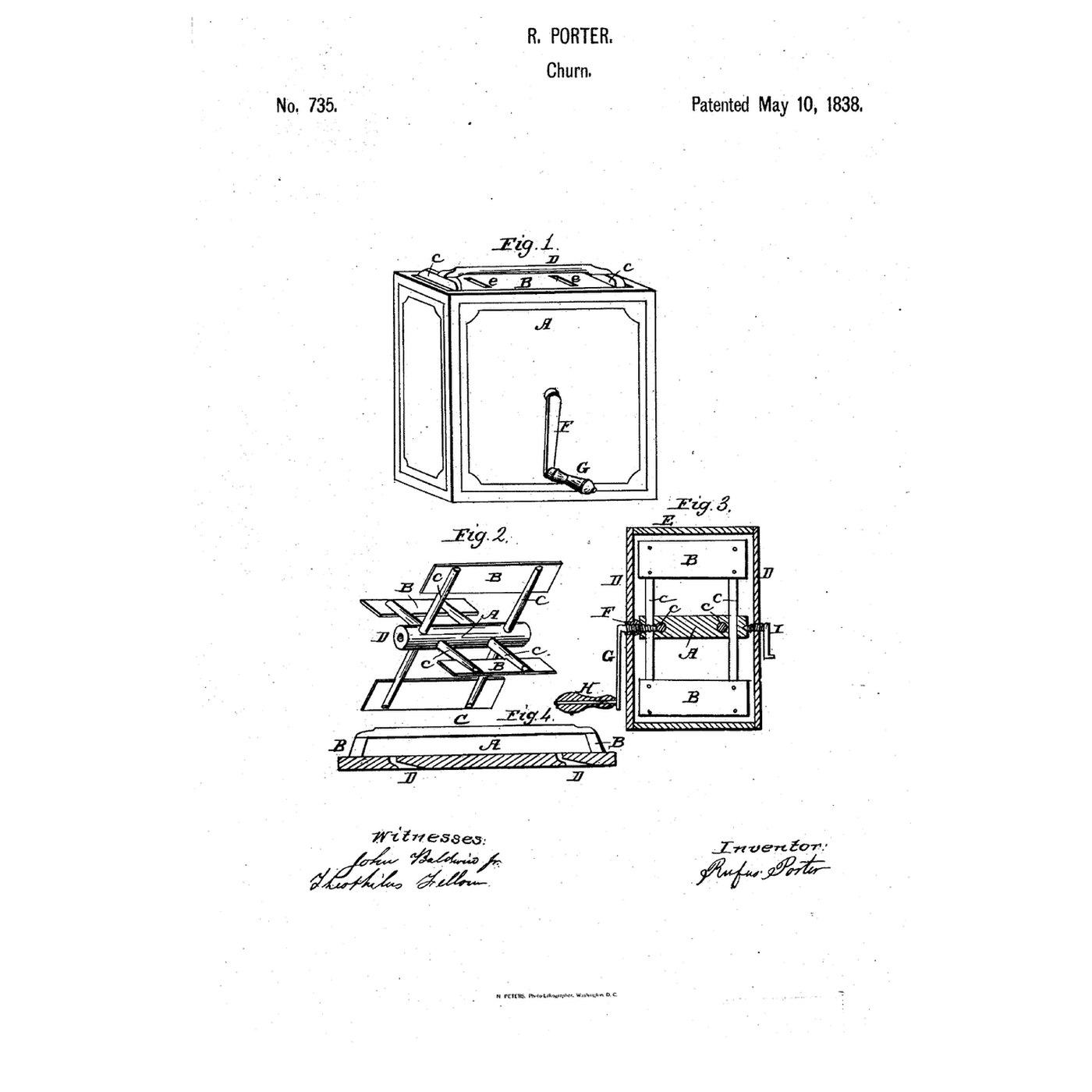
Rotary-Dasher Box Churn: Float Boards on Crossed Arms in a Curved Box
láti ọwọ́ Martin
OÚNJẸ ÀTI OHUN MÍMU
27
0
0
0
0
0
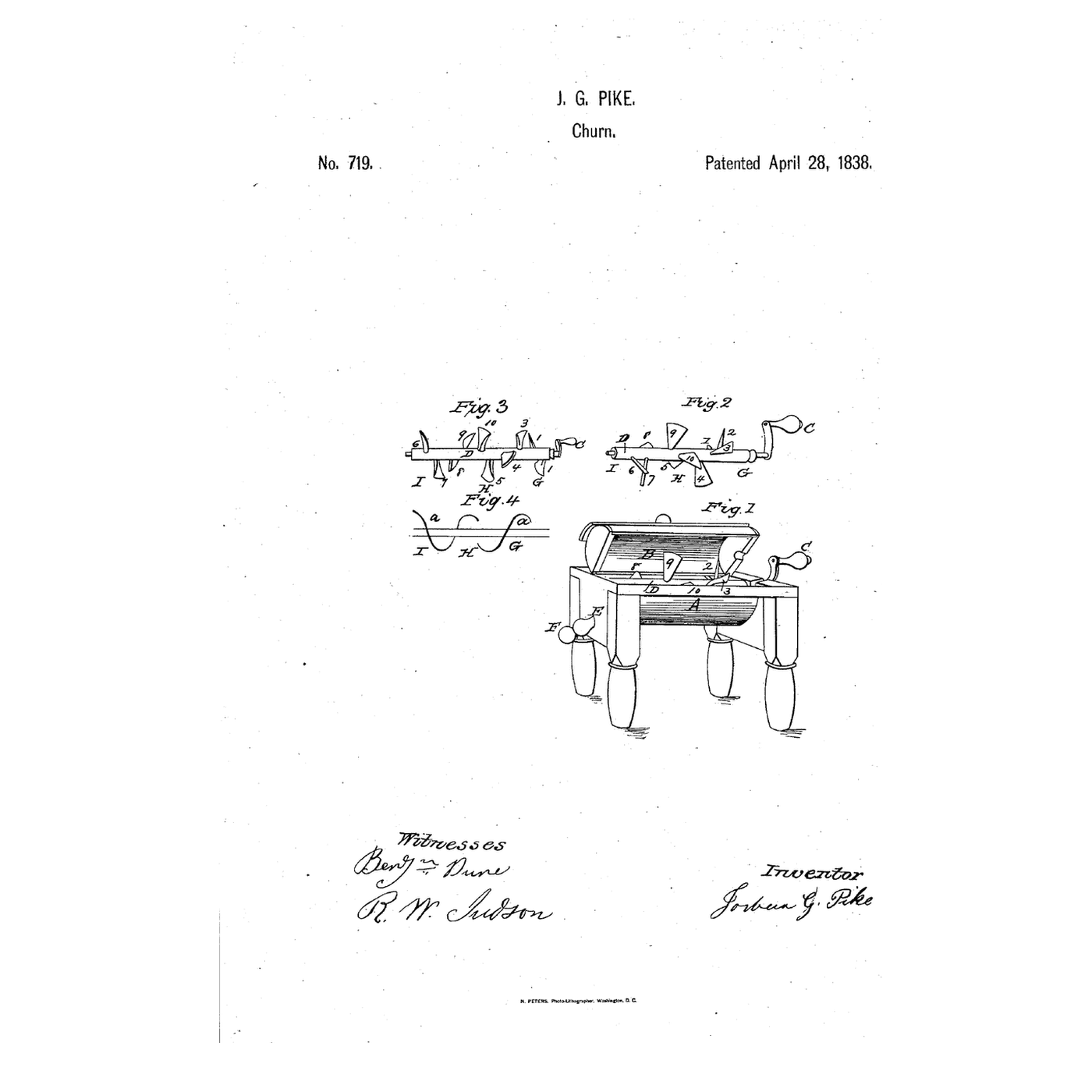
Oblique-Paddle Churn: Turn One Way to Gather the Butter, Back to Spread It
láti ọwọ́ TheChef
OÚNJẸ ÀTI OHUN MÍMU
16
0
0
0
0
0

Churning Butter from Cream — The 5,000-Year-Old Fat Separation
láti ọwọ́ TheChef
IṢẸ́ ỌWỌ́
49
0
0
0
0
0
CC0 Àgbègbè Gbogbogbò
Blueprint yìí ti jáde lábẹ́ CC0. O lè ṣe àdàkọ, yí padà, pín, àti lò láìsí ìyọ̀ǹda.
Ṣàtìlẹ́yìn Olùṣẹ́dá nípa rírà àwọn ọjà nipasẹ̀ Blueprint wọn Ẹ̀san Olùṣẹ́dá tí àwọn Olùtajà gbé kalẹ̀, tàbí ṣẹ̀dá àtúnṣe tuntun ti Blueprint yìí kí o sì fi sínú Blueprint rẹ gẹ́gẹ́ bí ìsopọ̀ láti pín owó-wíwọlé.