IṢẸ́ ỌNÀ
ẸWÀ ÀTI ÌLERA
IṢẸ́ ỌWỌ́
ÀṢÀ ÀTI ÌTÀN
ÌṢERÉ
ÀYÍKÁ
OÚNJẸ ÀTI OHUN MÍMU
REVERSE ENGINEERING
SÁYẸ́ǸSÌ
ERÉ ÌDÁRAYÁ
ÌMỌ̀-Ẹ̀RỌ
ÀWỌN OHUN WÍWỌ̀


Surface Dash-Wheel Churn: A Fast Fan Skims the Cream Over a Partition on a Parallel-Rule Frame
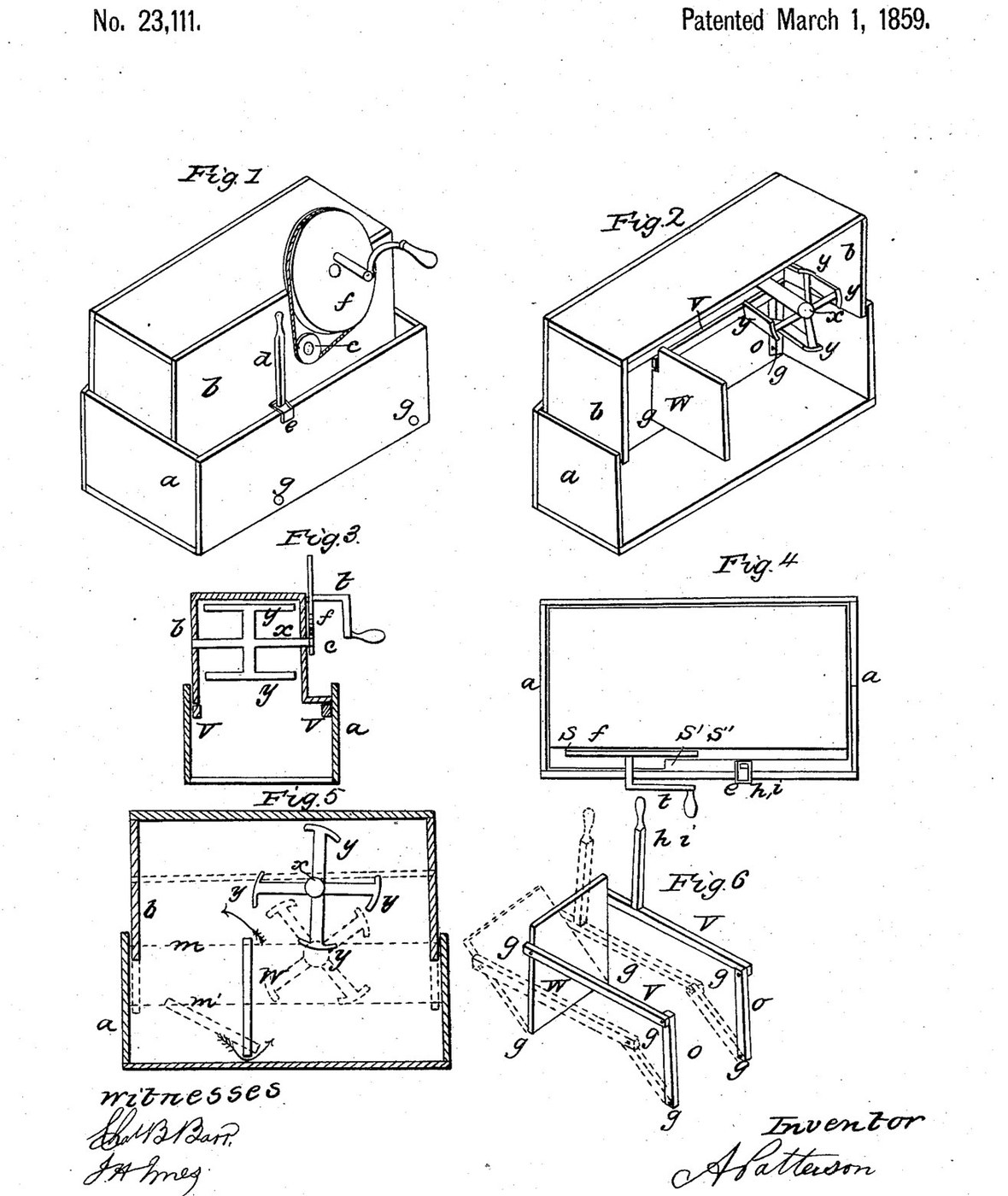
Andrew Patterson of Birmingham, Pennsylvania, received US 23,111, dated 1 March 1859, for a churn whose fan wheel only strikes the surface of the cream. Turned fast through a pulley, it throws the cream over a partition; the cream sinks and comes back under it. The wheel's chamber is also the churn's lid and rests on a jointed frame that works like a parallel rule, so a handle sets the fan to dip about 1/8 in. into whatever quantity of cream is in the box.
This rung builds it in pine with a belt-driven printed fan.
Àárín
About 8 hours, plus printing
Ìlànà
1
1
Setting the rest for the cream you have
Setting the rest for the cream you have
Ń ṣí ìwé Jupyter…
2
2
A dasher that adjusts to the tub, before it
A dasher that adjusts to the tub, before it
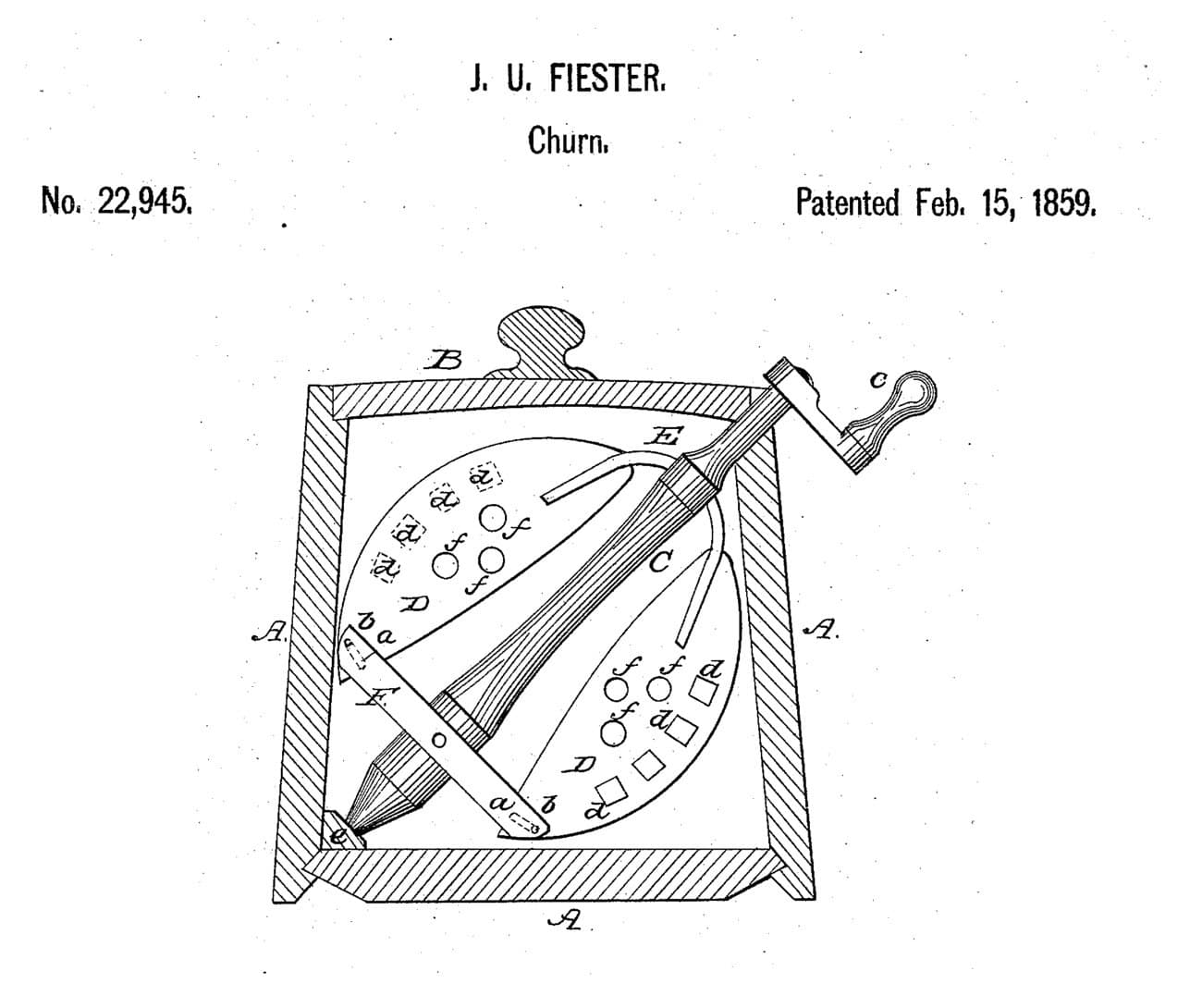
Fiester's blades spread to fit his tub. Patterson moves his whole fan up and down to the cream's surface.
3
3
Read US 23,111
Read US 23,111
"... the rest o, o, w, v, v, is raised or lowered until when b is placed on it the buckets or fans will dip about one-eighth of an inch into the cream and the crank is turned rapidly in such manner that the wheel shall impel the milk or cream which it strikes in the direction of w".
4
4
Print the hub
Print the hub
The fan's hub with eight square sockets for the arms. PETG, 0.2 mm layers, 40 % infill, 4 walls; wash before first use.
5
5
Print the bucket y
Print the bucket y
A curved bucket for an arm pair's ends. Print four. PETG, 0.2 mm layers, 40 % infill, 4 walls; wash before first use.
6
6
Box a
Box a
From 18 mm pine make an oblong box open at the top, 600 x 300 mm and 320 mm deep inside: floor 636 x 336 mm, sides 636 x 320 mm, ends 300 x 320 mm, glued and screwed.
Àwọn ohun èlò fún ìgbésẹ̀ yìí:
 Pákó igi pine2 ẹyọ
 Ìdìpọ̀ Igi1 ẹyọ
 Ìṣó igi30 ẹyọ
Àwọn irinṣẹ́ tí a nílò:
 Ayùn Ọwọ́
 Ẹ̀rọ Ìlùkòkò Aláìlókùn
 Àkójọ Orí Ìlùkòkò
 Àwọn clamp
 Bébà Ìfá
 Ìṣù àwọn ohun ìyí skurú
 Okùn Ìdíwọ̀n
7
7
The parallel rest v v o o w
The parallel rest v v o o w
Cut two hardwood uprights o 30 x 13 x 190 mm and pin each to a side of the box with an 8 mm bolt 22 mm above the inside floor, 100 mm from the right end. Cut a pine division board w 228 x 170 mm and pin its foot to two hardwood blocks on the floor 200 mm from the left end, so it stands 16 mm clear of the floor. Cut two hardwood bars v 20 x 20 x 340 mm and pin them to the uprights' tops and w's top corners, 300 mm apart, with 160 mm between each foot and top pivot, so the bars stay level as the frame leans. Screw a hardwood handle h i 30 x 12 mm to the left end of one bar, long enough to stand 100 mm above the rim, and bend a flat-bar frame e over the rim to hold it with a pin through holes drilled every 20 mm in the handle.
Àwọn ohun èlò fún ìgbésẹ̀ yìí:
 Pátákó Igi Líle1 ẹyọPákó igi pine1 ẹyọ
 Skurú ẹ̀rọ8 ẹyọ
 Ẹ̀kù Ìdìmú Onínáílọ́ọ̀nù8 ẹyọ
 Wáṣà Pẹrẹsẹ16 ẹyọ
 Ọ̀pá Pẹrẹsẹ Irin Pẹ́lẹ́1 ẹyọÌṣó igi6 ẹyọ
Àwọn irinṣẹ́ tí a nílò:
Ayùn Ọwọ́Ẹ̀rọ Ìlùkòkò AláìlókùnÀkójọ Orí Ìlùkòkò Ayùn Irin
 Ìdìmú Tábìlì
 Àwọn Ìfá (Ìfá Ọwọ́)
 Kọ́kọ́rọ́ tí a lè ṣàtúnṣe
8
8
Chamber b and the fan
Chamber b and the fan
From pine make chamber b open below: two sides 360 x 270 mm, two ends 234 x 270 mm and a top 360 x 270 mm, 270 mm wide outside so it sits on the bars inside a. Drill both sides 12.5 mm for the fan shaft 40 mm up from b's lower edge and 230 mm from its left end, and one side again 170 mm above that for the crank shaft. Cut the 12 mm stainless rod to 285 mm for the fan. Push eight hardwood arms 18 x 18 x 69 mm into the hub's sockets, screw a bucket across each pair of arm ends, slide the hub onto the shaft inside b and fix it with an M4 screw across.
Àwọn ohun èlò fún ìgbésẹ̀ yìí:
Pákó igi pine2 ẹyọÌdìpọ̀ Igi1 ẹyọÌṣó igi20 ẹyọ Ọ̀pá irin tí kò ń yá1 ẹyọPátákó Igi Líle1 ẹyọ
 Okùn PETG1 ẹyọSkurú ẹ̀rọ9 ẹyọẸ̀kù Ìdìmú Onínáílọ́ọ̀nù9 ẹyọ
Àwọn irinṣẹ́ tí a nílò:
 Ẹ̀rọ ìtẹ̀ 3D oníwàyà (FDM)Ayùn Ọwọ́Ẹ̀rọ Ìlùkòkò AláìlókùnÀkójọ Orí ÌlùkòkòAyùn IrinÀwọn Ìfá (Ìfá Ọwọ́)Ìṣù àwọn ohun ìyí skurú
9
9
Pulleys f and c, crank t
Pulleys f and c, crank t
Cut a pulley f 240 mm across and a pulley c 60 mm across from 12 mm plywood, each with a 3 mm flange glued on the outer face, and file a groove round each rim for the cord. Fix c on the fan shaft outside b. Run a 12 mm stainless stub shaft through b's side 170 mm above, fix f on it and a hardwood crank arm 24 x 10 x 112 mm with a 24 mm dowel handle 80 mm long beyond it, out over the side of a. Tie a loop of 6 mm cotton cord round both pulleys.
Àwọn ohun èlò fún ìgbésẹ̀ yìí:
 Àwo igi tí a lẹ̀ pọ̀1 ẹyọÌdìpọ̀ Igi1 ẹyọỌ̀pá irin tí kò ń yá1 ẹyọPátákó Igi Líle1 ẹyọ
 Àwọn dowel igi líle1 ẹyọ
 Okùn òwú ńlá1 mSkurú ẹ̀rọ2 ẹyọẸ̀kù Ìdìmú Onínáílọ́ọ̀nù2 ẹyọ
Àwọn irinṣẹ́ tí a nílò:
 Ayùn JígísòÀwọn Ìfá (Ìfá Ọwọ́)Ẹ̀rọ Ìlùkòkò AláìlókùnÀkójọ Orí ÌlùkòkòAyùn IrinÌṣù àwọn ohun ìyí skurú
10
10
The build in 3D
The build in 3D
FreeCAD model of this build, the near side of both boxes cut away: box a, the uprights, division board and bars of the parallel rest leaning 50 degrees, chamber b on the bars, the fan with its buckets, pulleys f and c, the crank, and handle h i in its frame e. The cord is not drawn.
11
11
Churn
Churn
Pour in about 14 litres of heavy cream at about 15 °C, checked with the thermometer. Set chamber b on the bars and move the handle until the buckets just dip into the cream, about 3 mm, then pin it in frame e (the notebook gives the lean for other quantities). Turn the crank fast and time it: the fan throws cream over the division board and it returns under it. When the butter comes, lift b off, pour off the buttermilk, wash the butter in cold water until it runs clear, work in a pinch of salt and weigh it.
Àwọn ohun èlò fún ìgbésẹ̀ yìí:
 Ọ̀rá wàrà tó nípọn14 l
 Iyọ̀ Òkun Rúkèrúdò1 ẹyọ
 Omi1 ẹyọ
Àwọn irinṣẹ́ tí a nílò:
 Ẹ̀rọ ìwọ̀n ooru oníhun tí ó dúró sí inú
 Aago Ìdúró
 Òṣùwọ̀n Díjítà Ilé Ìdáná
 Àwo ìdàpọ̀ ńlá ti irin tí kò ń yá
12
12
Troubleshooting
Troubleshooting
Surface dash-wheel churn troubleshooting.
Flow
Loading...
13
13
History and honest limits
History and honest limits
**Andrew Patterson** of Birmingham, Allegheny County, Pennsylvania, US 23,111, 1 March 1859, "Churn". He held that a fast fan at the surface does more than a submerged wheel, which has to lift the whole cream, and that it also gathers the butter on the far side of the partition. He claimed box a with chamber b serving as its lid and as the frame for the dash wheel and crank. His only figure is the 1/8 in. dip; every size and material here is ours.
Àwọn ohun-èlò
16- 2 ẹyọÀyè
- 3 ẹyọÀyè
- 56 ẹyọÀyè
- 1 ẹyọÀyè
- 19 ẹyọÀyè
- 19 ẹyọÀyè
- 16 ẹyọÀyè
- Àyè
- 1 ẹyọÀyè
- 1 ẹyọÀyè
- 1 ẹyọÀyè
- 1 ẹyọÀyè
- 1 mÀyè
- Àyè
- 1 ẹyọÀyè
- 1 ẹyọÀyè
Àwọn irinṣẹ́ tó nílò
17- Àyè
- 1 vendor sell this, none ship to you yetÀyè
- Àyè
- Àyè
- 1 vendor sell this, none ship to you yetÀyè
- Àyè
- Àyè
- 1 vendor sell this, none ship to you yetÀyè
- Àyè
Àwọn fáìlì àpẹrẹ
3Ìtọ́nisọ́nà yìí ń ṣe

Blueprint tó jọra
Àwọn blueprint wọ̀nyí pín ìmọ̀ — ọ̀nà, ohun-èlò tàbí ìlànà


CC0 Àgbègbè Gbogbogbò
Blueprint yìí ti jáde lábẹ́ CC0. O lè ṣe àdàkọ, yí padà, pín, àti lò láìsí ìyọ̀ǹda.
Ṣàtìlẹ́yìn Olùṣẹ́dá nípa rírà àwọn ọjà nipasẹ̀ Blueprint wọn Ẹ̀san Olùṣẹ́dá tí àwọn Olùtajà gbé kalẹ̀, tàbí ṣẹ̀dá àtúnṣe tuntun ti Blueprint yìí kí o sì fi sínú Blueprint rẹ gẹ́gẹ́ bí ìsopọ̀ láti pín owó-wíwọlé.