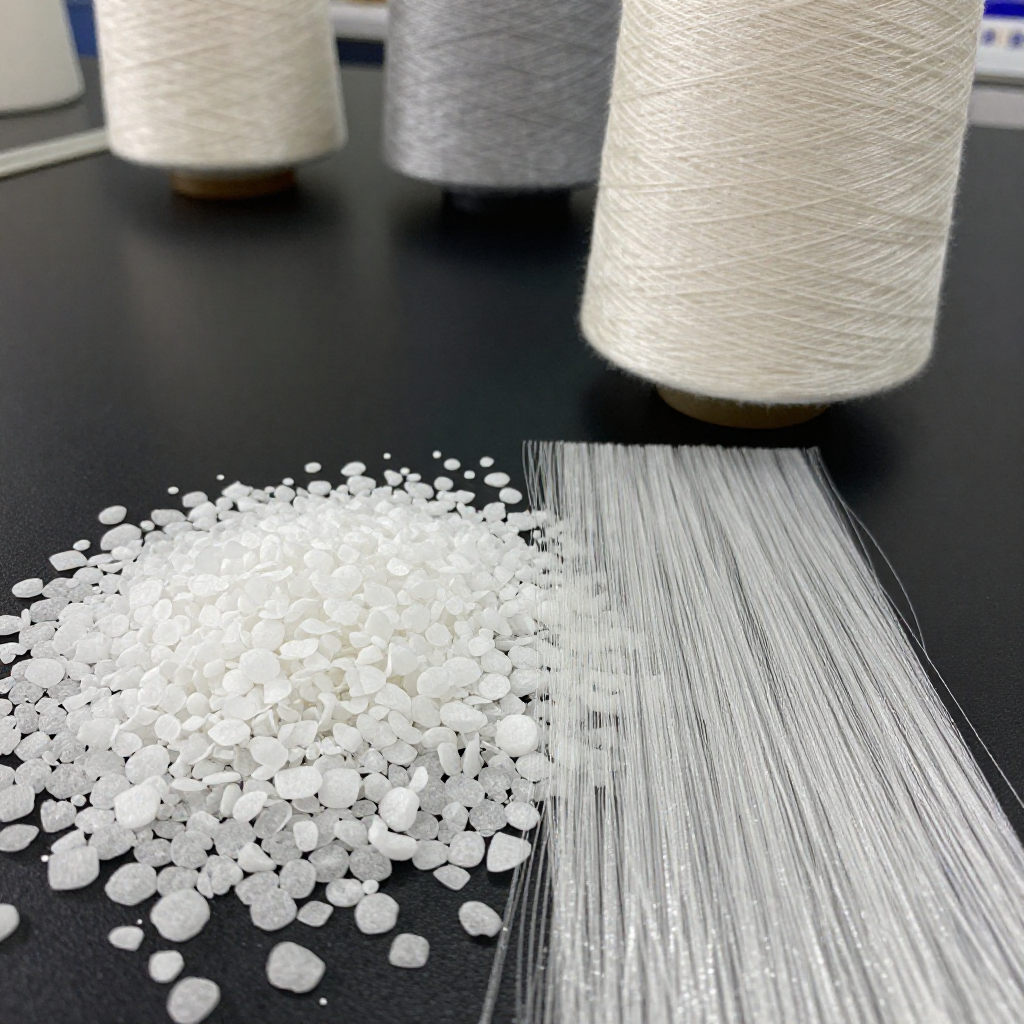


Polyester (PET) — The Fiber That Clothed the World
On March 22, 1941, John Rex Whinfield and James Tennant Dickson, working at the Calico Printers' Association laboratory in Accrington, Lancashire, synthesized polyethylene terephthalate (PET) — the polyester fiber that would become the most produced textile fiber in human history. By 2024, polyester accounts for over 54% of all fiber production worldwide: roughly 60 million tonnes per year, more than cotton, wool, silk, and all other fibers combined.
PET is made from two petrochemical monomers: terephthalic acid (or its ester, dimethyl terephthalate) and ethylene glycol. These react via condensation polymerization to form long chains linked by ester bonds (-COO-), hence 'polyester.' The resulting polymer is melt-spun into fibers, just like nylon — but polyester has properties nylon lacks. It resists stretching (high modulus), holds its shape through washing (dimensional stability), resists wrinkling (elastic recovery), and dries quickly (low moisture absorption at only 0.4%).
Whinfield and Dickson's work built directly on Wallace Carothers' polymer research at DuPont. Carothers had actually synthesized polyesters in the early 1930s but abandoned them as inferior to polyamides (nylon) because his polyesters had low melting points. Whinfield realized that using an aromatic acid (terephthalic acid, with its rigid benzene ring) instead of Carothers' aliphatic acids would raise the melting point above 250°C — high enough for textile use. DuPont licensed the patents and commercialized the fiber as Dacron in 1953; ICI launched it as Terylene in Britain. The wash-and-wear revolution of the 1960s and the global fast-fashion industry both depend on Whinfield's insight.
Àkóónú tó léwu
Blueprint yii ni awọn ilana ti o lewu. Wọle ki o mu akoonu ti o lewu ṣiṣẹ ninu awọn eto akaunti rẹ lati wo awọn itọnisọna igbesẹ-nipasẹ-igbesẹ.
Blueprint tó jọra
Àwọn blueprint wọ̀nyí pín ìmọ̀ — ọ̀nà, ohun-èlò tàbí ìlànà
CC0 Àgbègbè Gbogbogbò
Blueprint yìí ti jáde lábẹ́ CC0. O lè ṣe àdàkọ, yí padà, pín, àti lò láìsí ìyọ̀ǹda.
Ṣàtìlẹ́yìn Olùṣẹ́dá nípa rírà àwọn ọjà nipasẹ̀ Blueprint wọn Ẹ̀san Olùṣẹ́dá tí àwọn Olùtajà gbé kalẹ̀, tàbí ṣẹ̀dá àtúnṣe tuntun ti Blueprint yìí kí o sì fi sínú Blueprint rẹ gẹ́gẹ́ bí ìsopọ̀ láti pín owó-wíwọlé.