IṢẸ́ ỌNÀ
ẸWÀ ÀTI ÌLERA
IṢẸ́ ỌWỌ́
ÀṢÀ ÀTI ÌTÀN
ÌṢERÉ
ÀYÍKÁ
OÚNJẸ ÀTI OHUN MÍMU
REVERSE ENGINEERING
SÁYẸ́ǸSÌ
ERÉ ÌDÁRAYÁ
ÌMỌ̀-Ẹ̀RỌ
ÀWỌN OHUN WÍWỌ̀
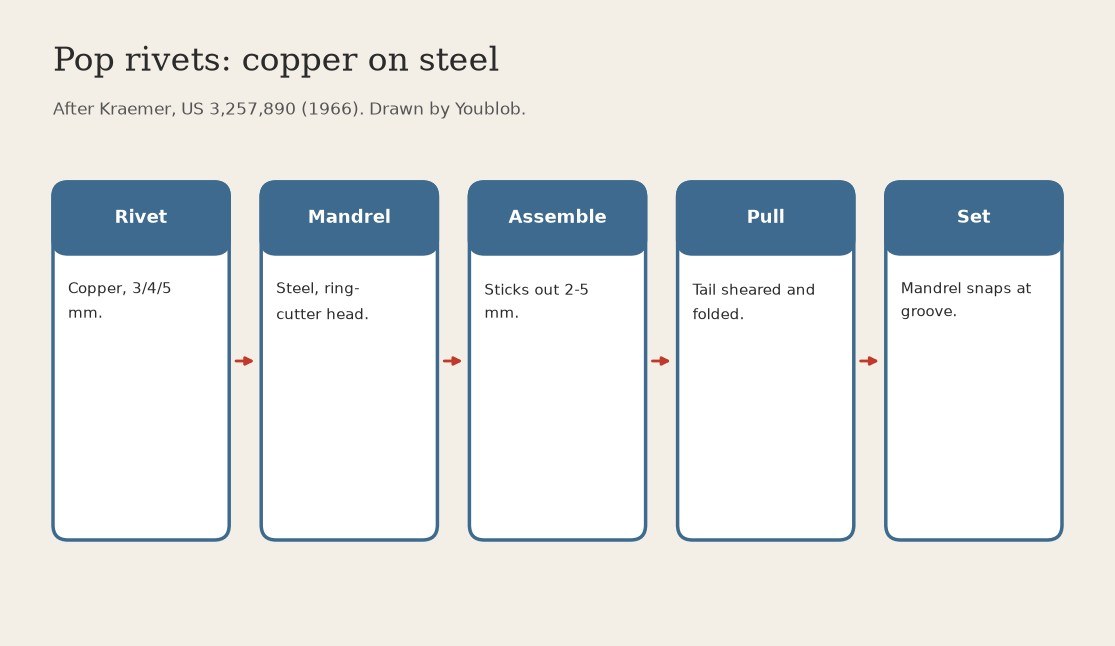


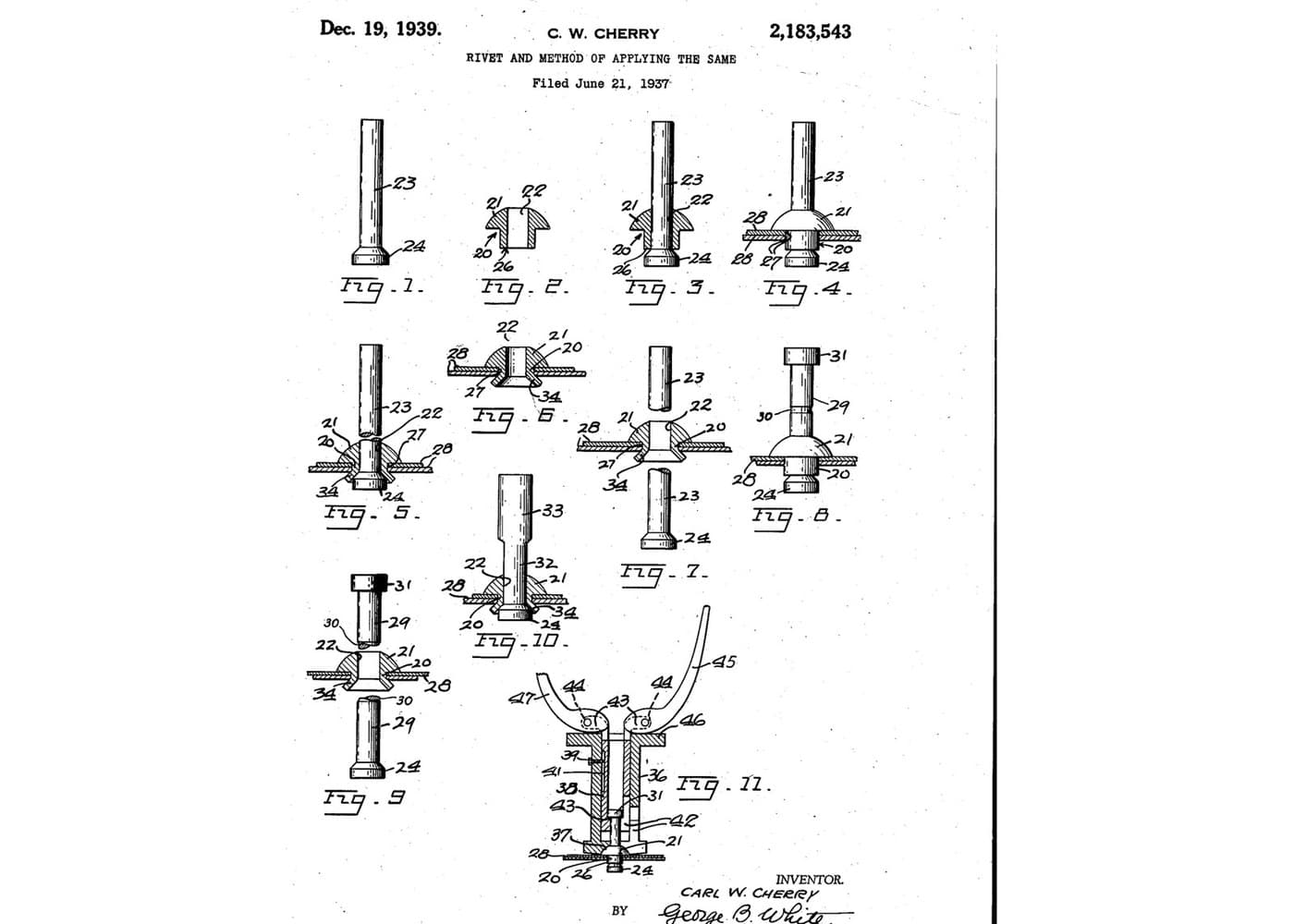
Pop Rivets: Copper Hollow Rivet on a Steel Break Mandrel with a Ring-Cutter Head (Kraemer, US 3,257,890)
A blind rivet set from one side. Kraemer's mandrel head has a sharp ring edge that shears the inner part of the rivet's tail and pushes it into the bore, while the outer part folds round the head. The pull needed is about half, and the set rivet is about as strong in shear as a solid one.
Result: copper pop rivets, 3, 4 or 5 mm, each on its steel mandrel.
Source: Kraemer, US 3,257,890 (1966). His other rivet metals, aluminium-magnesium and 80/20 copper-nickel, are separate compositions. Not given: die design. Picture drawn by Youblob.
Ilọsíwájú
Factory process
Ìlànà
1
1
Stamp the copper rivet
Stamp the copper rivet
Form a hollow rivet with a flange (set head) at one end and a straight bore. Kraemer says the parts can be made e.g. by stamping. Sizes (mm), outside / bore: 5 / 3, 4 / 2.6, 3 / 1.8. Ours: from copper sheet.
Àwọn ohun èlò fún ìgbésẹ̀ yìí:
 Pẹlẹbẹ Bàbà1 as required
Àwọn irinṣẹ́ tí a nílò:
 Ẹ̀rọ ìtẹ̀ àwo irin
2
2
Form the steel mandrel
Form the steel mandrel
Shape a steel mandrel: draw shaft, a groove as the breaking point, a cone tapering up to the bore size, and a near-hemispherical button head. Head edge diameter (mm): 4.3, 3.6, 2.6 for the 5, 4, 3 mm rivets, so it covers 55-70 % of the rivet's end face. Ours: from steel wire.
Àwọn ohun èlò fún ìgbésẹ̀ yìí:
 Okun waya irin1 as required
Àwọn irinṣẹ́ tí a nílò:
Ẹ̀rọ ìtẹ̀ àwo irin3
3
Assemble and size for the work
Assemble and size for the work
Push the mandrel fully into the rivet; it is supplied this way. Pick a length that sticks out past the sheets by 3-5 mm (5 mm rivet), 2.5-3.5 mm (4 mm) or 2-4 mm (3 mm).
Àwọn irinṣẹ́ tí a nílò:
 Ìdìpọ̀ ẹ̀rọ ìso pop rivet
4
4
Set it from one side
Set it from one side
Put the rivet in the hole, grip the draw shaft and press the tool's head on the flange while pulling. The ring edge shears the tail, the rest bulges and folds round the button head, and the mandrel breaks at its groove.
Àwọn irinṣẹ́ tí a nílò:
Ìdìpọ̀ ẹ̀rọ ìso pop rivetÀwọn ohun-èlò
2- 1 as requiredÀyè
- 1 as requiredÀyè
Àwọn irinṣẹ́ tó nílò
2Ìtọ́nisọ́nà yìí ń ṣe

Blueprint tó jọra
Àwọn blueprint wọ̀nyí pín ìmọ̀ — ọ̀nà, ohun-èlò tàbí ìlànà

CC0 Àgbègbè Gbogbogbò
Blueprint yìí ti jáde lábẹ́ CC0. O lè ṣe àdàkọ, yí padà, pín, àti lò láìsí ìyọ̀ǹda.
Ṣàtìlẹ́yìn Olùṣẹ́dá nípa rírà àwọn ọjà nipasẹ̀ Blueprint wọn Ẹ̀san Olùṣẹ́dá tí àwọn Olùtajà gbé kalẹ̀, tàbí ṣẹ̀dá àtúnṣe tuntun ti Blueprint yìí kí o sì fi sínú Blueprint rẹ gẹ́gẹ́ bí ìsopọ̀ láti pín owó-wíwọlé.