IṢẸ́ ỌNÀ
ẸWÀ ÀTI ÌLERA
IṢẸ́ ỌWỌ́
ÀṢÀ ÀTI ÌTÀN
ÌṢERÉ
ÀYÍKÁ
OÚNJẸ ÀTI OHUN MÍMU
REVERSE ENGINEERING
SÁYẸ́ǸSÌ
ERÉ ÌDÁRAYÁ
ÌMỌ̀-Ẹ̀RỌ
ÀWỌN OHUN WÍWỌ̀
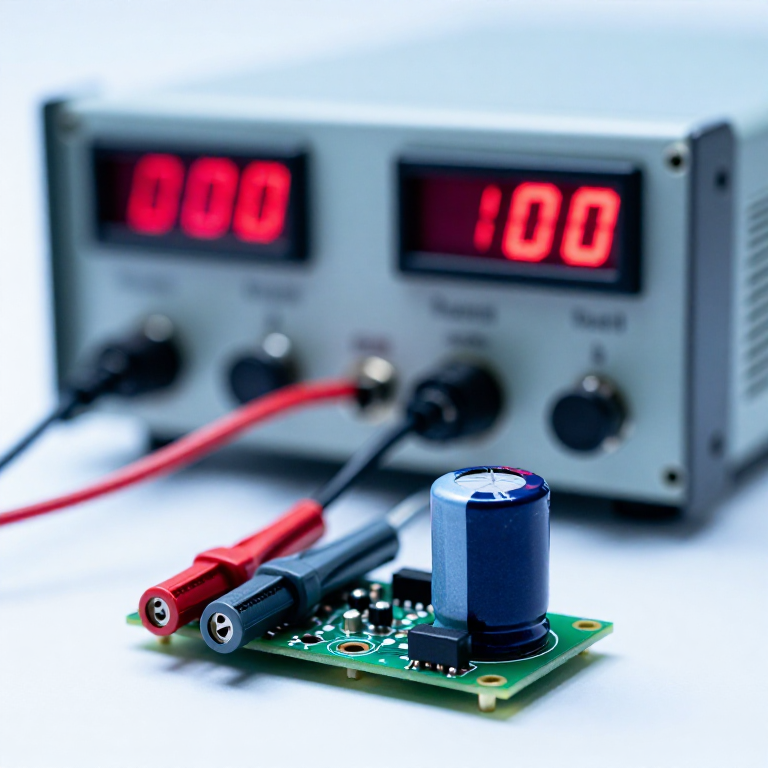


Power: Why It Works on USB and Dies on a Battery
A circuit that works on the bench and misbehaves on batteries is not haunted. It is almost always one of three things: the supply cannot deliver the current, the wiring drops too much voltage on the way, or nothing is smoothing the moment a load switches on.
The symptoms are strange enough to look like software faults — a microcontroller that resets whenever a motor starts, a display that flickers on a keypress, a circuit that is fine until the battery is half used. All three are power.
Which makes power the last rung of this ladder: it is what remains after the joint is sound, the meter is understood, and the fault-finding has ruled out the obvious.
Àárín
3 hours
Ìlànà
1
1
A supply has an internal resistance, and so does a battery
A supply has an internal resistance, and so does a battery
Ń ṣí ìwé Jupyter…
Àwọn irinṣẹ́ tí a nílò:
 Ìpèsè Agbára Tábìlì
 Òǹwọ̀n iná mànàmáná onírúurú
 Ẹ̀rọ Ìṣirò
2
2
Decoupling: the small capacitor next to every chip
Decoupling: the small capacitor next to every chip
Put a 100 nF ceramic capacitor between the supply and ground pins of every integrated circuit, as physically close to the pins as you can manage.
A digital chip draws current in sharp spikes every time its outputs switch. The supply wiring has inductance and cannot deliver a spike quickly, so the local voltage dips — and the chip sees its own supply flicker. The decoupling capacitor is a tiny local reservoir that supplies the spike from millimetres away instead of from the far end of the board.
This is why it must be CLOSE. A decoupling capacitor at the other end of the board is connected through the very inductance it exists to bypass, and does almost nothing. It is the most-omitted component in beginner circuits and the cause of a great deal of unexplained flakiness.
Àwọn ohun èlò fún ìgbésẹ̀ yìí:
 Àkójọpọ̀ Capacitor1 ẹyọ
Àwọn irinṣẹ́ tí a nílò:
 Pátákó Àdánwò
 Òsílóskóòpù
3
3
Bulk capacitance for the things that gulp
Bulk capacitance for the things that gulp
Add a larger electrolytic — a few hundred microfarads — near anything that switches a heavy load: a motor, a relay, a string of LEDs, a servo.
Decoupling handles nanosecond spikes; this handles millisecond gulps. The bulk capacitor charges gently between events and hands the charge over quickly when the load switches, so the rail stays up and the processor survives the motor start.
Mind the polarity — electrolytics are marked with a stripe on the negative side and fitted backwards they heat, swell and eventually vent. That is the single most common way a beginner destroys a component, and the visual check in the fault-finding rung exists largely because of it.
Àwọn ohun èlò fún ìgbésẹ̀ yìí:
Àkójọpọ̀ Capacitor1 ẹyọÀwọn irinṣẹ́ tí a nílò:
Pátákó ÀdánwòÒǹwọ̀n iná mànàmáná onírúurú Dígí Ìgbéga
4
4
Give the motor its own path back
Give the motor its own path back
Run the motor's supply and ground as their own pair of wires back to the source, rather than letting the motor current share the thin wire your sensitive circuit uses for ground.
Ground is not a perfect conductor. An amp flowing down a wire with a tenth of an ohm of resistance lifts one end a hundred millivolts above the other — so the logic's idea of 'zero volts' moves whenever the motor draws current. That shifts every signal referenced to it, which is why an analogue reading wanders exactly when the motor runs.
Joining the two grounds at ONE point near the supply — rather than daisy-chaining through the motor — keeps the noisy current out of the quiet circuit's reference. That is the whole idea behind a star ground, and it is free.
Àwọn irinṣẹ́ tí a nílò:
Ìpèsè Agbára TábìlìÒǹwọ̀n iná mànàmáná onírúurú Ẹ̀mú ìbóhun
5
5
Measure the sag yourself
Measure the sag yourself
Put the meter across the supply rail AT the circuit and watch it while the load switches on. A meter is slow, so it will understate a brief dip — but a visible drop on a slow instrument means a much deeper one in reality.
An oscilloscope shows the true shape: how far the rail falls, how long it takes to recover, and whether the decoupling is doing anything. If you have one, this is the measurement that turns 'it randomly resets' into a number.
Then add the bulk capacitor and measure again. Seeing the dip shrink is the most convincing argument for decoupling anyone ever gets, and it takes five minutes.
Àwọn ohun èlò fún ìgbésẹ̀ yìí:
Àkójọpọ̀ Capacitor1 ẹyọÀwọn irinṣẹ́ tí a nílò:
Òǹwọ̀n iná mànàmáná onírúurúÒsílóskóòpùÌpèsè Agbára TábìlìBlueprint tó jọra
Àwọn blueprint wọ̀nyí pín ìmọ̀ — ọ̀nà, ohun-èlò tàbí ìlànà

CC0 Àgbègbè Gbogbogbò
Blueprint yìí ti jáde lábẹ́ CC0. O lè ṣe àdàkọ, yí padà, pín, àti lò láìsí ìyọ̀ǹda.
Ṣàtìlẹ́yìn Olùṣẹ́dá nípa rírà àwọn ọjà nipasẹ̀ Blueprint wọn Ẹ̀san Olùṣẹ́dá tí àwọn Olùtajà gbé kalẹ̀, tàbí ṣẹ̀dá àtúnṣe tuntun ti Blueprint yìí kí o sì fi sínú Blueprint rẹ gẹ́gẹ́ bí ìsopọ̀ láti pín owó-wíwọlé.