IṢẸ́ ỌNÀ
ẸWÀ ÀTI ÌLERA
IṢẸ́ ỌWỌ́
ÀṢÀ ÀTI ÌTÀN
ÌṢERÉ
ÀYÍKÁ
OÚNJẸ ÀTI OHUN MÍMU
REVERSE ENGINEERING
SÁYẸ́ǸSÌ
ERÉ ÌDÁRAYÁ
ÌMỌ̀-Ẹ̀RỌ
ÀWỌN OHUN WÍWỌ̀
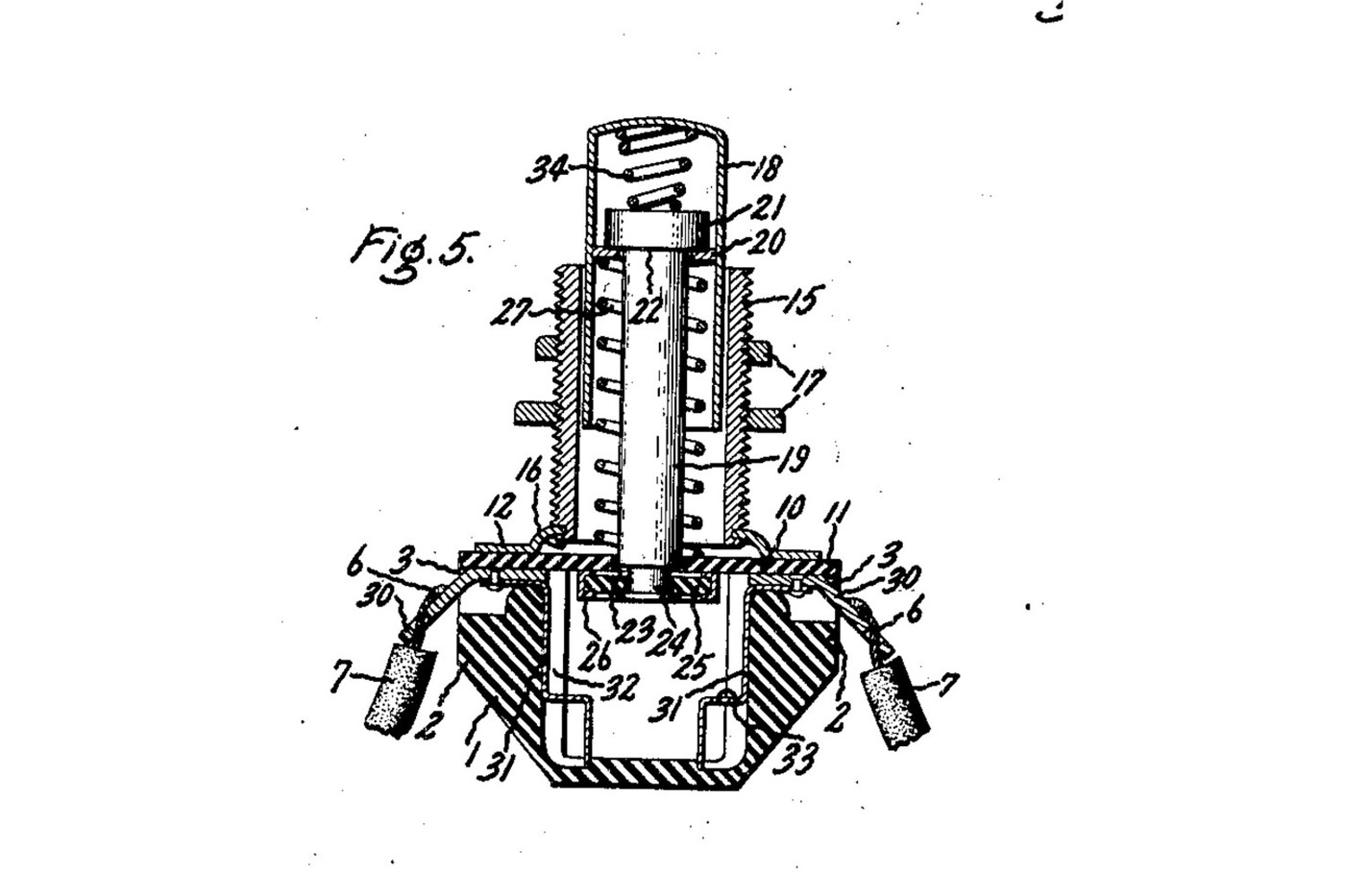

Push Button: Normally Open Momentary Switch with a Cushioned Contact (De Reamer, GE 1939)
A panel push button that closes a circuit only while you press it. A spring holds the button out, and a metal rim on the end of its rod sits clear of two contacts. Press it and the rim bridges both contacts. A second spring inside the button lets the rod give, so the contacts never take more than that spring's force.
Source: Frank C. De Reamer, US 2,166,803 (General Electric, 1939), Fig. 5. Unknown: the insulating material, the metals and every size. De Reamer gives none of them, so they are linked to unknown heads. The tools are ours. Picture: the patent's Fig. 5.
Ilọsíwájú
2 days
Ìlànà
1
1
Mould the housing
Mould the housing
Mould a cup-shaped housing of insulating material, with a boss on each of two opposite sides, a recess in the top of each boss, a groove inside below each boss, and a bead round the top. Unknown: the material, the sizes and the moulding.
Àwọn ohun èlò fún ìgbésẹ̀ yìí:
 Ohun ìdènà iná tí a kò mọ̀1 as required
Àwọn irinṣẹ́ tí a nílò:
 Àwòṣe ìtẹ̀mọ́lẹ̀
 Ìwọ̀n tí a kò mọ̀
2
2
Make the terminals and contacts
Make the terminals and contacts
Bend two angled metal strips. The upper end of each sits in a boss recess, and the lower end is a solder lug. Fix each upper end to a contact that fits the groove inside the housing, stepped at its bottom end. Unknown: the metal.
Àwọn ohun èlò fún ìgbésẹ̀ yìí:
 Irin tí a kò mọ̀1 as required
Àwọn irinṣẹ́ tí a nílò:
 Ìlàǹkàn irin
 Ẹmú Ẹnu PẹrẹsẹÌwọ̀n tí a kò mọ̀
3
3
Make the sleeve, plate and cover
Make the sleeve, plate and cover
Turn a threaded sleeve and cut its thread. Spin its lower end over onto a metal plate with tangs. Cut a cover of insulating sheet with ears that reach over the bosses and a hole in the middle to guide the rod.
Àwọn ohun èlò fún ìgbésẹ̀ yìí:
Irin tí a kò mọ̀1 as requiredOhun ìdènà iná tí a kò mọ̀1 as requiredÀwọn irinṣẹ́ tí a nílò:
 Ẹ̀rọ Ìyí Irin
 Àpò ohun èlò lathe (HSS)
 Ìdìmú ihá òdeÌlàǹkàn irin
 Kálípà FáníàÌwọ̀n tí a kò mọ̀
4
4
Make the push button
Make the push button
Make a drawn metal tube closed at the top, and a rod with a head. Put a small coil spring in the top of the tube, then the rod's head. Wedge a washer into the tube under the head. Leave clearance so the rod can swivel a little. Turn the rod's lower end down to a smaller diameter. Unknown: the metal.
Àwọn ohun èlò fún ìgbésẹ̀ yìí:
Irin tí a kò mọ̀1 as required Àkójọ Ìsúnkì Ìtẹ̀1 spring
Àwọn irinṣẹ́ tí a nílò:
Ẹ̀rọ Ìyí IrinÀpò ohun èlò lathe (HSS)Kálípà FáníàÌwọ̀n tí a kò mọ̀5
5
Assemble
Assemble
Set the terminals in their recesses and the contacts in their grooves. Slide the button into the sleeve, with a coil spring round the rod between the cover and the wedged washer. Pass the rod's end through the cover's hole. Put on it a loose insulating washer with a metal rim round its edge. Hammer the rod's end over into a flange. Lay the cover on the housing, so its ears clamp the terminals, and bend the plate's tangs over the bead.
Àwọn ohun èlò fún ìgbésẹ̀ yìí:
Ohun ìdènà iná tí a kò mọ̀1 as requiredIrin tí a kò mọ̀1 as requiredÀkójọ Ìsúnkì Ìtẹ̀1 springÀwọn irinṣẹ́ tí a nílò:
 Ìdìmú Tábìlì
 Òòlù olórí bọ́ọ̀lùẸmú Ẹnu Pẹrẹsẹ
 Gíláàsì ààbò
6
6
Mount and wire it
Mount and wire it
Put the sleeve through a hole in the panel and clamp the panel between two nuts on the thread. Solder the bared wire ends to the two lugs.
Àwọn ohun èlò fún ìgbésẹ̀ yìí:
 Nọ́ọ̀tì Onígun Mẹ́fà2 pcs
 Wáyà Sọ́ldà1 as required
Àwọn irinṣẹ́ tí a nílò:
 Irin ìsúdìẸmú Ẹnu Pẹrẹsẹ
7
7
Check it
Check it
At rest, the rim sits against the underside of the cover and the circuit is open. Pressed, the rim meets the stepped ends of both contacts and closes it. The checking is ours: the meter reads open, then closed while pressed.
Àwọn irinṣẹ́ tí a nílò:
 Òǹwọ̀n iná mànàmáná onírúurú
Àwọn ohun-èlò
5- 1 as requiredÀyè
- 1 as requiredÀyè
- 1 springÀyè
- 2 pcsÀyè
- 1 as requiredÀyè
Àwọn irinṣẹ́ tó nílò
13- Àyè
- Àyè
- Àyè
- Àyè
- 2 vendors sell this, none ship to you yetÀyè
Ìtọ́nisọ́nà yìí ń ṣe
Blueprint tó jọra
Àwọn blueprint wọ̀nyí pín ìmọ̀ — ọ̀nà, ohun-èlò tàbí ìlànà

CC0 Àgbègbè Gbogbogbò
Blueprint yìí ti jáde lábẹ́ CC0. O lè ṣe àdàkọ, yí padà, pín, àti lò láìsí ìyọ̀ǹda.
Ṣàtìlẹ́yìn Olùṣẹ́dá nípa rírà àwọn ọjà nipasẹ̀ Blueprint wọn Ẹ̀san Olùṣẹ́dá tí àwọn Olùtajà gbé kalẹ̀, tàbí ṣẹ̀dá àtúnṣe tuntun ti Blueprint yìí kí o sì fi sínú Blueprint rẹ gẹ́gẹ́ bí ìsopọ̀ láti pín owó-wíwọlé.