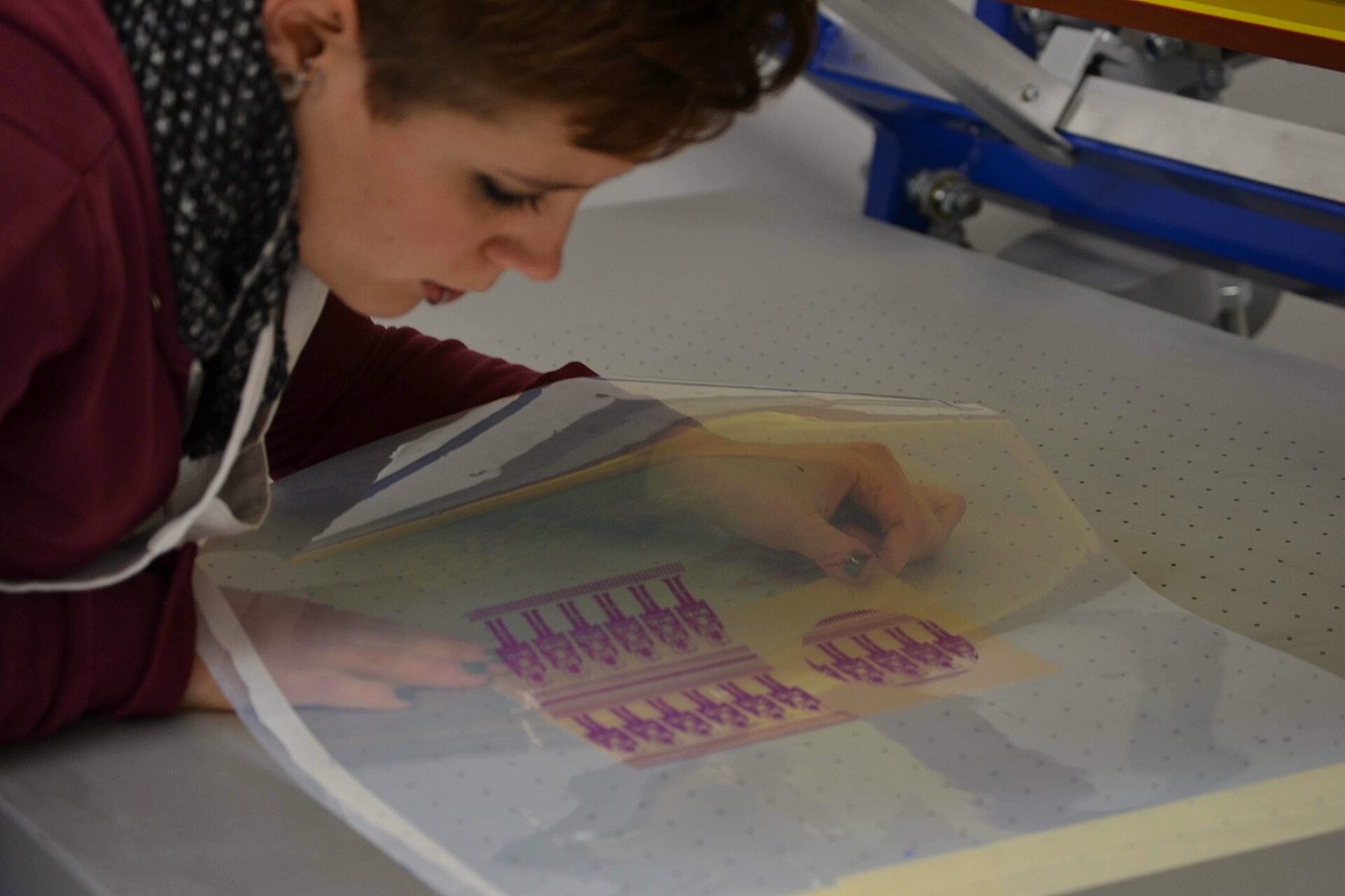


Screen Printing
A stencil is the oldest printing idea there is — cut a hole, push colour through it. It has one fatal flaw that no amount of care fixes: an island cannot float. Cut the letter O and the middle falls out. Cut a ring and you lose the disc inside it. Every enclosed shape needs a bridge to hold its centre in place, which is why traditional stencil lettering has those little gaps in it.
Screen printing solves this by putting the stencil on a mesh. The fabric holds every part of the stencil in position — islands included — while remaining open enough for ink to pass through the weave. The bridges become invisible because the mesh is the bridge, everywhere at once.
Once the stencil can be any shape, the rest follows. A squeegee drags ink across the screen, forcing it through the open mesh and shearing it off cleanly at the edge of the blocked areas. The screen is held a whisker above the surface — the off-contact gap — so it peels away behind the squeegee instead of sticking down and smearing.
The ink is laid on top of the surface rather than pressed into it, and it can be laid thickly. That is why screen printing works on fabric, glass, plastic, metal and wood while every process so far in this batch needs paper.
Ìlànà
Meet the floating island problem
Meet the floating island problem
Cut the letters O, A and B out of card as a stencil and try to use it.
Expect the centres to fall out immediately.
Now solve it the traditional way, by leaving bridges, and print the result.
Record what the bridges cost you: the letterforms are broken, and the design is now constrained by structure rather than by intent.
Everything screen printing does follows from removing this constraint, so it is worth feeling it properly before you dissolve it.
Stretch a mesh and find out why tension matters
Stretch a mesh and find out why tension matters
Stretch fine fabric — polyester or silk — over a rigid frame as tightly as you can, and staple or glue it. Make a second, deliberately slack.
Tap each: a good screen sounds like a drum.
Print through both.
Expect the slack screen to give blurred, doubled edges, because it stretches ahead of the squeegee and lands in a different place than where the stencil sits.
Tension is not tidiness. A screen that moves relative to the work cannot register, and no stencil quality compensates.
Àwọn ohun èlò fún ìgbésẹ̀ yìí:
 Tééṣì twill òwú1 m
Block the mesh, and let islands float
Block the mesh, and let islands float
Block out your design on the mesh — paper stencil, drawing fluid and filler, or photo emulsion exposed under a light through a positive.
Now cut that same O from step 1.
Expect the centre of the O to stay exactly where it belongs, supported by the mesh, with no bridges at all.
Hold the screen up to the light and look at what you have made: a map of open and closed threads. The image is no longer a hole in something — it is a pattern of permeability, which is why it can be any shape whatsoever.
Set the off-contact gap and watch it decide the edge
Set the off-contact gap and watch it decide the edge
Print once with the screen resting flat on the surface, then again with it raised a few millimetres on shims.
Expect the flat-contact print to smear as the wet mesh drags, and the raised one to be sharp.
Watch the screen as the squeegee passes: it should touch only along the squeegee line and snap back up immediately behind it.
That peeling action is what separates the mesh from the wet ink without dragging it. Too little gap and it sticks; too much and the squeegee has to press hard enough to distort the image.
Vary the mesh count and see ink thickness change
Vary the mesh count and see ink thickness change
Print the same design through a coarse mesh and a fine one, and compare the deposit — scratch each with a fingernail once dry, and hold both to the light.
Expect the coarse mesh to lay down a much thicker, more opaque film, and the fine mesh to hold finer detail but less ink.
This is the trade that governs every screen job: opacity against detail. It is why a bold white on a black shirt uses a coarse mesh and a fine halftone uses a fine one, and why printing light ink on dark fabric often needs two passes with a flash-dry between.
History & Context
History & Context
The mesh is the old part. Stencilling through fabric goes back a long way in Japan and China, where katazome stencils were held together by fine silk threads or human hair — solving the floating-island problem centuries before anyone framed a screen. The industrial version arrived in the West in the early twentieth century, and the name silkscreen records the original mesh material.
Photo emulsion changed what could be on the screen. Once a stencil could be made by exposing a light-sensitive coating through a photographic positive, screens could carry photographs, fine type and halftones instead of hand-cut shapes. It is the same manoeuvre as photographic platemaking in offset and photoresist in circuit boards — light defines the mask, so the image no longer has to be made by hand.
It prints on things, not just paper. Thick ink laid on the surface, a frame that can sit over a curved or awkward object, and no press pressure to speak of. Hence: T-shirts, circuit boards, control panel legends, bottles, road signs, membrane switches, and the conductive tracks and electrodes inside batteries and solar cells. Andy Warhol's use of it was almost incidental to an industry that mostly prints things you do not think of as printed.
Colour by repetition, again. Like chromolithography, each colour is a separate screen, registered to the last. Because the ink is opaque, colours can be printed light-over-dark, which lithography and offset — with their transparent inks — cannot do. That is why screen printing owns dark fabric.
Honest limits. Slow per impression and awkward to automate compared with offset, so it loses badly on long runs of paper. Fine detail and subtle gradients are hard, limited by the mesh itself. Screens must be reclaimed with solvents or strong chemicals, which is a real waste-handling responsibility. And the thick ink film that makes it strong also makes it stiff — a heavy screen print on fabric is a plastic patch that cracks with age, which is why water-based and discharge inks exist despite being harder to use.
Àwọn ohun-èlò
5- Àyè
- 2 lítàÀyè
- 100 mlÀyè
- 1 àkópọ̀Àyè
- 25 ewéÀyè
Àwọn irinṣẹ́ tó nílò
1Àwọn Ohun Èlò Ìtọ́nisọ́nà Tí A So Pọ̀

Blueprint tó jọra
Àwọn blueprint wọ̀nyí pín ìmọ̀ — ọ̀nà, ohun-èlò tàbí ìlànà

CC0 Àgbègbè Gbogbogbò
Blueprint yìí ti jáde lábẹ́ CC0. O lè ṣe àdàkọ, yí padà, pín, àti lò láìsí ìyọ̀ǹda.
Ṣàtìlẹ́yìn Olùṣẹ́dá nípa rírà àwọn ọjà nipasẹ̀ Blueprint wọn Ẹ̀san Olùṣẹ́dá tí àwọn Olùtajà gbé kalẹ̀, tàbí ṣẹ̀dá àtúnṣe tuntun ti Blueprint yìí kí o sì fi sínú Blueprint rẹ gẹ́gẹ́ bí ìsopọ̀ láti pín owó-wíwọlé.