IṢẸ́ ỌNÀ
ẸWÀ ÀTI ÌLERA
IṢẸ́ ỌWỌ́
ÀṢÀ ÀTI ÌTÀN
ÌṢERÉ
ÀYÍKÁ
OÚNJẸ ÀTI OHUN MÍMU
REVERSE ENGINEERING
SÁYẸ́ǸSÌ
ERÉ ÌDÁRAYÁ
ÌMỌ̀-Ẹ̀RỌ
ÀWỌN OHUN WÍWỌ̀


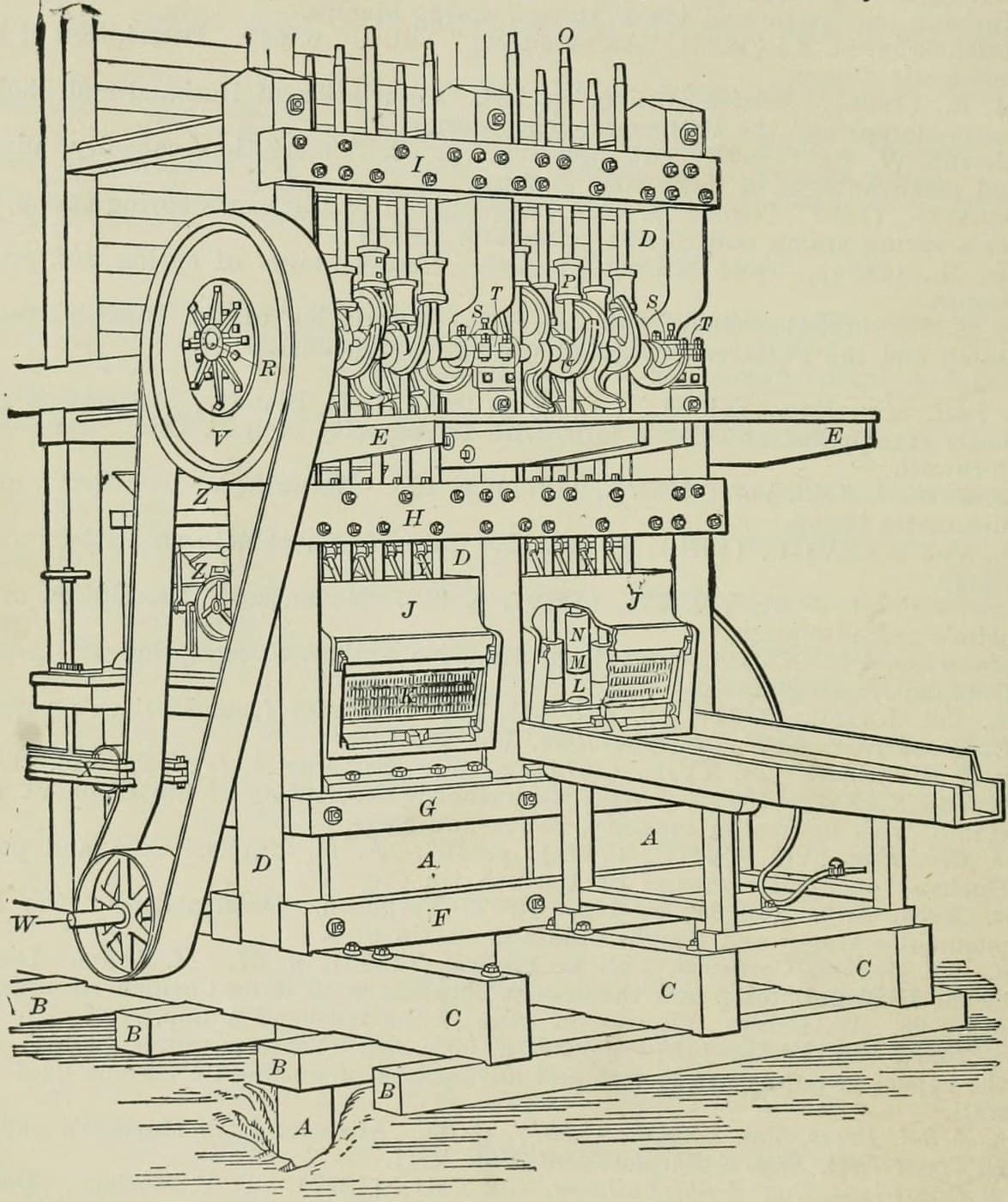
Ore Crushing Rolls: Hard Shells on Soft Iron Cores, One Roll in Spring-Loaded Boxes, Gap Set by Shims (Richards, Ore Dressing, 1903)
The crushing rolls that took ore from the jaw breaker in a 1900s mill, as Robert Richards described them: two shafts on one cast-iron frame, each carrying a soft-iron core with a replaceable hard shell; one runs in fixed boxes, the other in movable boxes pushed toward it by a nest of steel springs that yields like a safety valve; shims set the gap. Little fines, ideal for soft brittle ores.
Ilọsíwájú
Weeks (castings and machining)
Ìlànà
1
1
His figures
His figures
Ń ṣí ìwé Jupyter…
2
2
Read Richards
Read Richards
"The ore is therefore broken by compression."
3
3
Frame and shafts
Frame and shafts
Cast the frame as one piece, both sides joined by end pieces, so settling of the building can't throw the shafts out of line (make it in two parts only if it must travel by mule). Turn two shafts of mild steel or wrought iron, each on two bearings.
Àwọn ohun èlò fún ìgbésẹ̀ yìí:
 Àwọn ohun irin dídà1 ẹyọ
 Ọ̀pá irin agbéǹkẹ́kẹ́1 ẹyọ
Àwọn irinṣẹ́ tí a nílò:
 Ṣíbí gígùn fún irin yíyọ́
 Ẹ̀rọ Ìyí Irin
 Kẹ̀kẹ́ okùn alápapọ̀
4
4
Cores and shells
Cores and shells
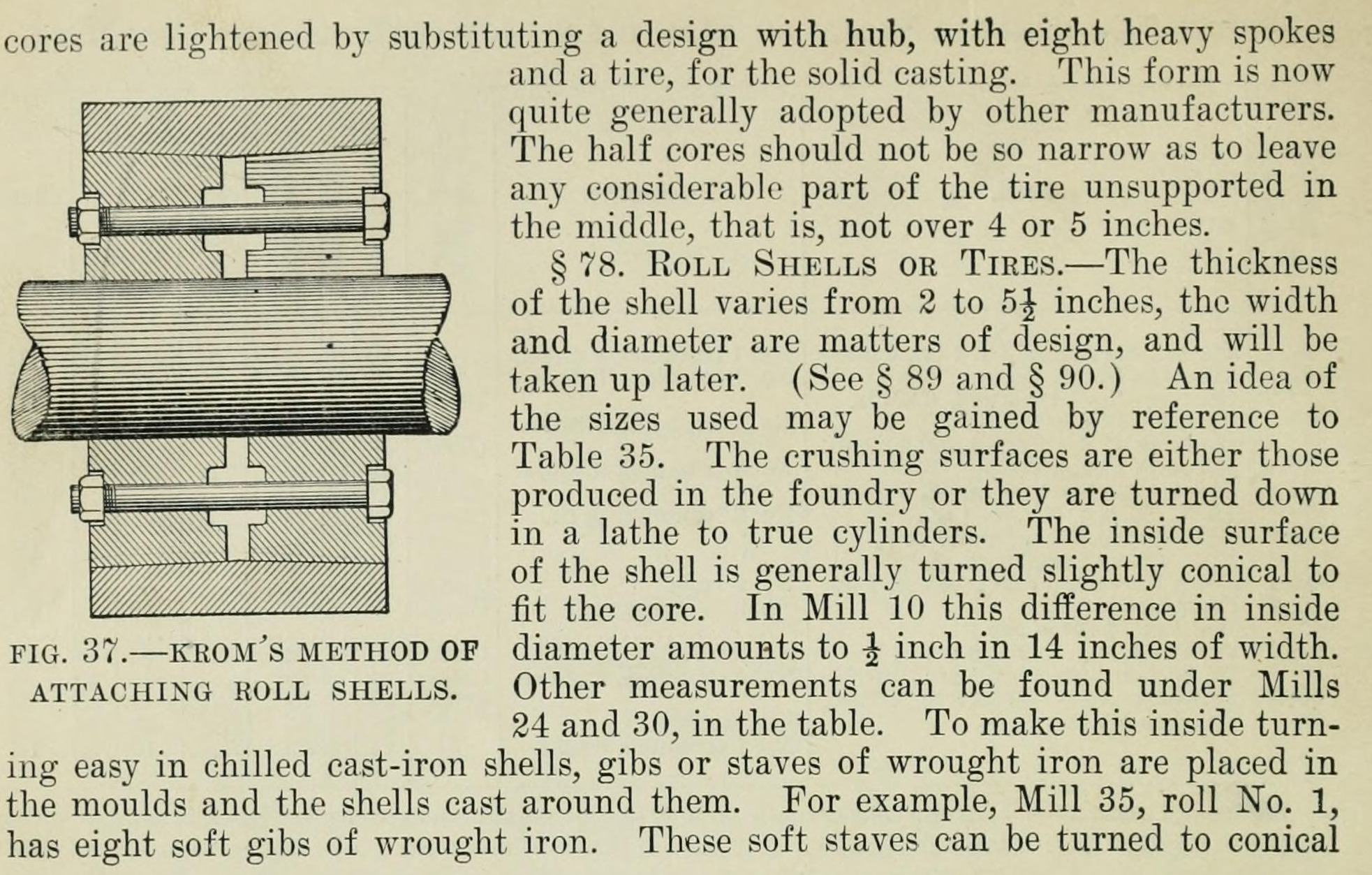
Force a soft cast-iron core onto each shaft. Krom's way (Fig. 37): two slightly conical half-cores, one shrunk on for good, the other split on one side and drawn in by four draw bolts; half-cores no wider than 4-5 in. Cast hard shells 2-5½ in. thick (chilled iron or steel), with wrought-iron staves cast in if chilled so the slightly conical inside can be turned to fit; turn the face true.
Àwọn ohun èlò fún ìgbésẹ̀ yìí:
Àwọn ohun irin dídà1 ẹyọ Ọ̀pá irin lílù1 ẹyọ
 Àkójọ bọ́ọ̀lù onígun mẹ́fà1 ẹyọ
Àwọn irinṣẹ́ tí a nílò:
Ẹ̀rọ Ìyí IrinṢíbí gígùn fún irin yíyọ́5
5
Boxes, springs and shims
Boxes, springs and shims
Mount one shaft in fixed boxes and the other in movable ones, both babbitted, with shields and a cotton-waste groove against grit. Put a nest of steel spiral springs outside the fixed pillow block, with bolts carrying the force to the movable box, equal on both sides, compressed between plates by two compression bolts. Set the gap with shims and keep them in: the springs should only give when a hard lump comes through.
Àwọn ohun èlò fún ìgbésẹ̀ yìí:
 Coil Spring1 ẹyọ
 Irin tí a kò mọ̀1 ẹyọÀkójọ bọ́ọ̀lù onígun mẹ́fà1 ẹyọÀwọn ohun irin dídà1 ẹyọ
Àwọn irinṣẹ́ tí a nílò:
 Àkójọ ẹ̀rọ ìgbáradìẸ̀rọ Ìyí Irin
6
6
Drive and run
Drive and run
Drive by belt and pulley (or gears and pulleys for slow coarse work). Feed lumps no bigger than about 1½ in. (4 cm), 2½ in. at most, evenly with a feeder so a rush of ore does not choke it.
Àwọn ohun èlò fún ìgbésẹ̀ yìí:
 Kẹ̀kẹ́ okùn1 ẹyọ
 Bẹ́líìtì ìwakọ̀1 ẹyọ
Àwọn irinṣẹ́ tí a nílò:
Àkójọ ẹ̀rọ ìgbáradì7
7
Troubleshooting
Troubleshooting
Crushing rolls troubleshooting.
Flow
Loading...
8
8
History and honest limits
History and honest limits
From Robert H. Richards, *Ore Dressing* vol. I (1903), Chapter III, §§ 71-85, pp. 62-74, Fig. 37 and Tables 34-39 (checked on the archive.org scan oredressing01richuoft; p. 62 from its text layer). Rubber springs were the cheap short-life option; levers and weights had nearly gone out of use. Richards surveys machines from many makers rather than one design: building from castings, the size and metric are ours, and the babbitt alloy has no head yet.
Àwọn ohun-èlò
8- 1 ẹyọÀyè
- Àyè
- 1 ẹyọÀyè
- Àyè
- 1 ẹyọÀyè
- 1 ẹyọÀyè
- 1 ẹyọÀyè
- 1 ẹyọÀyè
Àwọn irinṣẹ́ tó nílò
4Ìtọ́nisọ́nà yìí ń ṣe
Blueprint tó jọra
Àwọn blueprint wọ̀nyí pín ìmọ̀ — ọ̀nà, ohun-èlò tàbí ìlànà

CC0 Àgbègbè Gbogbogbò
Blueprint yìí ti jáde lábẹ́ CC0. O lè ṣe àdàkọ, yí padà, pín, àti lò láìsí ìyọ̀ǹda.
Ṣàtìlẹ́yìn Olùṣẹ́dá nípa rírà àwọn ọjà nipasẹ̀ Blueprint wọn Ẹ̀san Olùṣẹ́dá tí àwọn Olùtajà gbé kalẹ̀, tàbí ṣẹ̀dá àtúnṣe tuntun ti Blueprint yìí kí o sì fi sínú Blueprint rẹ gẹ́gẹ́ bí ìsopọ̀ láti pín owó-wíwọlé.