

Pocket Micrometer
Palmer showed in 1848 that a screw could read a thousandth. Forty years later the problem was no longer can it be read but do two different machinists get the same number. They did not, because each squeezed the work differently.
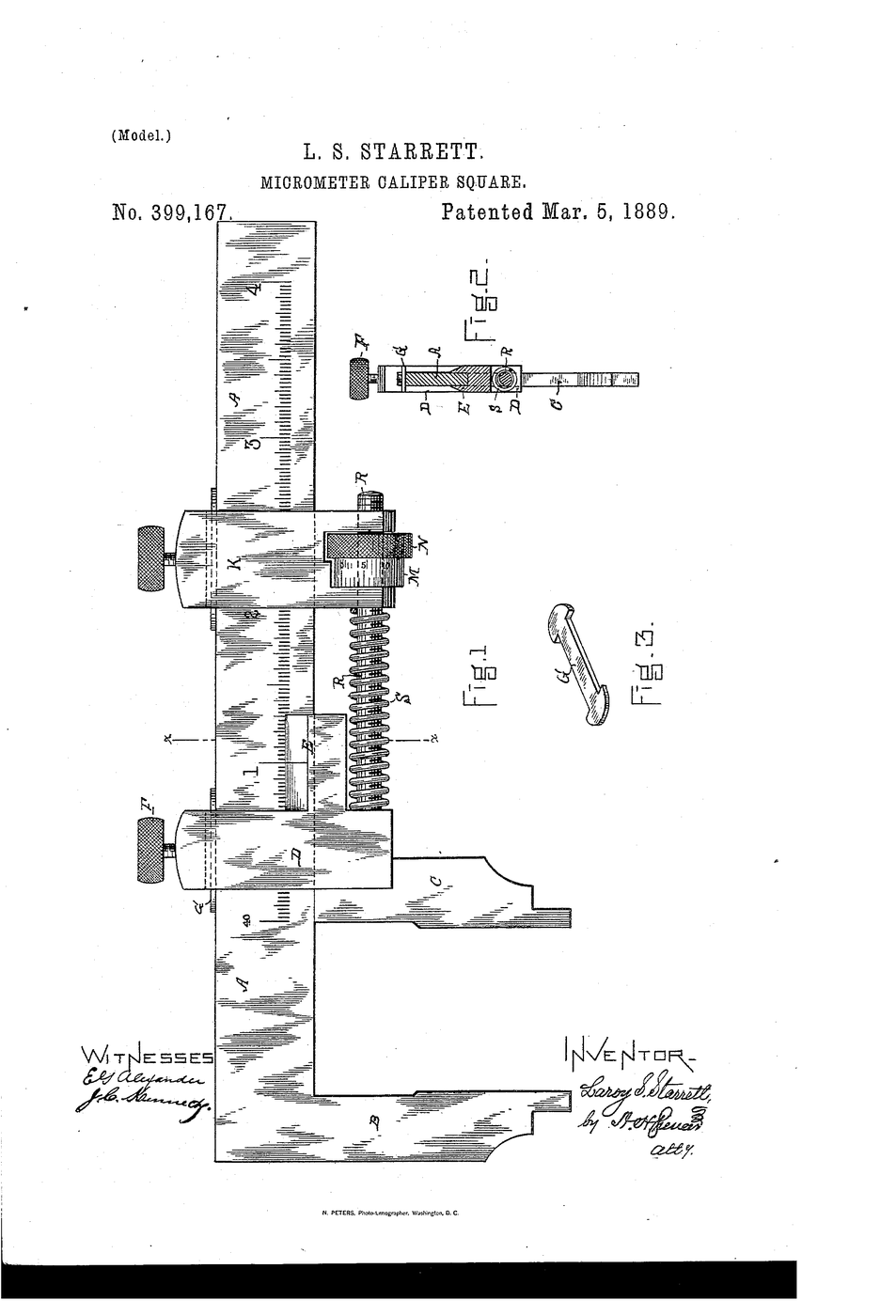
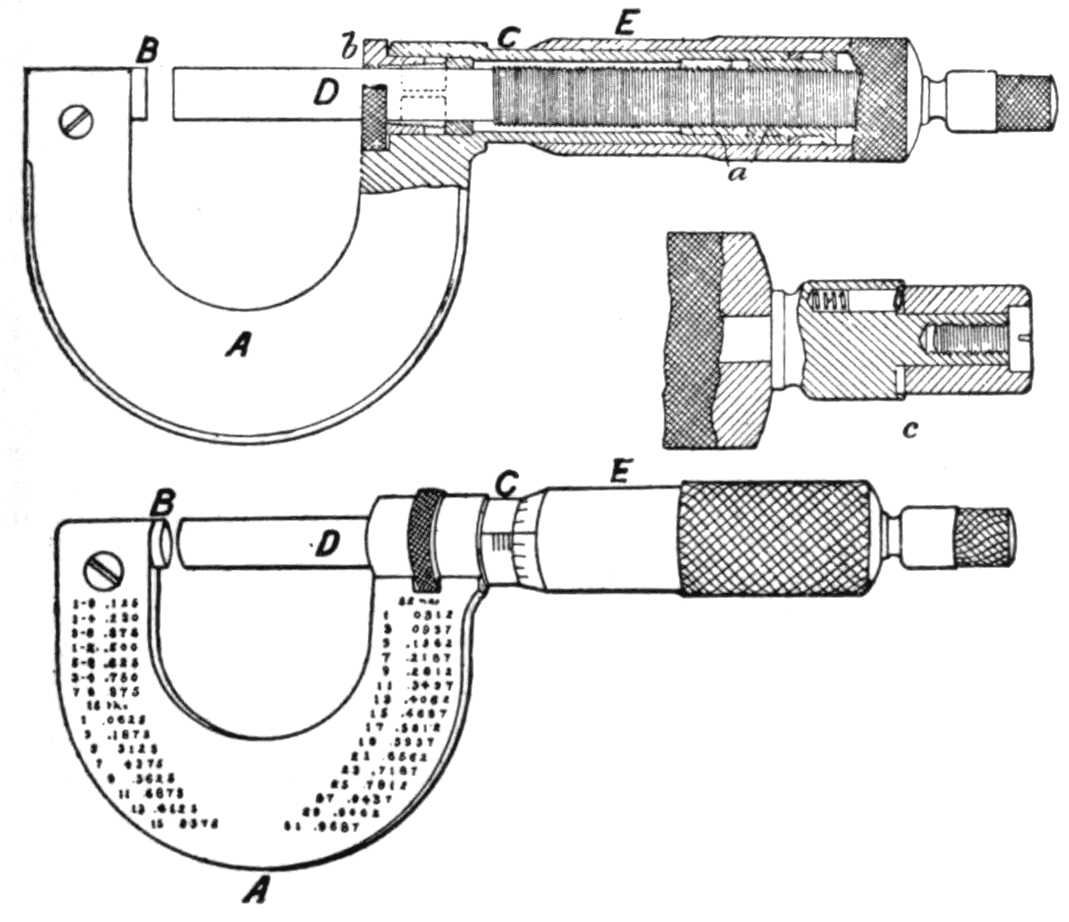
US 399,167, “Micrometer Caliper-Square”, Laroy S. Starrett of Athol, Massachusetts, filed 1 February 1888 and granted 5 March 1889. The patent combines a graduated beam with a micrometer-adjusted jaw — but the sentence that matters is the spiral spring which, in Starrett's words, “takes up all backlash and limits the force with which the movable jaw is pressed by the nut against the work”.
Constant measuring force. That is the invention. A measurement that depends on the strength of the hand holding the tool is not a measurement, it is an opinion.
Ìlànà
Read the claim before you build
Read the claim before you build
Starrett claims a spring that limits force and removes backlash. Write down why a measurement that varies with grip strength is worthless on a production line.
Measure a foil sheet gently
Measure a foil sheet gently
Measure one foil sheet with the micrometer, closing until you just feel contact. Record it.
Àwọn ohun èlò fún ìgbésẹ̀ yìí:
 Bébà Alumíníọ̀mù1 ewé
Àwọn irinṣẹ́ tí a nílò:
 Máíkírómítà
Measure the same sheet hard
Measure the same sheet hard
Measure the same spot again, squeezing firmly. Record. The two numbers differ — on the same sheet, with the same instrument.
Àwọn ohun èlò fún ìgbésẹ̀ yìí:
Bébà Alumíníọ̀mù1 ewéÀwọn irinṣẹ́ tí a nílò:
MáíkírómítàQuantify the grip error
Quantify the grip error
Subtract. That difference is pure operator error, and it is often larger than the tolerance you are trying to hold.
Àwọn ohun èlò fún ìgbésẹ̀ yìí:
 Bébà Àwòrán1 ewé
Have three people measure one sheet
Have three people measure one sheet
Three people, one sheet, no instruction on how hard to squeeze. Record all three. This is the 1880s workshop.
Àwọn ohun èlò fún ìgbésẹ̀ yìí:
Bébà Alumíníọ̀mù1 ewéÀwọn irinṣẹ́ tí a nílò:
MáíkírómítàUse the ratchet or friction thimble
Use the ratchet or friction thimble
Now repeat with everyone closing on the ratchet until it slips. The spread collapses. That is Starrett's spring, in your hand.
Àwọn ohun èlò fún ìgbésẹ̀ yìí:
Bébà Alumíníọ̀mù1 ewéÀwọn irinṣẹ́ tí a nílò:
MáíkírómítàModel the spring with steel wire
Model the spring with steel wire
Wind a short coil from steel wire around the brass rod. Compress it — force rises with compression. A spring converts a squeeze into a known force.
Àwọn ohun èlò fún ìgbésẹ̀ yìí:
 Okùn Irin Tí A Fi Sinkì Bò0.2 mítà
Àwọn irinṣẹ́ tí a nílò:
 Ọ̀pá Bàbà Ofeefee
Build a slip clutch from card
Build a slip clutch from card
Cut two card discs, press them together with the coil between, and turn one. Past a certain torque they slip. That is a friction thimble.
Àwọn ohun èlò fún ìgbésẹ̀ yìí:
Bébà Àwòrán1 ewéÀwọn irinṣẹ́ tí a nílò:
 Ìṣẹ́ná
Find the backlash in the screw
Find the backlash in the screw
Close the micrometer, then reverse the thimble slightly. There is a dead zone before the spindle moves. That is backlash, the spring's other target.
Àwọn irinṣẹ́ tí a nílò:
MáíkírómítàAlways approach from one direction
Always approach from one direction
Measure the foil five times, always closing from open. The spread shrinks. Consistent approach beats a better instrument.
Àwọn ohun èlò fún ìgbésẹ̀ yìí:
Bébà Alumíníọ̀mù5 ewéÀwọn irinṣẹ́ tí a nílò:
MáíkírómítàCompare against a feeler leaf
Compare against a feeler leaf
Measure a 0.20 mm feeler leaf. It is a manufactured standard, so it tells you whether your instrument is honest.
Àwọn irinṣẹ́ tí a nílò:
Máíkírómítà Ìdìpọ̀ òǹwọ̀n àyè
Check the zero
Check the zero
Close the micrometer on nothing and read. If it does not read zero, every measurement you have taken today carries that offset.
Àwọn irinṣẹ́ tí a nílò:
MáíkírómítàMeasure a rod in three places
Measure a rod in three places
Measure the brass rod at three points along its length. A single measurement of a real object is almost always a lie about the whole.
Àwọn irinṣẹ́ tí a nílò:
MáíkírómítàỌ̀pá Bàbà OfeefeeHistory & Context
History & Context
US 399,167, “Micrometer Caliper-Square”, Laroy S. Starrett of Athol, Massachusetts, filed 1 February 1888, granted 5 March 1889. The patent describes a micrometer nut of 25 divisions working against fortieth-inch beam graduations to read thousandths.
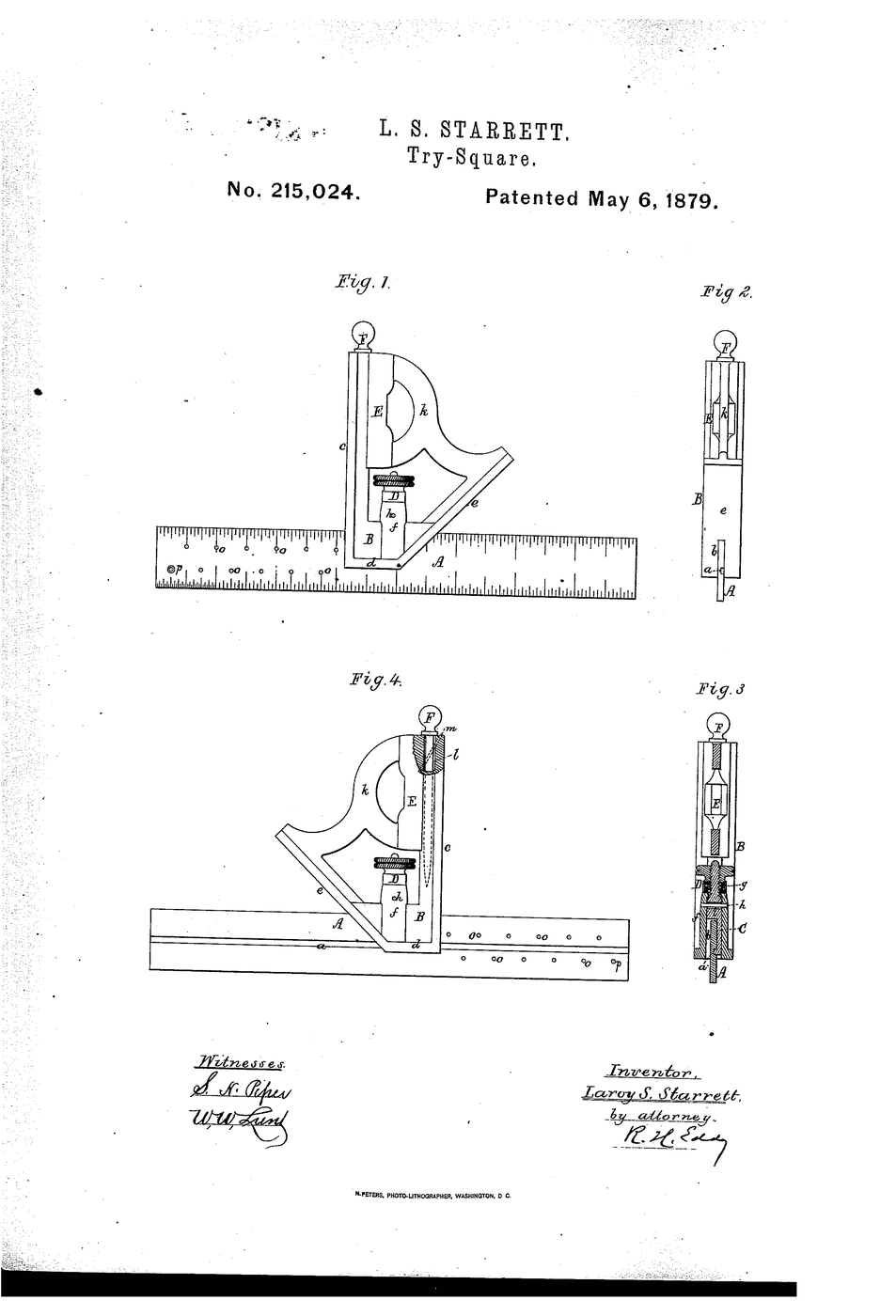
Starrett was a Maine farm boy whose first patent was a meat chopper. He founded the L. S. Starrett Company in Athol in 1880 and held roughly a hundred patents; his combination square, a separate blueprint in this library, is the other tool of his that every workshop still owns.
Why constant force is the real subject. Palmer's screw made the thousandth readable. It did not make it reproducible, because the reading depends on how hard the jaw is pressed — and soft materials compress measurably. Starrett's spring removes the operator's hand from the result. That is the difference between an instrument a craftsman can use and an instrument an industry can use, and it is why this patent belongs beside Palmer's rather than inside it.
The pattern repeats. Every instrument in this batch eventually meets the same problem — the human operating it — and every good answer is the same: remove the judgement. The ratchet, the reversal test, the go/no-go gauge and the projected shadow of the optical comparator are four versions of one idea.
Àwọn ohun-èlò
3- 9 ewéÀyè
- 1 ewéÀyè
- 0.2 mítàÀyè
Àwọn Ohun Èlò Ìtọ́nisọ́nà Tí A So Pọ̀

Blueprint tó jọra
Àwọn blueprint wọ̀nyí pín ìmọ̀ — ọ̀nà, ohun-èlò tàbí ìlànà

CC0 Àgbègbè Gbogbogbò
Blueprint yìí ti jáde lábẹ́ CC0. O lè ṣe àdàkọ, yí padà, pín, àti lò láìsí ìyọ̀ǹda.
Ṣàtìlẹ́yìn Olùṣẹ́dá nípa rírà àwọn ọjà nipasẹ̀ Blueprint wọn Ẹ̀san Olùṣẹ́dá tí àwọn Olùtajà gbé kalẹ̀, tàbí ṣẹ̀dá àtúnṣe tuntun ti Blueprint yìí kí o sì fi sínú Blueprint rẹ gẹ́gẹ́ bí ìsopọ̀ láti pín owó-wíwọlé.