IṢẸ́ ỌNÀ
ẸWÀ ÀTI ÌLERA
IṢẸ́ ỌWỌ́
ÀṢÀ ÀTI ÌTÀN
ÌṢERÉ
ÀYÍKÁ
OÚNJẸ ÀTI OHUN MÍMU
REVERSE ENGINEERING
SÁYẸ́ǸSÌ
ERÉ ÌDÁRAYÁ
ÌMỌ̀-Ẹ̀RỌ
ÀWỌN OHUN WÍWỌ̀


The Apex-First Lemon Squeezer: Press From the Tip Out, and the Seeds Stay Whole
Squeezing a lemon from its middle pushes juice back the way it came, and crushes seeds whose bitterness gets into the juice.
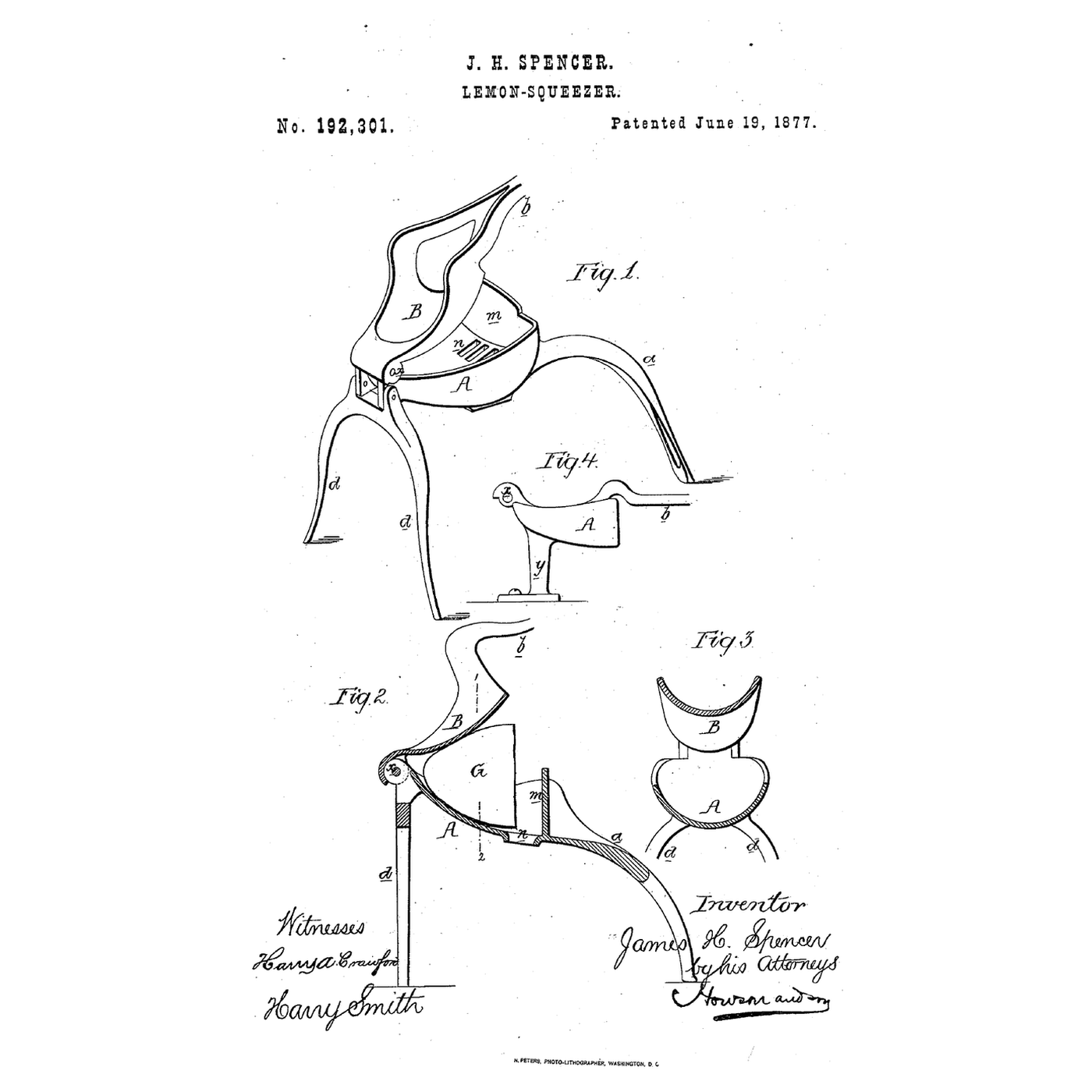
James H. Spencer of Philadelphia, Pennsylvania, received US 192,301, dated 19 June 1877, for a squeezer of "two main parts—namely, the concavo-convex socket or receptacle A, made to conform, or nearly so, with, and form a proper lodgment for, half a lemon, G, and the presser B, convex on the under side, the two parts being hinged together". The socket curves up toward the hinge; the presser bears first on the lemon's apex, then on its body, so the juice is driven toward a flange and out through a grating at the socket's front end. The seeds are expelled uncrushed.
This rung works out how the force moves from the apex outward, then forges and bends the socket and presser from sheet steel on bent-rod legs, and squeezes lemons with it.
Àárín
About 5 hours
Ìlànà
1
1
Force from the apex out
Force from the apex out
Ń ṣí ìwé Jupyter…
2
2
A squeezer that guides the juice before it
A squeezer that guides the juice before it
The embedded blueprint presses a lemon to one side so the juice flows past it. Spencer presses from the apex out so the juice is driven one way, to a grating.
3
3
Read US 192,301
Read US 192,301
"The socket is curved upward gradually toward the hinge, so as to constitute a fitting lodgment for the half, G, of a lemon, and the under side of the presser is so formed that when elevated, as in Fig. 2, it will bear on the lemon near the apex of the same, as shown."
"By this action of the presser there can be no possibility of the juices being forced rearward, for they must necessarily be expelled, from the first to the last movement of the presser, outward from within the skin, and through the severed end of the lemon toward the flange m, and must pass through the grating n into any suitable receptacle which the height of the legs permits to be introduced beneath the socket."
4
4
Make the squeezer and press lemons
Make the squeezer and press lemons
**Socket.** Cut a piece of stainless steel sheet and hammer it over a hardwood form into a trough that curves up at one end, shaped to take half a lemon with its apex toward that end. Solder or rivet a low partition across the other end as the flange m, and drill a row of holes in the bottom just behind it as the grating n.
**Presser.** Hammer a second piece into a convex shell that fits into the socket, and rivet a flat-bar arm to it as the handle b.
**Hinge and legs.** Hinge the presser to the socket's curved-up end with a bolt through two lugs. Bend 6 mm steel rod into two legs d d fixed at the hinge end and a long arm a running from the flange end down to the table, tall enough for a glass under the grating.
**Test.** Put a half lemon in with its apex toward the hinge and press the arm down slowly. Watch where the juice comes out, and look at the seeds afterwards.
Àwọn ohun èlò fún ìgbésẹ̀ yìí:
 Àwo irin tí kò ń yá1 ẹyọ
 Ọ̀pá Pẹrẹsẹ Irin Pẹ́lẹ́0.3 mítà
 Ọ̀pá Róbótó Irin Rírọ̀1 mítà
 Àwọn pop rivet6 ẹyọ
 Àkójọ bọ́ọ̀lù onígun mẹ́fà1 ẹyọ
 Nọ́ọ̀tì Onígun Mẹ́fà1 ẹyọ
 Ìṣù Igi Líle1 ẹyọ
 Lẹ́mọ́ọ̀nù3 ẹyọ
Àwọn irinṣẹ́ tí a nílò:
 Ìlàǹkàn irin
 Òòlù
Òòlù Ìdí Alágbẹ̀dẹ
 Ìdìmú Tábìlì
 Ọ̀pá Iná Pùróféènì
 Ẹ̀rọ Ìlùkòkò Aláìlókùn
 Àkójọ Orí Ìlùkòkò
 Ìdìpọ̀ ẹ̀rọ ìso pop rivet
 Àwọn Ìfá (Ìfá Ọwọ́)
 Kọ́kọ́rọ́ tí a lè ṣàtúnṣe
 Ife ìmumi
 Ìbọ̀wọ́ Iṣẹ́ Awọ
 Gílásì Ààbò Tí Ó Mọ́
5
5
A squeezer that sprays backward or crushes seeds
A squeezer that sprays backward or crushes seeds
Apex-first lemon squeezer troubleshooting.
Flow
Loading...
6
6
History and honest limits
History and honest limits
**James H. Spencer** of Philadelphia, Pennsylvania, filed US 192,301 on 26 April 1877; it is dated 19 June 1877. He noted the rind as well as the pulp was pressed dry, left as a hard mass. The legs could be dispensed with, the arm a being straight and held in one hand, or the socket fixed to a bar with a single stud y. His claims cover the socket and presser hinged together to act on a half lemon, the socket's grating and partition, and the legs a d d.
**Honest limits.** Hammered stainless steel and bent rod stand in for his cast parts. The notebook ignores the lemon's own resistance; its forces and lengths are examples. Your juice and seeds are the result.
Àwọn ohun-èlò
8- 1 ẹyọÀyè
- 0.3 mítàÀyè
- 1 mítàÀyè
- 6 ẹyọÀyè
- Àyè
- 1 ẹyọÀyè
- 1 ẹyọÀyè
- 3 ẹyọÀyè
Àwọn irinṣẹ́ tó nílò
13- Àyè
- Àyè
- Àyè
- 1 vendor sell this, none ship to you yetÀyè
- Àyè
Ìtọ́nisọ́nà yìí ń ṣe

Blueprint tó jọra
Àwọn blueprint wọ̀nyí pín ìmọ̀ — ọ̀nà, ohun-èlò tàbí ìlànà
The Inclined-Knife Lemon Squeezer: Put In a Whole Lemon, Cut and Press in One Stroke
láti ọwọ́ Penny
Àwọn Ohun Mímu
33
0
0
0
0
0
The Slotted Lemon Squeezer: Squeeze, Then Slice Through the Slots
láti ọwọ́ TheChef
Iṣẹ́ Irin
26
0
0
0
0
0

The Cap-and-Cone Lemon Squeezer: Squeeze Sideways, Not Inside Out
láti ọwọ́ YourGrandma
Àwọn Ohun Mímu
21
0
0
0
0
0
CC0 Àgbègbè Gbogbogbò
Blueprint yìí ti jáde lábẹ́ CC0. O lè ṣe àdàkọ, yí padà, pín, àti lò láìsí ìyọ̀ǹda.
Ṣàtìlẹ́yìn Olùṣẹ́dá nípa rírà àwọn ọjà nipasẹ̀ Blueprint wọn Ẹ̀san Olùṣẹ́dá tí àwọn Olùtajà gbé kalẹ̀, tàbí ṣẹ̀dá àtúnṣe tuntun ti Blueprint yìí kí o sì fi sínú Blueprint rẹ gẹ́gẹ́ bí ìsopọ̀ láti pín owó-wíwọlé.