IṢẸ́ ỌNÀ
ẸWÀ ÀTI ÌLERA
IṢẸ́ ỌWỌ́
ÀṢÀ ÀTI ÌTÀN
ÌṢERÉ
ÀYÍKÁ
OÚNJẸ ÀTI OHUN MÍMU
REVERSE ENGINEERING
SÁYẸ́ǸSÌ
ERÉ ÌDÁRAYÁ
ÌMỌ̀-Ẹ̀RỌ
ÀWỌN OHUN WÍWỌ̀
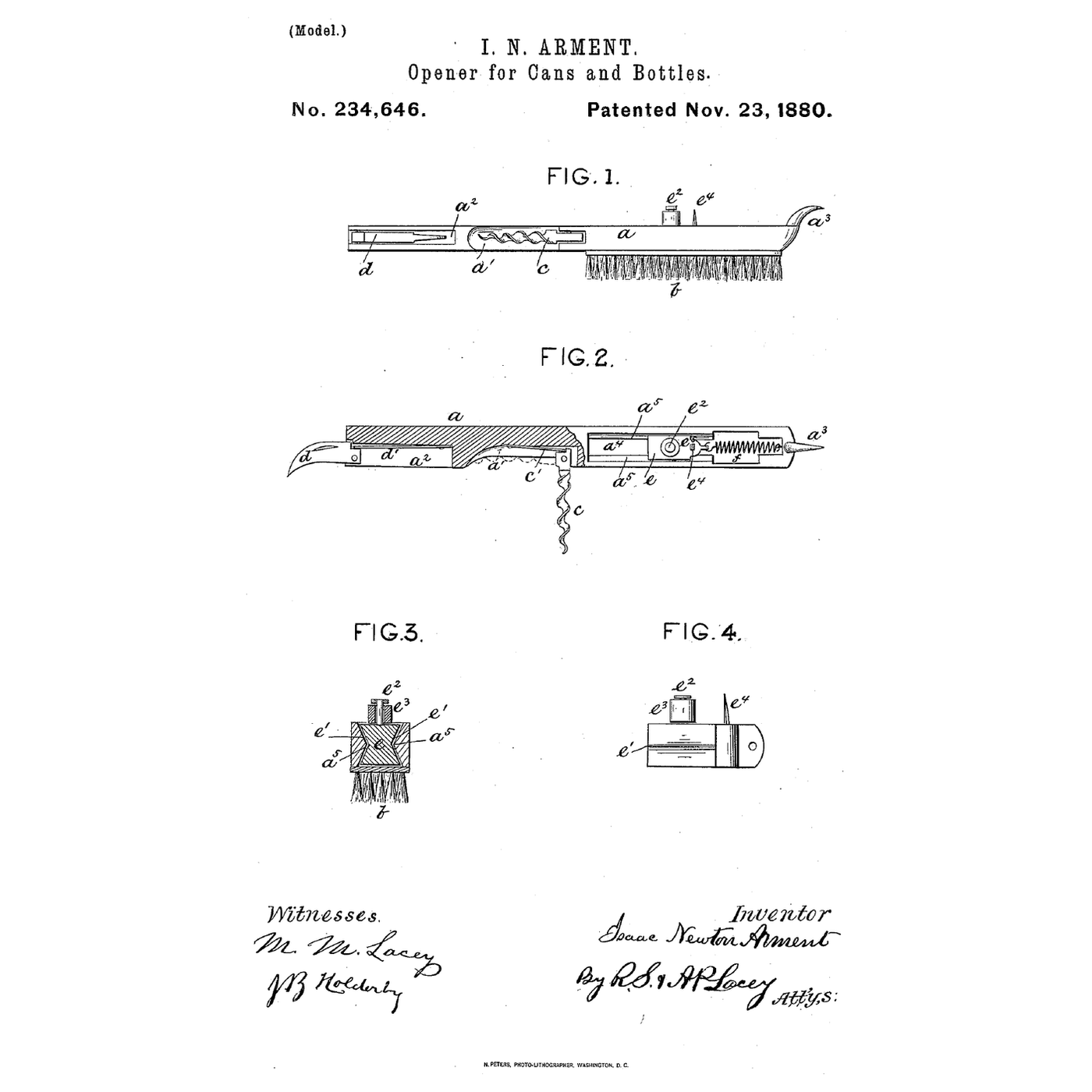


The Circle-Cutting Can Opener: A Spur at the Centre and a Blade Set to the Can's Size
Cutting a can's lid by hand round its edge leaves a ragged line, and one tool rarely does for cans of every size and for bottles too.
Isaac N. Arment of Dayton, Washington Territory, received US 234,646, dated 23 November 1880, for "a substantial device for opening cans and bottles": a bar with a sharp curved spur at one end, thrust through the top of the can, and next to it a slot in which a head block slides, carrying a bearing stud that runs down the can's side and a two-edged blade that is pressed through the top beside it. "By pushing the bar sidewise the blade moves in a circle and cuts the top open." The bar also carries a corkscrew, a stub blade for cutting wax from bottle corks, and a brush.
This rung works out the blade's force as the bar turns about the spur, with a work check, then makes the bar with a sliding blade block and a folding corkscrew, and opens cans of two sizes.
Ilọsíwájú
About 5 hours
Ìlànà
1
1
Turning about the spur
Turning about the spur
Ń ṣí ìwé Jupyter…
2
2
A can opener before it
A can opener before it
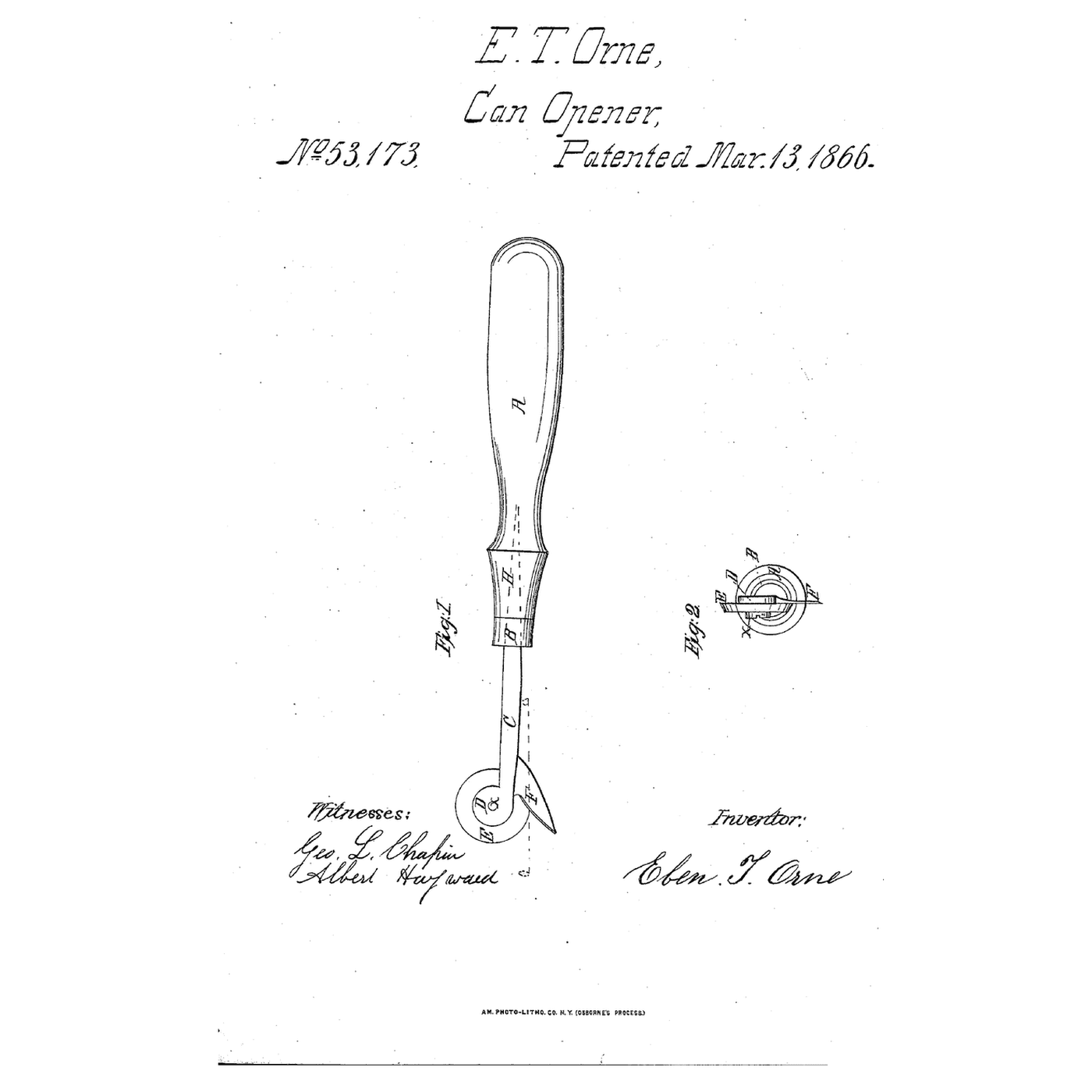
The embedded blueprint pushes a shear round the lid by hand. Arment fixes a spur at the centre so the blade cuts a true circle, sized by a sliding block.
3
3
Read US 234,646
Read US 234,646
"On the opposite end of the bar a, and on the under side, is fixed a sharp spur, a3, curved outward, and designed to be thrust through the top of the can. When it is thrust through, the bar a can be turned down against the top of the can."
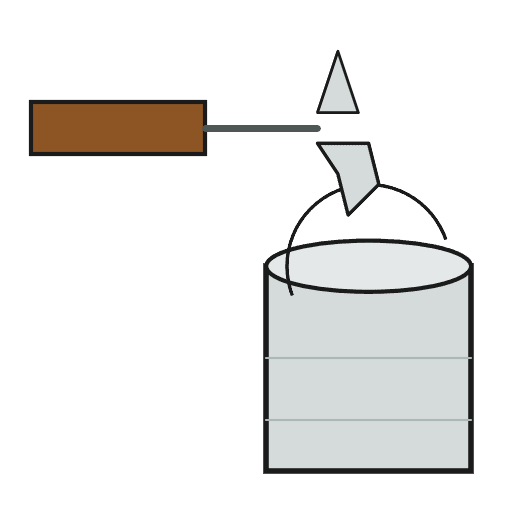
"The device can be employed on any size of can. The spur a3 is thrust through the top of the can and the block e is drawn outward till the stud e2 will pass down on the outside of the can. The bar is then pressed down against the can. This movement pushes the blade e4 through the top and the stud e2 down on the outside of the can. By pushing the bar sidewise the blade moves in a circle and cuts the top open."
4
4
Make the opener and open two cans
Make the opener and open two cans
**Bar.** Cut 22 cm of 20 × 5 mm mild steel flat bar. At one end, file a curved spur a3 on the underside, pointed and hardened. Next to it, saw and file a slot a4 8 cm long along the bar, and file its edges to a bevel as the guides a5.
**Head block and blade.** File a block of flat bar with V grooves on its edges that slide on the guides. Screw a short stud e2 to its underside, and fix a small two-edged blade e4, filed from spring steel and hardened, just inside the stud. Fit a thumb screw and plate to lock the block anywhere along the slot, in place of Arment's spring f.
**Corkscrew and wax blade.** Wind a small steel-wire helix and pivot it in a recess filed in the bar's other end so it folds away; fix a short stub blade d beside it.
**Test.** Push the spur through the middle of a small can's lid, slide the block out until the stud is outside the can's rim, press the bar down so the blade pierces the lid, and swing the bar round. Reset the block and open a larger can.
Àwọn ohun èlò fún ìgbésẹ̀ yìí:
 Ọ̀pá Pẹrẹsẹ Irin Pẹ́lẹ́0.35 mítà
 Ọ̀pá irin orísun0.1 mítà
 Skurú ẹ̀rọ1 ẹyọ
 Nọ́ọ̀tì Onígun Mẹ́fà2 ẹyọ
 Okun waya irin0.3 mítà
 Àwọn pop rivet2 ẹyọ
 Ìgò irin2 ẹyọ
Àwọn irinṣẹ́ tí a nílò:
 Ayùn Irin
 Àwọn Ìfá (Ìfá Ọwọ́)
 Àkójọ Ìfá Kékeré
 Ìdìmú Tábìlì
 Ẹ̀rọ Ìlùkòkò Aláìlókùn
 Àkójọ Orí Ìlùkòkò
 Ọ̀pá Iná Pùróféènì
 Ẹ̀mú Olórí Yíká
 Ìṣù àwọn ohun ìyí skurú
 Ìbọ̀wọ́ Tí Ń Fara Da Ooru
 Ìbọ̀wọ́ Iṣẹ́ Awọ
 Gílásì Ààbò Tí Ó Mọ́
5
5
An opener that wanders, jams or will not pierce
An opener that wanders, jams or will not pierce
Circle-cutting can opener troubleshooting.
Flow
Loading...
6
6
History and honest limits
History and honest limits
**Isaac N. Arment** of Dayton, Columbia County, Washington Territory, filed US 234,646 on 24 September 1880; it is dated 23 November 1880. His block e had channels e′ fitting the guides a5, a friction roller e3 on the stud e2, and a spring f coupling it to the bar's end to hold the stud against the can's side; the brush b cleaned the can or bottle top. His claims cover the bar, slot, guides and spur with the adjustable block, stud and blade, and the whole opener with its blade d, corkscrew, block and spring.
**Honest limits.** Filed flat bar and a thumb-screw lock stand in for his spring-held block, and the brush is left out. The notebook ignores friction; its forces and lengths are examples. Your opened cans are the result.
Àwọn ohun-èlò
7- 0.35 mítàÀyè
- 0.1 mítàÀyè
- 1 ẹyọÀyè
- 2 ẹyọÀyè
- 0.3 mítàÀyè
- 2 ẹyọÀyè
- 2 ẹyọÀyè
Àwọn irinṣẹ́ tó nílò
12- Àyè
- Àyè
- 1 vendor sell this, none ship to you yetÀyè
Ìtọ́nisọ́nà yìí ń ṣe
Blueprint tó jọra
Àwọn blueprint wọ̀nyí pín ìmọ̀ — ọ̀nà, ohun-èlò tàbí ìlànà

CC0 Àgbègbè Gbogbogbò
Blueprint yìí ti jáde lábẹ́ CC0. O lè ṣe àdàkọ, yí padà, pín, àti lò láìsí ìyọ̀ǹda.
Ṣàtìlẹ́yìn Olùṣẹ́dá nípa rírà àwọn ọjà nipasẹ̀ Blueprint wọn Ẹ̀san Olùṣẹ́dá tí àwọn Olùtajà gbé kalẹ̀, tàbí ṣẹ̀dá àtúnṣe tuntun ti Blueprint yìí kí o sì fi sínú Blueprint rẹ gẹ́gẹ́ bí ìsopọ̀ láti pín owó-wíwọlé.