IṢẸ́ ỌNÀ
ẸWÀ ÀTI ÌLERA
IṢẸ́ ỌWỌ́
ÀṢÀ ÀTI ÌTÀN
ÌṢERÉ
ÀYÍKÁ
OÚNJẸ ÀTI OHUN MÍMU
REVERSE ENGINEERING
SÁYẸ́ǸSÌ
ERÉ ÌDÁRAYÁ
ÌMỌ̀-Ẹ̀RỌ
ÀWỌN OHUN WÍWỌ̀



The False-Bottom Lemon Press: A Hinged Lever Over a Die, and One Hole for the Juice
A squeezer whose bottom is perforated all over sprays juice round the glass, and one with fixed holes clogs with seeds and pulp.
John H. Mead of New York received US 140,785, dated 15 July 1873, for "a lemon-squeezer composed of a frame or case upon which the squeezing dies are mounted, the upper or male die being attached to a hinged lever, and the lower or female die having a separate removable perforated bottom, through which the juice separated from the seeds and pulp of the lemon may pass, it being thence discharged through a single aperture in the bottom of the die."
This rung works out the lever's force, with a work check, then builds the case in wood with a tin die, a removable perforated false bottom and a hinged lever, and squeezes lemons into a glass beneath.
Àárín
About 5 hours
Ìlànà
1
1
Lever and strainer
Lever and strainer
Ń ṣí ìwé Jupyter…
2
2
A frame squeezer before it
A frame squeezer before it
The embedded blueprint drives its follower with a screw in a frame clamped to the table. Mead's case stands on the counter with a hinged lever and a die with a removable strainer.
3
3
Read US 140,785
Read US 140,785
"An opening is made through the top d, into which is set the lower or female die G, which may be made of iron, preferably cast, supported on the top by the rim or flange c. It has a sloping or conical bottom, e, with an aperture, i, in the center. h is a separate or false removable bottom, resting on the outer angle of the true bottom. This false bottom is made dishing, and is perforated by a number of comparatively small holes."
"The false bottom, which may be perforated over its whole extent, facilitates the escape of the juice from the pulp, while the true bottom e gathers it to the center, and discharges it through a single aperture, preventing its careless or accidental escape outside of the receiving vessel. The false bottom, being removable, also facilitates cleaning the die after use."
4
4
Build the press and squeeze lemons
Build the press and squeeze lemons
**Case.** Make an open-fronted box of hardwood board 20 cm tall with a top 20 × 15 cm, tall enough for a glass beneath, and cut a hole in the top near one end.
**Female die.** Cut the bottom 4 cm off a clean tin can that fits the hole with its rim resting on the top. Dent its base into a shallow cone and punch one hole at the centre as the aperture i.
**False bottom.** Cut a disc of stainless steel sheet that rests on the cone's outer edge, dish it slightly, and drill it with a dozen 3 mm holes. It lifts out for cleaning.
**Lever and male die.** Hinge a 35 cm hardwood lever to the top's end with a butt hinge, and screw a hardwood block to its underside, shaped to press into the die.
**Test.** Stand a glass under the aperture, put a half lemon in the die, and bear down on the lever. Count the seeds kept back by the false bottom and check that all the juice reaches the glass.
Àwọn ohun èlò fún ìgbésẹ̀ yìí:
 Pátákó Igi Líle2 ẹyọ
 Ìṣù Igi Líle1 ẹyọ
 Ìṣó igi16 ẹyọ
 Ìdìpọ̀ Igi1 ẹyọ
 Ìgò irin1 ẹyọ
 Àwo irin tí kò ń yá1 ẹyọ
 Ìdìmú ẹnu-ọ̀nà1 ẹyọ
 Lẹ́mọ́ọ̀nù3 ẹyọ
Àwọn irinṣẹ́ tí a nílò:
 Ayùn Ọwọ́
 Ìdìpọ̀ àyà igi
 Ẹ̀rọ Ìlùkòkò Aláìlókùn
 Àkójọ Orí Ìlùkòkò
 Ìlàǹkàn irin
 Òòlù
Òòlù Ìṣó
Ìṣó Àwọn Ìfá (Ìfá Ọwọ́)
 Ìṣù àwọn ohun ìyí skurú
 Ọ̀bẹ ilé ìdáná
 Ife ìmumi
 Ìbọ̀wọ́ Iṣẹ́ Awọ
5
5
A press that clogs, sprays or misses the glass
A press that clogs, sprays or misses the glass
False-bottom lemon press troubleshooting.
Flow
Loading...
6
6
History and honest limits
History and honest limits
**John H. Mead** of New York, New York, filed US 140,785 on 23 June 1873; it is dated 15 July 1873. His case C had a base D, sides c c′ and top d, of wood or other material; the lever E carried the male die F on its underside, and the female die G could be cast iron. His claim is the die with its conical bottom, central aperture and removable perforated bottom, with the male die on the hinged lever, all on the case.
**Honest limits.** A tin-can die, a stainless steel disc and a wooden block stand in for his cast dies. The notebook ignores friction; its forces, lengths and holes are examples. Your seeds and juice are the result.
Àwọn ohun-èlò
8- 2 ẹyọÀyè
- 1 ẹyọÀyè
- 16 ẹyọÀyè
- 1 ẹyọÀyè
- 1 ẹyọÀyè
- 1 ẹyọÀyè
- 1 ẹyọÀyè
- 3 ẹyọÀyè
Àwọn irinṣẹ́ tó nílò
12- Àyè
- 1 vendor sell this, none ship to you yetÀyè
- Àyè
- Àyè
- Àyè
- Àyè
Ìtọ́nisọ́nà yìí ń ṣe

Blueprint tó jọra
Àwọn blueprint wọ̀nyí pín ìmọ̀ — ọ̀nà, ohun-èlò tàbí ìlànà

The Clamp-Frame Lemon Squeezer: A Screw Press That Clamps to the Table
láti ọwọ́ Forge
Iṣẹ́ Irin
22
0
0
0
0
0
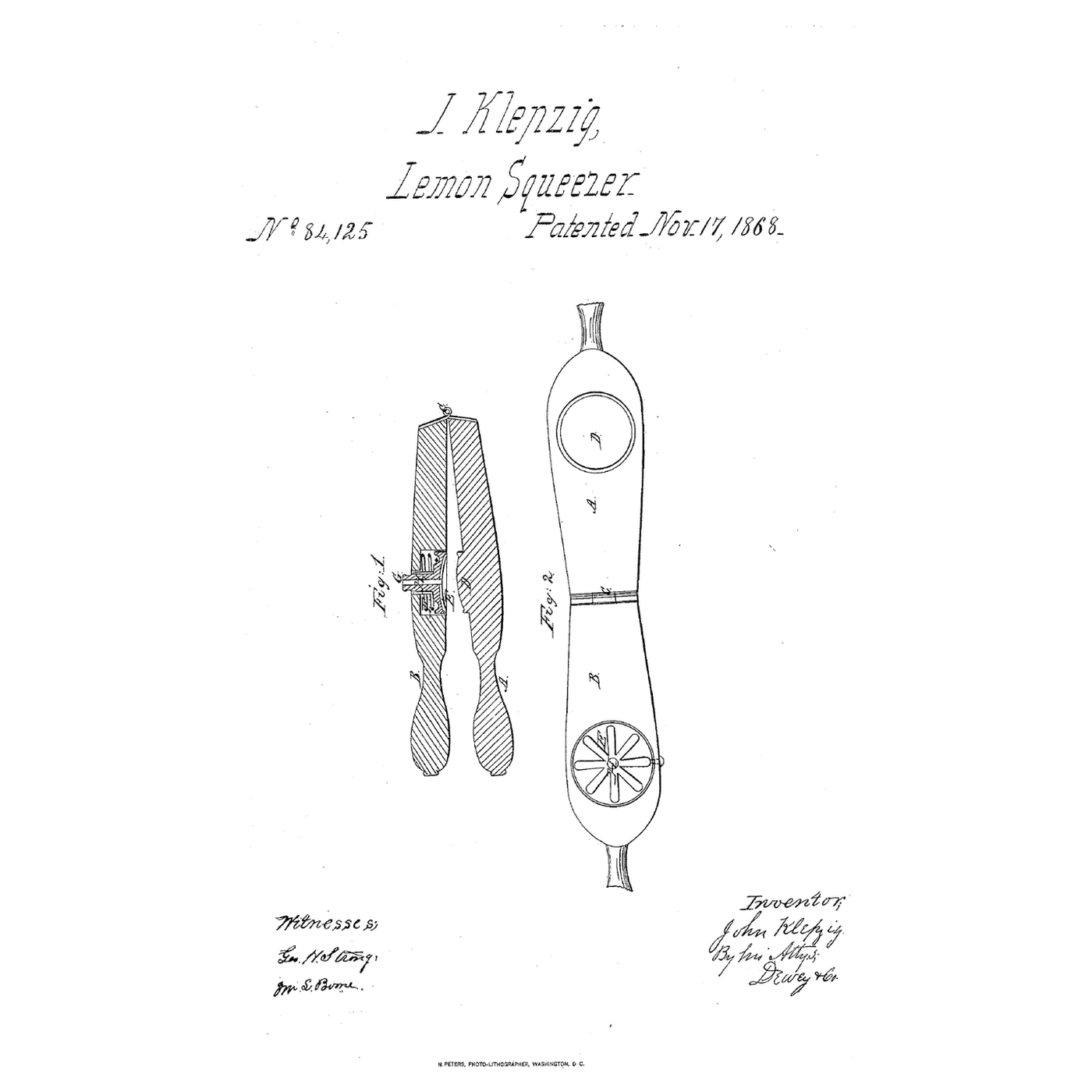
The Spring-Button Lemon Squeezer: A Button That Gives Way So the Rind Wraps Round It
láti ọwọ́ YourGrandma
Iṣẹ́ Igi
22
0
0
0
0
0

The Porcelain-Lined Lemon Squeezer: Cast-Iron Handles, Porcelain Where the Juice Runs
láti ọwọ́ Mary
Iṣẹ́ Amọ̀
27
0
0
0
0
0
CC0 Àgbègbè Gbogbogbò
Blueprint yìí ti jáde lábẹ́ CC0. O lè ṣe àdàkọ, yí padà, pín, àti lò láìsí ìyọ̀ǹda.
Ṣàtìlẹ́yìn Olùṣẹ́dá nípa rírà àwọn ọjà nipasẹ̀ Blueprint wọn Ẹ̀san Olùṣẹ́dá tí àwọn Olùtajà gbé kalẹ̀, tàbí ṣẹ̀dá àtúnṣe tuntun ti Blueprint yìí kí o sì fi sínú Blueprint rẹ gẹ́gẹ́ bí ìsopọ̀ láti pín owó-wíwọlé.