IṢẸ́ ỌNÀ
ẸWÀ ÀTI ÌLERA
IṢẸ́ ỌWỌ́
ÀṢÀ ÀTI ÌTÀN
ÌṢERÉ
ÀYÍKÁ
OÚNJẸ ÀTI OHUN MÍMU
REVERSE ENGINEERING
SÁYẸ́ǸSÌ
ERÉ ÌDÁRAYÁ
ÌMỌ̀-Ẹ̀RỌ
ÀWỌN OHUN WÍWỌ̀



The Hoof-Cleaner Pocket Knife: Blade, Box Opener, Hoof Pick, Hammer and Corkscrew in One Handle
A horseman needs a hoof pick, a knife, a small hammer and a corkscrew, and carries them separately.
Thomas Davis of Scranton, Pennsylvania, received US 177,696, dated 23 May 1876, for "an implement containing a number of useful tools arranged in a neat and compact form; and it consists of a knife-blade, cigar-box opener, hammer, corkscrew, and hoof-cleaner combined with a suitable inclosing-case or handle". The knife blade and cigar-box opener pivot at one end, the hoof-cleaner at the other, each held by springs in the handle's back as in an ordinary clasp-knife; a small hammer head is fixed at the hoof-cleaner end, and a corkscrew folds between two flanges of the handle.
This rung works out how the back spring holds each tool, then builds the knife from flat-bar liners with a spring-steel back spring, stainless tools, a riveted hammer and a wound corkscrew, and uses each tool.
Ilọsíwájú
About 6 hours
Ìlànà
1
1
The back spring
The back spring
Ń ṣí ìwé Jupyter…
2
2
A pocket implement before it
A pocket implement before it
The embedded blueprint hangs small tools inside tweezers. Davis builds his like a clasp knife, with springs that hold each tool open or shut, and adds a hoof-cleaner for the horse.
3
3
Read US 177,696
Read US 177,696
"In the drawings, H represents the inclosing case or handle of the implement; A B, a knife-blade and cigar-box opener, respectively, arranged at one end of the handle on a common pivot; and C, a hoof-cleaner, located at the opposite end of the handle. Each of these devices is held in position by springs in the back of the handle similar to those employed in any ordinary clasp-knife."
"D is a small hammer-head, secured to the end of the handle carrying the hoof-cleaner; and E is a corkscrew pivoted between two extensions or flanges, e, of the handle. The corkscrew can be folded down between said flanges and the knife-blade, box-opener, and hoof-cleaner concealed within the handle when not in use."
4
4
Build the knife and use each tool
Build the knife and use each tool
**Liners and scales.** Cut two 10 cm liners from 20 × 3 mm flat bar, shaped as a knife handle, and two hardwood scales to match. Leave two short tabs on the liners' middle as the flanges e for the corkscrew.
**Tools.** From stainless steel sheet, cut a knife blade and a cigar-box opener with a thin bent lip, both with tangs to pivot at one end, and a curved hoof pick with a tang for the other end. File each tang's end with a flat and a corner, as a clasp knife's.
**Back springs.** Cut two strips about 2 mm thick from spring steel to lie along the handle's back between the liners, one for each end, each pressing on the tangs' flats.
**Assemble.** Pin the tools and springs between the liners with rivets through the scales. Rivet a short block of steel square bar at the hoof-pick end as the hammer D. Wind a small steel-wire helix, set its straight end on a pin between the flanges so it folds down.
**Test.** Open and shut each tool and feel it snap. Clean a hoof or a muddy boot sole with the pick, open a wooden box, tap in a tack, and draw a cork.
Àwọn ohun èlò fún ìgbésẹ̀ yìí:
 Ọ̀pá Pẹrẹsẹ Irin Pẹ́lẹ́0.25 mítà
 Ìṣù Igi Líle1 ẹyọ
 Àwo irin tí kò ń yá1 ẹyọ
 Ọ̀pá irin orísun0.15 mítà
 Ọ̀pá Róbótó Irin Rírọ̀0.05 mítà
 Ọ̀pá onígun mẹ́rin irin rírọ̀0.03 mítà
 Okun waya irin0.3 mítà
 Àwọn pop rivet4 ẹyọ
 Àwọn kọ́ọ̀kì1 ẹyọ
 Ìgò dígí (tí ó mọ́)1 ẹyọ
Àwọn irinṣẹ́ tí a nílò:
 Ayùn Irin
 Ìlàǹkàn irin
 Àwọn Ìfá (Ìfá Ọwọ́)
 Àkójọ Ìfá Kékeré
 Ìdìmú Tábìlì
 Òòlù
Òòlù Ẹ̀rọ Ìlùkòkò Aláìlókùn
 Àkójọ Orí Ìlùkòkò
 Ìdìpọ̀ ẹ̀rọ ìso pop rivet
 Ẹ̀mú Olórí Yíká
 Òkúta Ìpọ́n
 Ìbọ̀wọ́ Iṣẹ́ Awọ
 Gílásì Ààbò Tí Ó Mọ́
5
5
A knife whose tools flop, stick or will not snap
A knife whose tools flop, stick or will not snap
Hoof-cleaner pocket knife troubleshooting.
Flow
Loading...
6
6
History and honest limits
History and honest limits
**Thomas Davis** of Scranton, Luzerne County, Pennsylvania, filed US 177,696 on 28 April 1876; it is dated 23 May 1876. He held that the whole implement, when shut up, occupied no more space than an ordinary pocket-knife, and that its uses were too obvious to list. His claim is the knife-blade, cigar-box opener, hoof-cleaner, hammer and corkscrew combined with the inclosing case or handle.
**Honest limits.** Flat-bar liners, hardwood scales and hand-cut stainless tools stand in for his factory knife. The notebook uses the straight cantilever formula; its spring's dimensions and offsets are examples. Your use of each tool is the result.
Àwọn ohun-èlò
10- 0.25 mítàÀyè
- 1 ẹyọÀyè
- 1 ẹyọÀyè
- 0.15 mítàÀyè
- 0.05 mítàÀyè
- 0.03 mítàÀyè
- 0.3 mítàÀyè
- 4 ẹyọÀyè
- 1 ẹyọÀyè
- 1 ẹyọÀyè
Àwọn irinṣẹ́ tó nílò
13- Àyè
- Àyè
- Àyè
- Àyè
- 1 vendor sell this, none ship to you yetÀyè
- Àyè
Blueprint tó jọra
Àwọn blueprint wọ̀nyí pín ìmọ̀ — ọ̀nà, ohun-èlò tàbí ìlànà

The Tweezer Pocket Implement: Knife, Rule, Hook, Calipers and File Hung Inside a Pair of Tweezers
láti ọwọ́ Tex
Iṣẹ́ Irin
14
0
0
0
0
0
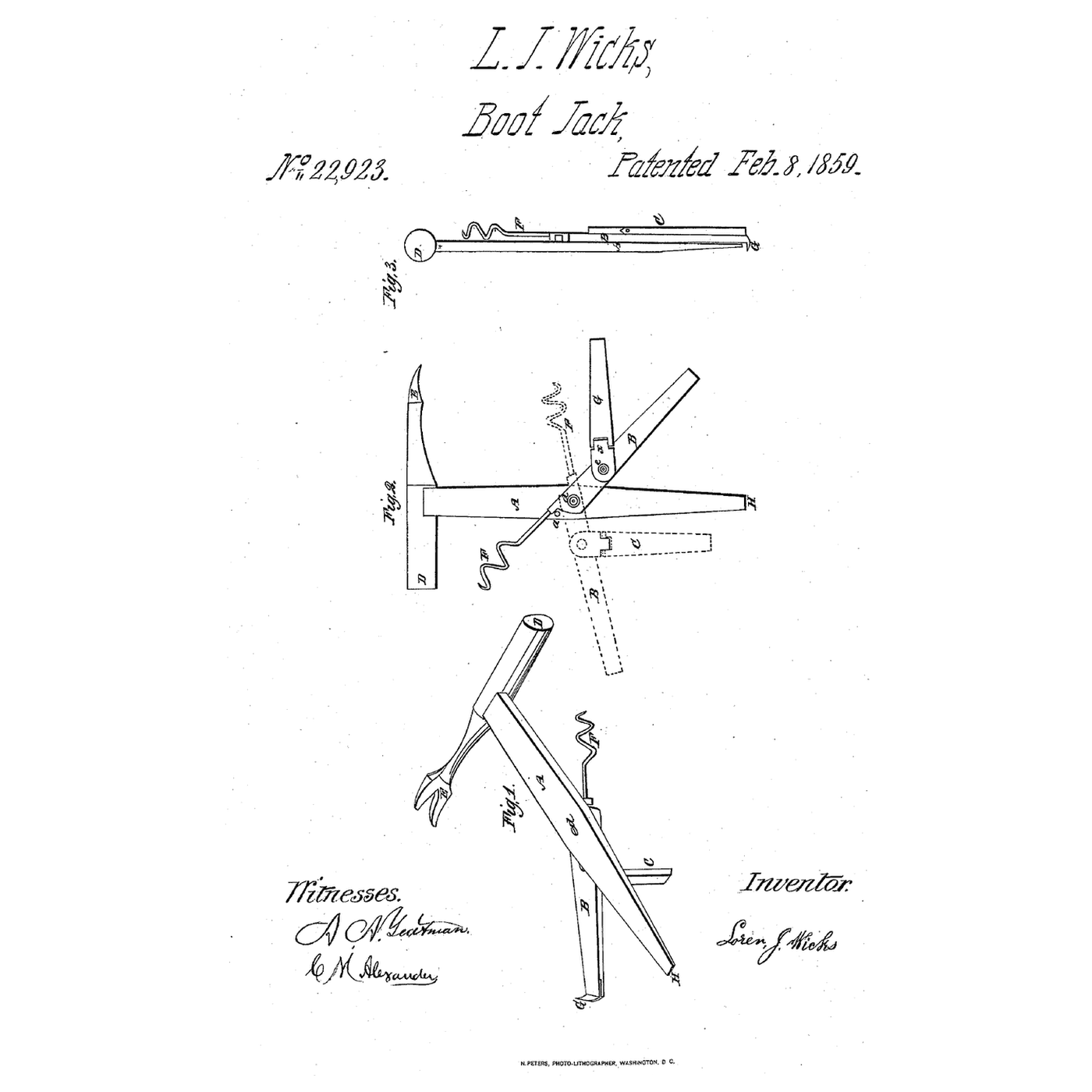
The Bootjack Multi-Tool: Scissor Arms That Pull Boots, Drive Tacks and Draw Corks
láti ọwọ́ Woody
Iṣẹ́ Igi
26
0
0
0
0
0

The Pocket-Case Corkscrew: A Tube That Holds the Screw, Then Becomes Its Handle
láti ọwọ́ Forge
Iṣẹ́ Irin
33
0
0
0
0
0
CC0 Àgbègbè Gbogbogbò
Blueprint yìí ti jáde lábẹ́ CC0. O lè ṣe àdàkọ, yí padà, pín, àti lò láìsí ìyọ̀ǹda.
Ṣàtìlẹ́yìn Olùṣẹ́dá nípa rírà àwọn ọjà nipasẹ̀ Blueprint wọn Ẹ̀san Olùṣẹ́dá tí àwọn Olùtajà gbé kalẹ̀, tàbí ṣẹ̀dá àtúnṣe tuntun ti Blueprint yìí kí o sì fi sínú Blueprint rẹ gẹ́gẹ́ bí ìsopọ̀ láti pín owó-wíwọlé.