IṢẸ́ ỌNÀ
ẸWÀ ÀTI ÌLERA
IṢẸ́ ỌWỌ́
ÀṢÀ ÀTI ÌTÀN
ÌṢERÉ
ÀYÍKÁ
OÚNJẸ ÀTI OHUN MÍMU
REVERSE ENGINEERING
SÁYẸ́ǸSÌ
ERÉ ÌDÁRAYÁ
ÌMỌ̀-Ẹ̀RỌ
ÀWỌN OHUN WÍWỌ̀
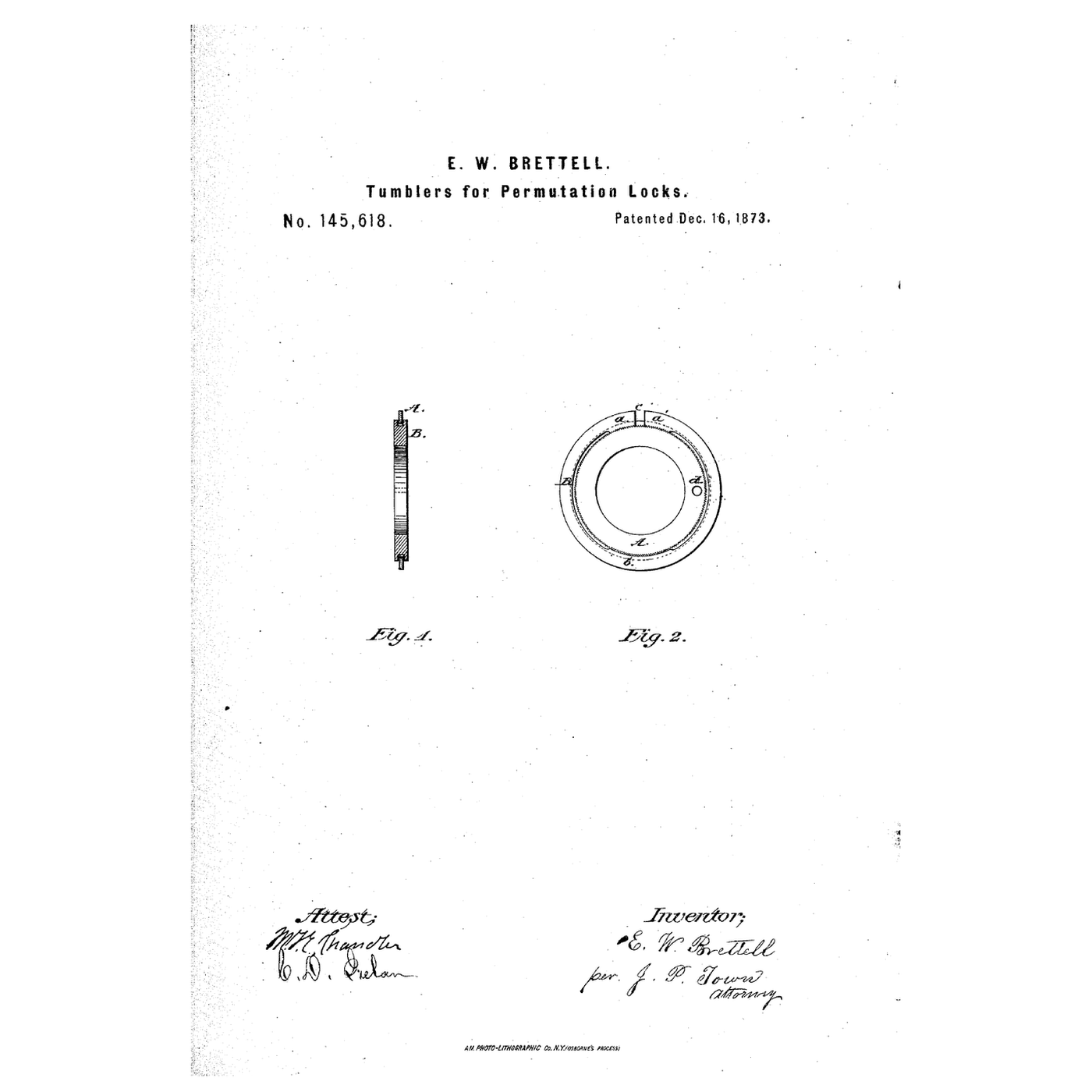


The Permutation Lock: Tumbler Wheels You Can Re-set
A permutation, or combination, lock has no keyhole. A pack of wheels behind the dial must all be turned so their gates line up; only then can the bolt move. A lock whose combination cannot be changed is only as safe as everyone who has ever known it.
Edward W. Brettell of New Haven, Connecticut, received US 145,618, dated 16 December 1873 (filed 3 May 1873), for tumblers "formed by encircling an inner ring or wheel with an elastic stop-ring". His steel stop-ring bears at three points, two of them toothed, which "lock into corresponding teeth" in the inner ring's groove. A key spreads the ring, the wheel is turned to a new position, and the ring snaps back: a new combination.
This rung counts combinations honestly, then builds a two-wheel plywood model that shows the wheels picking each other up.
Àárín
About 3 hours
Ìlànà
1
1
Counting combinations
Counting combinations
Ń ṣí ìwé Jupyter…
2
2
The keyed lock of the same years
The keyed lock of the same years
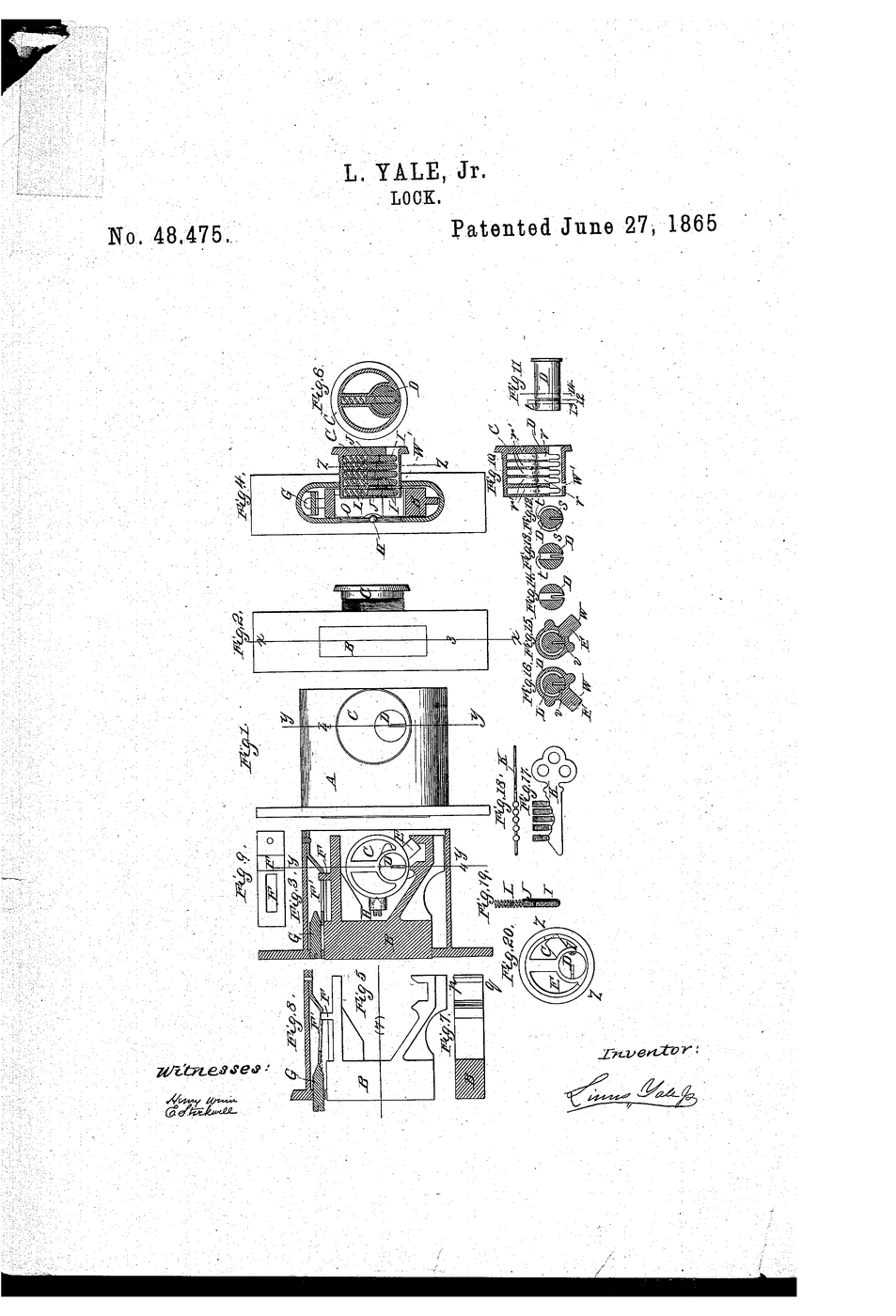
Linus Yale Jr.'s pin-tumbler cylinder is the keyed answer to the same problem. The embedded blueprint builds one.
3
3
Read US 145,618
Read US 145,618
"This invention relates to an improvement in that class of locks in which the tumblers are formed by encircling an inner ring or wheel with an elastic stop-ring, which is generally held in position by its friction upon the inner ring". Brettell forms the stop-ring "to give it a bearing at three points within a groove which encircles the inner ring, at two of which points, namely, those nearest the opening in the stop-ring, a series of triangular teeth are formed which lock into corresponding teeth formed in the bottom of the groove".
"In order to set the stop-ring at any desired point upon the ring A, a key of proper form is forced into the opening c in the stop-ring, thus spreading it sufficiently to raise the teeth a a' out of the serrations in the groove of the ring A, when the latter may be turned so as to bring any desired part of its periphery opposite the opening in the ring B."
He does not claim merely roughened rings: that "only increases the friction of one part upon the others, but does not securely lock them together until released by spreading the outer ring".
4
4
Build a two-wheel model
Build a two-wheel model
Cut two plywood discs 80 mm across and one 40 mm drive disc. Cut a gate, a notch 8 mm wide, in each large disc's rim. Glue a short dowel pin to the front face of the drive disc and to the front face of the first wheel, near the rim, so each can catch the next wheel's pin.
Stack them loosely on one bolt through a base board: drive disc, wheel one, wheel two. Mark 0-39 round the drive disc. Fix a strip of wood above the stack as the fence: it can drop only when both gates are under it.
Turn the dial two full turns one way to gather both wheels, then to the first number; one turn the other way past it, then to the second. Watch the pins pick the wheels up. Move one gate by re-gluing its pin elsewhere: that is what Brettell's key and stop-ring do without glue.
Àwọn ohun èlò fún ìgbésẹ̀ yìí:
 Àwo igi tí a lẹ̀ pọ̀1 ẹyọ
 Àwọn dowel igi líle1 ẹyọ
 Ìdìpọ̀ Igi1 ẹyọ
Àwọn irinṣẹ́ tí a nílò:
 Ayùn Kópìngì
 Ẹ̀rọ Ìlùkòkò Aláìlókùn
 Àkójọ Orí Ìlùkòkò
 Àgádágodo oníǹọ́mbà
5
5
A combination lock that will not open
A combination lock that will not open
Combination lock troubleshooting.
Flow
Loading...
6
6
History and honest limits
History and honest limits
**Edward W. Brettell** of New Haven, Connecticut, filed US 145,618 on 3 May 1873; it is dated 16 December 1873. The patent covers the tumbler only, not a whole lock.
**Honest limits.** The patent does not describe the dial, fence or bolt; the notebook's lock is the general wheel-pack principle. Dial size, wheel count, gate width and time per try are examples.
Àwọn ohun-èlò
3- 1 ẹyọÀyè
- 1 ẹyọÀyè
- 1 ẹyọÀyè
Àwọn irinṣẹ́ tó nílò
4- Àyè
- 1 vendor sell this, none ship to you yetÀyè
Blueprint tó jọra
Àwọn blueprint wọ̀nyí pín ìmọ̀ — ọ̀nà, ohun-èlò tàbí ìlànà
CC0 Àgbègbè Gbogbogbò
Blueprint yìí ti jáde lábẹ́ CC0. O lè ṣe àdàkọ, yí padà, pín, àti lò láìsí ìyọ̀ǹda.
Ṣàtìlẹ́yìn Olùṣẹ́dá nípa rírà àwọn ọjà nipasẹ̀ Blueprint wọn Ẹ̀san Olùṣẹ́dá tí àwọn Olùtajà gbé kalẹ̀, tàbí ṣẹ̀dá àtúnṣe tuntun ti Blueprint yìí kí o sì fi sínú Blueprint rẹ gẹ́gẹ́ bí ìsopọ̀ láti pín owó-wíwọlé.