IṢẸ́ ỌNÀ
ẸWÀ ÀTI ÌLERA
IṢẸ́ ỌWỌ́
ÀṢÀ ÀTI ÌTÀN
ÌṢERÉ
ÀYÍKÁ
OÚNJẸ ÀTI OHUN MÍMU
REVERSE ENGINEERING
SÁYẸ́ǸSÌ
ERÉ ÌDÁRAYÁ
ÌMỌ̀-Ẹ̀RỌ
ÀWỌN OHUN WÍWỌ̀

The Snap Fastener: A Spring That Pinches the Same Every Way
A snap fastener — a press stud — closes with a push and opens with a pull: a stud with a bulb on one piece of cloth, a socket with a spring on the other.
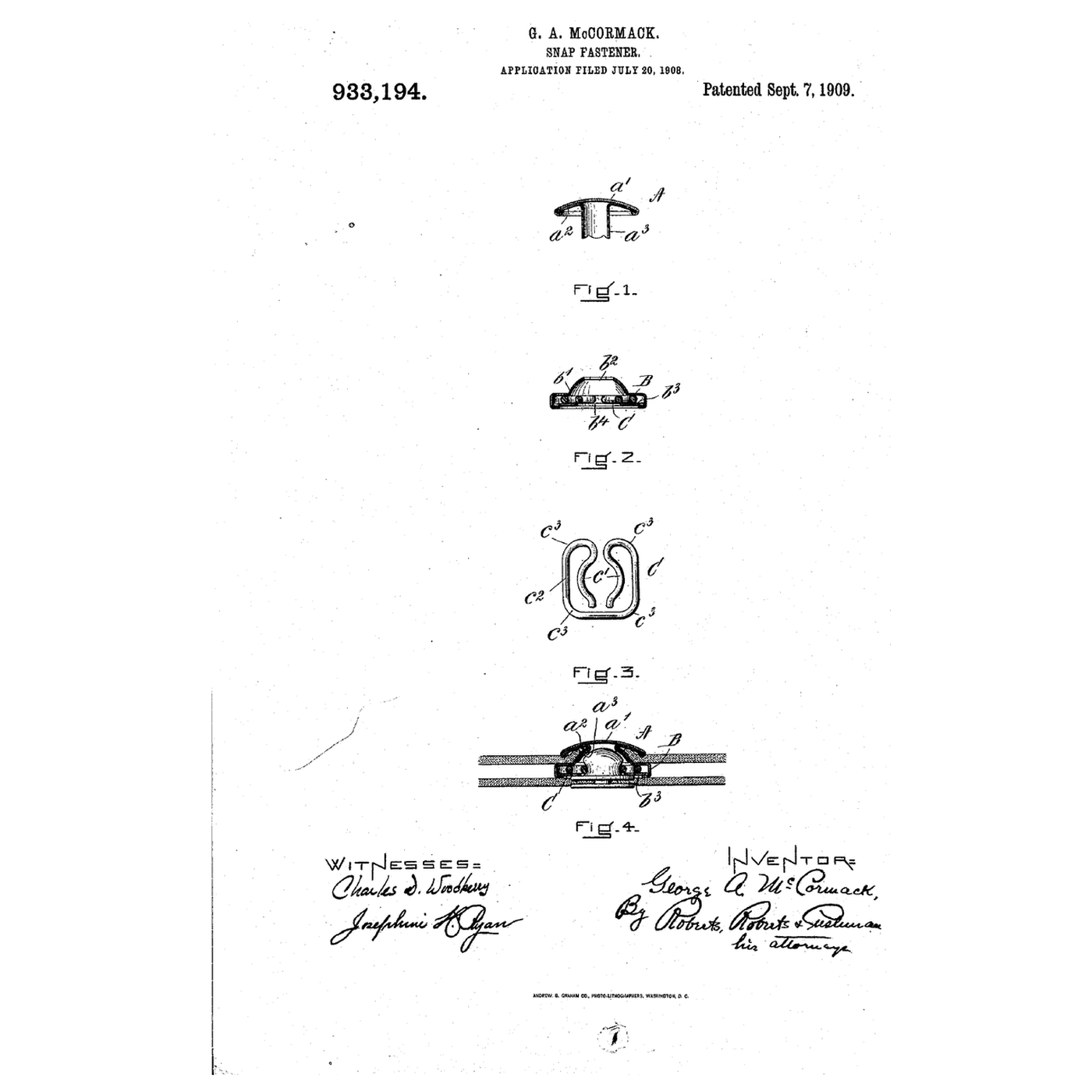
George A. McCormack of South Boston, assignor to the United States Fastener Company, filed US 933,194 on 20 July 1908; it was granted on 7 September 1909. Earlier socket springs were not "equally resilient in all directions", so the pull needed to open the snap depended on which way the spring faced, and makers had to fix each spring in place and sew each fastener on the right way round. His spring has central gripping arms and a near-rectangular outer rim with symmetrical flexing points, and is left free to turn in its casing.
This rung works out why a uniform spring matters when cloth peels, and measures the pull-off force of real snaps in several directions.
Olùbẹ̀rẹ̀
About 2 hours
Ìlànà
1
1
Pull-off force and peel direction
Pull-off force and peel direction
Ń ṣí ìwé Jupyter…
2
2
The closure it competes with
The closure it competes with
A button needs a buttonhole and a shank; a snap needs neither. The embedded blueprint shows how a button is sewn to last.
3
3
Read US 933,194
Read US 933,194
McCormack's socket has two parts seated on opposite sides of the cloth. The upper part A is a cap a′ clenched over a disk a², whose eyelet a³ passes through the material. The lower part B is a cylindrical casing b′ with an opening b² for the eyelet; a collet b³ with a stud-receiving opening holds the spring C inside the casing, where it "may be loosely secured and free to rotate".
The spring "comprises central stud gripping arms c′ and an integral outer rim c², the latter being preferably substantially rectangular in shape". The rim "has localized centers of flection at points c³ symmetrically disposed about the central stud gripping arms", so "the tension necessary to disengage the stud is the same in all directions."
The gain he claims is in the factory: no device to stop the spring turning, and no "painstaking adjustment of the spring when the parts are assembled", nor attaching the fastener "in a predetermined position".
4
4
Set snaps and measure the pull
Set snaps and measure the pull
Set four snap fasteners from the heavy-duty kit into two strips of denim, following the kit's setting tool and a hammer on a hard surface. Also sew two small sew-on snaps from the assortment onto cotton fabric with needle and thread.
Close each snap. Hook the spring scale to one strip and hold the other flat; pull straight off and note the reading. Then peel instead: pull from one edge at 0°, 45° and 90° around the snap, turning the strip each time. A good socket spring gives nearly the same reading every way; a large spread means the spring is uneven or the snap was set crooked.
Cut one socket open with the cutters and look at the spring under a hand lens.
Àwọn ohun èlò fún ìgbésẹ̀ yìí:
 Ẹ̀rọ Bọ́tìnì Ìtẹ̀ (Iṣẹ́ Wíwúwo)1 ẹyọ
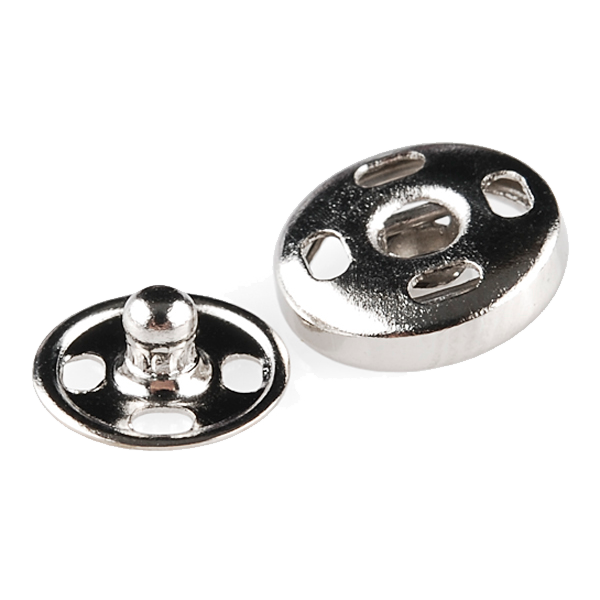 Snap Assortment - 30 pack (male and female)1 ẹyọ
 Aṣọ denim1 ẹyọ
 Aṣọ òwú (fúyẹ́)1 ẹyọ
 Òwú1 ẹyọ
Àwọn irinṣẹ́ tí a nílò:
 Òòlù
Òòlù Ẹ̀rọ Ìwọ̀n Agbára (Òṣùwọ̀n Ìsúnkì)
 Abẹ́rẹ́ ìránṣọ ọwọ́
 Ẹ̀mú ìgé oníkọ̀rọ̀
 Gílásì Ìgbéga Ọwọ́ 10x
 Ẹ̀rọ Ìwọ̀n Igun
5
5
A snap that will not behave
A snap that will not behave
Snap fastener troubleshooting.
Flow
Loading...
6
6
History and honest limits
History and honest limits
**George A. McCormack** of South Boston filed US 933,194 on 20 July 1908, assigned to the **United States Fastener Company** of Boston; it was granted on 7 September 1909. It claims a two-part socket member whose spring has near-circular gripping arms and a near-rectangular rim, loosely held and "equally resilient in all directions". Press studs themselves were older.
**Honest limits.** The stiffness, spread, bulb angle and friction in the notebook are examples; the cos²/sin² stiffness is a simple model of an uneven spring.
Àwọn ohun-èlò
5- Àyè
- 1 ẹyọ$3.54
- 1 ẹyọÀyè
- 1 ẹyọÀyè
- 1 ẹyọÀyè
Àwọn irinṣẹ́ tó nílò
6- Àyè
Àpapọ̀ Ìfojúsùn
Ohun tí ẹni tó ṣe é rà. Àwọn ohun èlò tí kò ní iye owó ni o máa rà níbi tí o bá ti rà á.
Blueprint tó jọra
Àwọn blueprint wọ̀nyí pín ìmọ̀ — ọ̀nà, ohun-èlò tàbí ìlànà

Sewing On a Button So It Stays On: The Shank Is the Whole Trick
láti ọwọ́ Tex
IṢẸ́ ỌWỌ́
19
0
0
0
0
0

Blanking: The Punch, the Die, and the Gap Between Them
láti ọwọ́ Forge
Iṣẹ́ Irin
10
0
0
0
0
0
Hooke's Law — Stretch a Spring and Find Its Stiffness
láti ọwọ́ Penny
Físíkì
37
0
0
0
0
0
The Leaf Spring: A Beam That Carries the Load and Locates the Axle
láti ọwọ́ Emma
Ìmọ̀ Ẹ̀rọ
6
0
0
0
0
0
Making a Seam: Pin, Tack, Sew, Press — In That Order
láti ọwọ́ Tex
Aṣọ àti Awọ
18
0
0
0
0
0
CC0 Àgbègbè Gbogbogbò
Blueprint yìí ti jáde lábẹ́ CC0. O lè ṣe àdàkọ, yí padà, pín, àti lò láìsí ìyọ̀ǹda.
Ṣàtìlẹ́yìn Olùṣẹ́dá nípa rírà àwọn ọjà nipasẹ̀ Blueprint wọn Ẹ̀san Olùṣẹ́dá tí àwọn Olùtajà gbé kalẹ̀, tàbí ṣẹ̀dá àtúnṣe tuntun ti Blueprint yìí kí o sì fi sínú Blueprint rẹ gẹ́gẹ́ bí ìsopọ̀ láti pín owó-wíwọlé.