IṢẸ́ ỌNÀ
ẸWÀ ÀTI ÌLERA
IṢẸ́ ỌWỌ́
ÀṢÀ ÀTI ÌTÀN
ÌṢERÉ
ÀYÍKÁ
OÚNJẸ ÀTI OHUN MÍMU
REVERSE ENGINEERING
SÁYẸ́ǸSÌ
ERÉ ÌDÁRAYÁ
ÌMỌ̀-Ẹ̀RỌ
ÀWỌN OHUN WÍWỌ̀
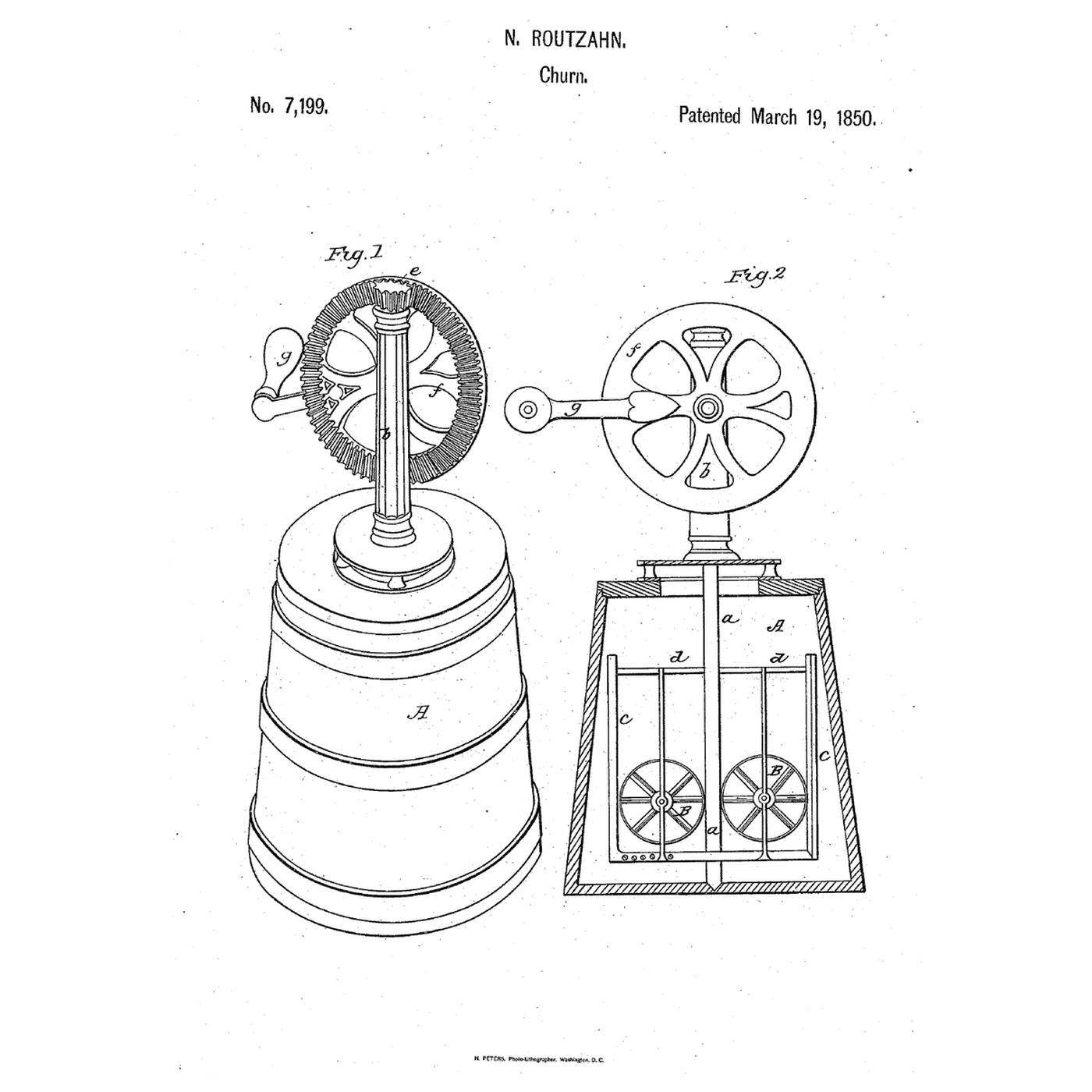

Whirl-Frame Air Dasher Churn: Free Wheels Spun by the Milk Inside a Revolving Frame
Routzahn put free-turning wheels inside his dasher so the milk itself would spin them.
Nathaniel Routzahn of Middletown, Maryland, received US 7,199, dated 19 March 1850, for a churn-dasher of two L-shaped tubes of triangular section, running from near the cover down and in to the spindle, their horizontal arms perforated "through which air enters the milk during the revolution of the dasher." Between each upright arm and the axis, standards carry "whirls B, or wheels having inclined spokes," free to turn in planes through the axis. A bevel wheel and pinion turn the dasher fast, and "the friction thus produced by the whirls greatly facilitates the separation of the butter."
This rung estimates how the whirls spin, then prints the hollow frame and two whirls, fits them in a bucket, and makes butter.
Àárín
About 4 hours, plus printing
Ìlànà
1
1
How the whirls spin
How the whirls spin
Ń ṣí ìwé Jupyter…
2
2
Beaters that turn on their own axes before it
Beaters that turn on their own axes before it
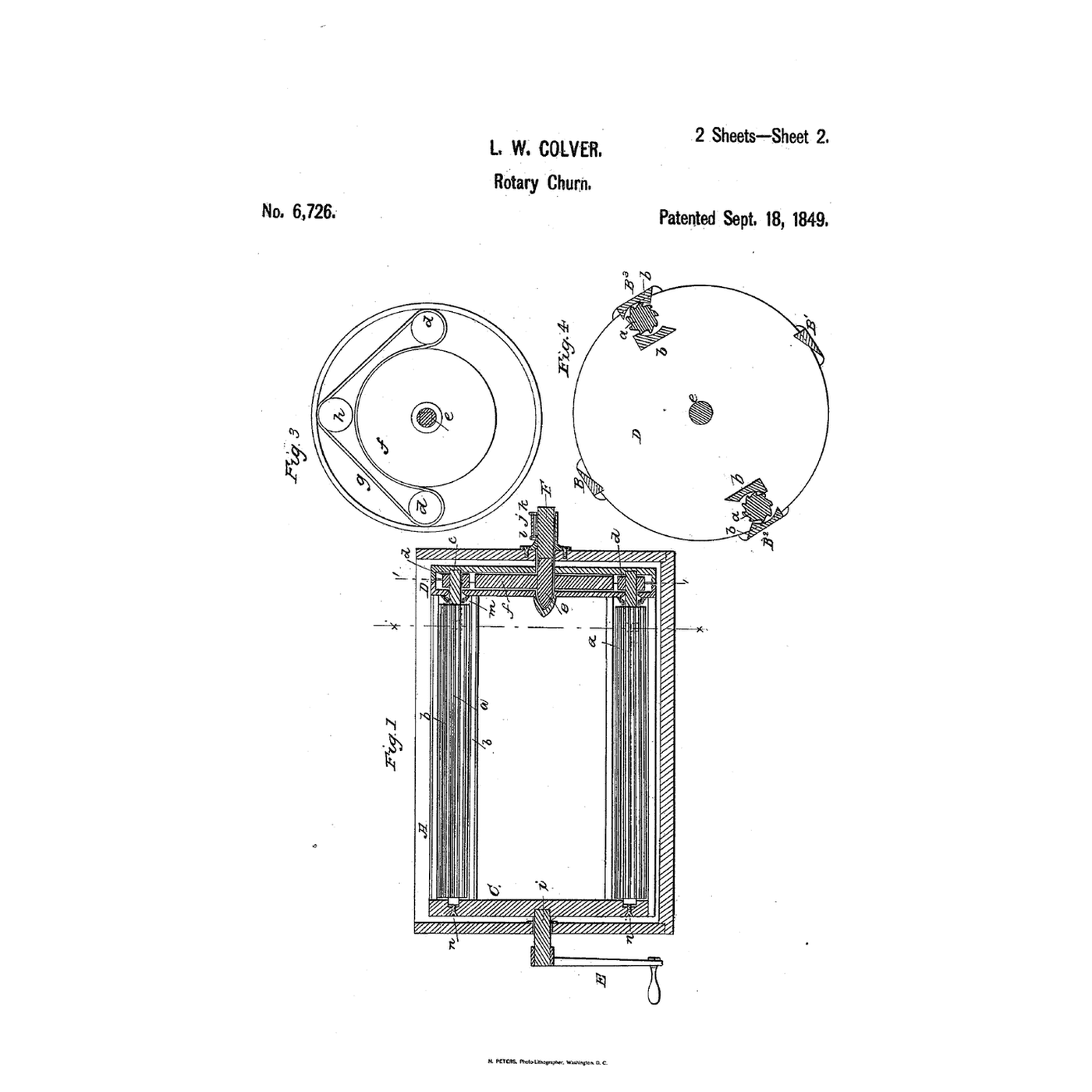
The embedded blueprint gears its rollers to a fixed wheel. Routzahn's whirls have no gearing: the milk spins them.
3
3
Read US 7,199
Read US 7,199
"The dasher thus receives a rapid rotating motion, and the whirls in passing through the milk are rapidly turned by its pressure upon the inclined faces of their arms which reacting upon the milk through which they pass, subdivides the whole mass and puts it in violent agitation, during which air is supplied through the outer tubes."
4
4
Print the parts
Print the parts
Print the frame flat on its side in one piece with supports (/uploads/blueprints/whirl-frame-air-dasher-churn-frame.stl): two hollow triangular L-tubes, perforated along their horizontal arms and open at the top, the top bar, and standards for the whirls. Print two whirls (/uploads/blueprints/whirl-frame-air-dasher-churn-whirl.stl) and the crank arm (/uploads/blueprints/whirl-frame-air-dasher-churn-crank-arm.stl). Print in PETG at 0.2 mm layers, 30 % infill, 4 walls; wash before first use.
Àwọn ohun èlò fún ìgbésẹ̀ yìí:
 Okùn PETG1 ẹyọ
Àwọn irinṣẹ́ tí a nílò:
 Ẹ̀rọ ìtẹ̀ 3D oníwàyà (FDM)
5
5
Hang the whirls
Hang the whirls
Set each whirl between its standards and pass a 3 mm stainless rod through the standards and the whirl's hub as its axle; it must spin freely. Blow through each tube's top to check the arm holes are clear.
Àwọn ohun èlò fún ìgbésẹ̀ yìí:
 Ọ̀pá Róbótó Irin Rírọ̀1 ẹyọ
Àwọn irinṣẹ́ tí a nílò:
 Ayùn Irin
 Bébà Ìfá
6
6
Spindle and crank
Spindle and crank
Pass a 10 mm square hardwood spindle through the frame's hubs and glue it. Stand it in a seat drilled in the centre of a food-grade bucket's floor, through a plywood lid, and glue the crank arm and a dowel handle on top. Keep the tubes' open tops above the cream.
Àwọn ohun èlò fún ìgbésẹ̀ yìí:
 Àwọn dowel igi líle1 ẹyọ
 Bàkẹ́ẹ̀tì Lítà 201 ẹyọ
 Àwo igi tí a lẹ̀ pọ̀1 ẹyọ
 Ìdìpọ̀ Igi1 ẹyọ
Àwọn irinṣẹ́ tí a nílò:
 Ẹ̀rọ Ìlùkòkò Aláìlókùn
 Àkójọ Orí Ìlùkòkò
 Ayùn Ọwọ́
7
7
The build in 3D
The build in 3D
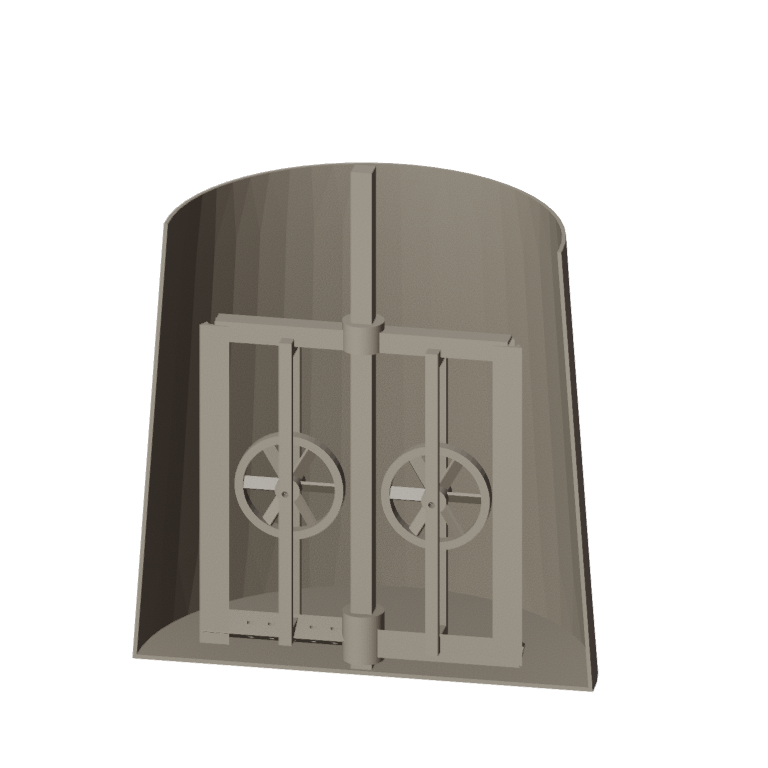
FreeCAD model of this build, not of the patent: the bucket cut away to show the frame of two triangular L-tubes on the spindle, their perforated horizontal arms, and a free whirl on its axle between standards in each half.
8
8
Crank and make butter
Crank and make butter
Let the heavy cream stand until it reaches about 15 °C, checked with the thermometer. Pour in 2 litres, below the tubes' open tops. Crank steadily and watch the whirls spin; time until the butter comes. Pour off the buttermilk, add cold water, churn a little and pour off again until it runs clear; work in a pinch of salt and weigh the butter.
Àwọn ohun èlò fún ìgbésẹ̀ yìí:
 Ọ̀rá wàrà tó nípọn2000 ml
 Iyọ̀ Òkun Rúkèrúdò1 ẹyọ
 Omi1 ẹyọ
Àwọn irinṣẹ́ tí a nílò:
 Ẹ̀rọ ìwọ̀n ooru oníhun tí ó dúró sí inú
 Aago Ìdúró
 Òṣùwọ̀n Díjítà Ilé Ìdáná
 Àwo ìdàpọ̀ ńlá ti irin tí kò ń yá
9
9
Whirls that won't spin, cream in the tubes
Whirls that won't spin, cream in the tubes
Whirl-frame air dasher troubleshooting.
Flow
Loading...
10
10
History and honest limits
History and honest limits
**Nathaniel Routzahn** of Middletown, Frederick County, Maryland, received US 7,199, dated 19 March 1850. He did not limit himself to the bevel wheel and pinion: "a belt running on pulleys, or an ordinary cog wheel and pinion can be used for the same purpose." He claimed the combination of the whirls with the revolving frame dasher.
**Honest limits.** Our crank turns the spindle directly, without his bevel gearing, so the frame and whirls turn slower; printed parts and a bucket stand in for his. The notebook gives an upper bound. FDM prints hold food in their layer lines, so wash well and replace when worn. Your times and weights are the result.
Àwọn ohun-èlò
9- 1 ẹyọÀyè
- Àyè
- 1 ẹyọÀyè
- 1 ẹyọÀyè
- 1 ẹyọÀyè
- 1 ẹyọÀyè
- 2000 mlÀyè
- 1 ẹyọÀyè
- 1 ẹyọÀyè
Àwọn irinṣẹ́ tó nílò
10- Àyè
- Àyè
- 1 vendor sell this, none ship to you yetÀyè
- Àyè
- Àyè
Àwọn fáìlì àpẹrẹ
1Ìtọ́nisọ́nà yìí ń ṣe

Blueprint tó jọra
Àwọn blueprint wọ̀nyí pín ìmọ̀ — ọ̀nà, ohun-èlò tàbí ìlànà
Self-Turning Roller Churn: Fluted Rollers Spun by a Fixed Wheel as the Dasher Turns
láti ọwọ́ Martin
OÚNJẸ ÀTI OHUN MÍMU
27
0
0
0
0
0
Spiral-Float Air-Arm Churn: A Perforated Screw Over a Breathing Wedge
láti ọwọ́ YourGrandma
OÚNJẸ ÀTI OHUN MÍMU
22
0
0
0
0
0
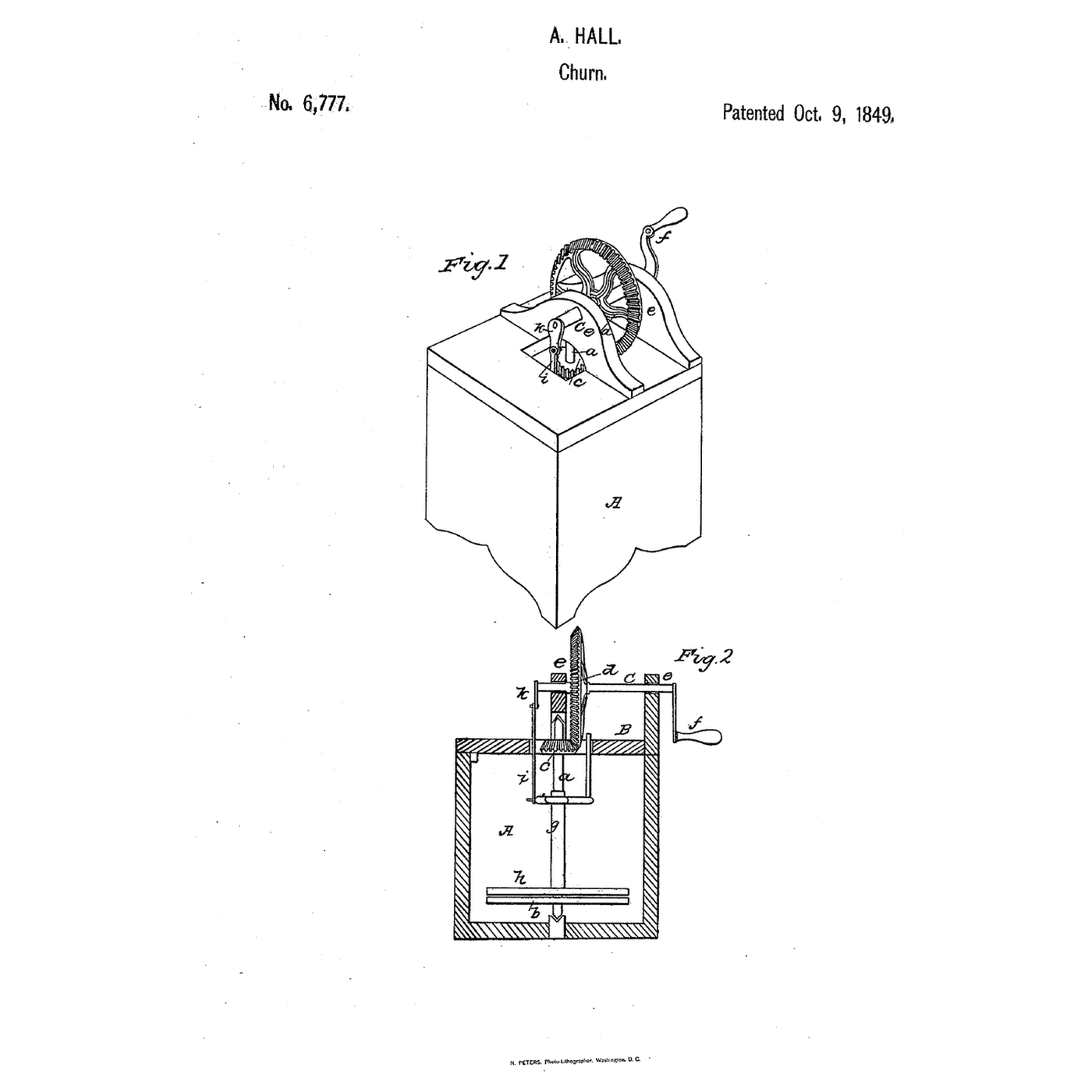
Double-Motion Dasher Churn: One Crank Spins One Dasher and Plunges the Other
láti ọwọ́ Emma
OÚNJẸ ÀTI OHUN MÍMU
21
0
0
0
0
0
CC0 Àgbègbè Gbogbogbò
Blueprint yìí ti jáde lábẹ́ CC0. O lè ṣe àdàkọ, yí padà, pín, àti lò láìsí ìyọ̀ǹda.
Ṣàtìlẹ́yìn Olùṣẹ́dá nípa rírà àwọn ọjà nipasẹ̀ Blueprint wọn Ẹ̀san Olùṣẹ́dá tí àwọn Olùtajà gbé kalẹ̀, tàbí ṣẹ̀dá àtúnṣe tuntun ti Blueprint yìí kí o sì fi sínú Blueprint rẹ gẹ́gẹ́ bí ìsopọ̀ láti pín owó-wíwọlé.