IṢẸ́ ỌNÀ
ẸWÀ ÀTI ÌLERA
IṢẸ́ ỌWỌ́
ÀṢÀ ÀTI ÌTÀN
ÌṢERÉ
ÀYÍKÁ
OÚNJẸ ÀTI OHUN MÍMU
REVERSE ENGINEERING
SÁYẸ́ǸSÌ
ERÉ ÌDÁRAYÁ
ÌMỌ̀-Ẹ̀RỌ
ÀWỌN OHUN WÍWỌ̀
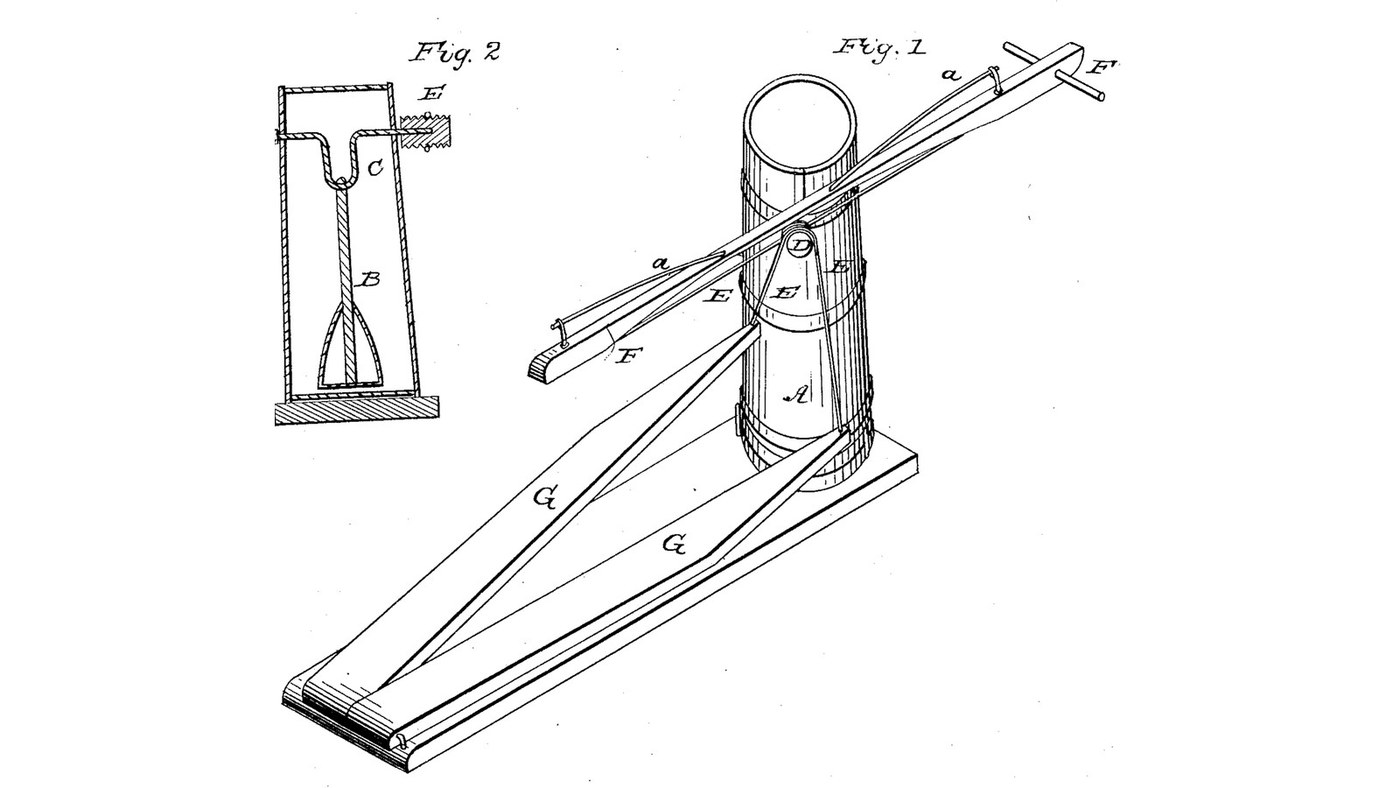

Spring-Bow Churn: A Bow With Two Springs Keeps Its Cord Tight Round a Screw Whirl on the Crank Shaft
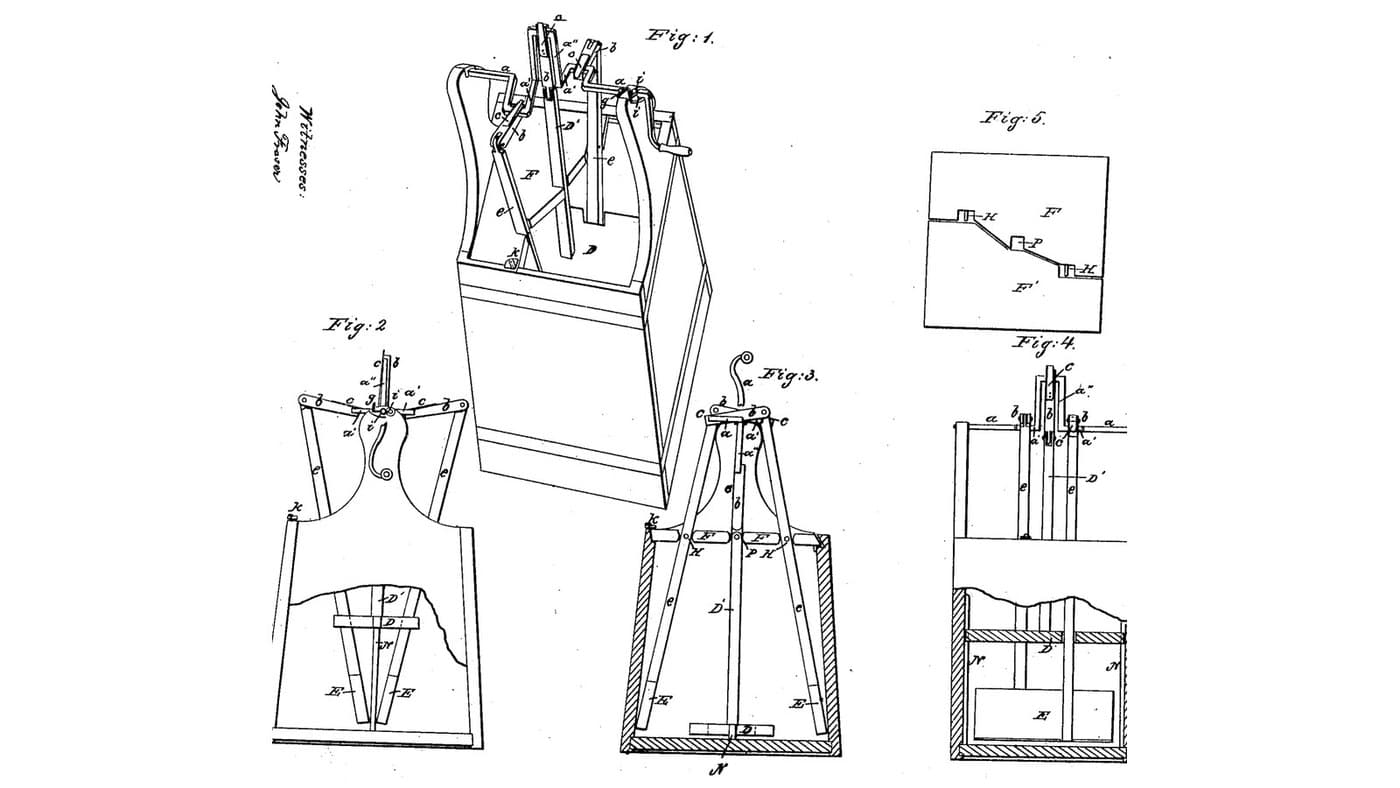
Abner Willson of Colden, New York, received US 27,181, dated 14 February 1860, for a churn worked like a bow drill. A cord from a stiff bow takes a turn round a screw whirl on the crank shaft; pushing and drawing the bow spins the crank, which lifts and drops the dasher. Two springs on the bow, one near each end, hold the cord, so it stays tight both ways and does not slip.
The patent gives no sizes; every size here is ours.
Àárín
About 2 days, plus printing
Ìlànà
1
1
From bow strokes to dasher strokes
From bow strokes to dasher strokes
Ń ṣí ìwé Jupyter…
2
2
The bow and cord that turn a spindle
The bow and cord that turn a spindle
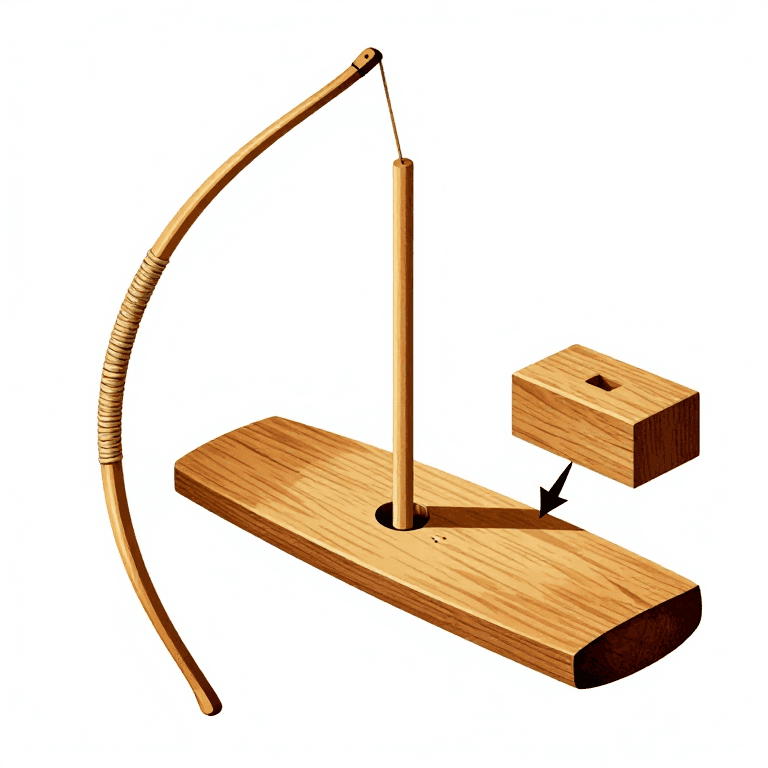
A bow drill's cord, wrapped round a spindle, turns it back and forth. Willson puts the same bow on a churn.
3
3
A crank that strokes a dasher, the year before
A crank that strokes a dasher, the year before
Austin's crank lifts and drops a dasher. Willson turns his crank with a bow instead of a handle.
4
4
Read US 27,181
Read US 27,181
"The effect of these two springs on an inflexible bow is to keep the cord always at a proper tension; in a flexible bow constructed as is customary, (unless the cord is very tense) when the bow is pushed, that portion of the cord between the whirl and the hither end of the bow slackens; and when the bow is drawn, that portion of the cord between the whirl and farther end of the bow slackens; this slackening which causes a slipping and a loss of power, is avoided by my peculiarly constructed bow. The threads of the whirl keep the cord from chafing."
5
5
Print the screw whirl D
Print the screw whirl D
Whirl 50 mm across and 60 long with a helical groove at 6 mm pitch for the cord, and a hub 36 mm across; bored 12.4 mm for the crank shaft. PETG, 0.2 mm layers, 40 % infill, 4 walls.
6
6
Print the dasher B
Print the dasher B
Cone dasher 160 mm across, open underneath, with a socket 20.6 mm across for the dasher rod. PETG, 0.2 mm layers, 40 % infill, 4 walls.
7
7
Crank shaft C and dasher B
Crank shaft C and dasher B
Drill a 13 mm hole through each side of the bucket, opposite each other, 300 mm above the inside floor. Cut a 12 mm stainless rod 450 mm long. Glue a 20 mm hardwood dowel 220 mm long into the dasher's socket, and drill 12.6 mm across its top end, 12 mm from the end. Starting 155 mm from one end, bend a crank 40 mm deep and 40 mm wide in the vise; slide the dasher rod's eye onto the crank pin before bending the second side. Pass the shaft through the bucket's holes with the crank inside, centred, and fit a collar on the short end. Seal round both holes outside with silicone sealant.
Àwọn ohun èlò fún ìgbésẹ̀ yìí:
 Bàkẹ́ẹ̀tì Lítà 201 ẹyọ
 Ọ̀pá irin tí kò ń yá1 ẹyọ
 Àwọn dowel igi líle1 ẹyọ
 Ìdìpọ̀ Igi1 ẹyọ
 Shaft Collar1 ẹyọ
 Ìdílẹ̀ Silikoni1 ẹyọ
 Okùn PETG1 ẹyọ
Àwọn irinṣẹ́ tí a nílò:
 Ẹ̀rọ ìtẹ̀ 3D oníwàyà (FDM)
 Ẹ̀rọ Ìlùkòkò Aláìlókùn
 Àkójọ Orí Ìlùkòkò
 Ayùn Irin
 Ìdìmú Tábìlì
 Àwọn Ìfá (Ìfá Ọwọ́)
 Okùn Ìdíwọ̀n
8
8
Fix the screw whirl D
Fix the screw whirl D
Slide the whirl onto the long end of the shaft outside the bucket, hub towards the bucket, 10 mm clear of it. Drill 4 mm through the hub and shaft, and drive in a 4 mm stainless pin cut from rod, so the whirl is "firmly attached to the crank shaft".
Àwọn ohun èlò fún ìgbésẹ̀ yìí:
Ọ̀pá irin tí kò ń yá1 ẹyọÀwọn irinṣẹ́ tí a nílò:
Ẹ̀rọ Ìlùkòkò AláìlókùnÀkójọ Orí ÌlùkòkòAyùn IrinÀwọn Ìfá (Ìfá Ọwọ́)Ìdìmú Tábìlì9
9
Bow F with springs a and cord E
Bow F with springs a and cord E
Cut a hardwood bow 700 x 50 x 30 mm, the patent's "inflexible bow", and plane and sand its underside slightly curved. Fit a dowel through one end as a handle, as in Fig. 1. Screw a spring-steel strip 120 x 16 mm by its inner end to the upper side near each end, outer ends free and reaching the bow's ends; drill a 5 mm hole through the bow under each spring's outer end and a 5 mm hole in each spring's tip. Pass a 4 mm cord up through each bow hole and tie it to the spring's tip, leaving enough slack between to take one turn round the whirl with the springs bent down a little.
Àwọn ohun èlò fún ìgbésẹ̀ yìí:
 Pátákó Igi Líle1 ẹyọÀwọn dowel igi líle1 ẹyọÌdìpọ̀ Igi1 ẹyọ
 Ọ̀pá irin orísun2 ẹyọ
 Ìṣó igi4 ẹyọ
 Okùn1 ẹyọ
Àwọn irinṣẹ́ tí a nílò:
 Ayùn tábìlì
 Bébà ÌfáẸ̀rọ Ìlùkòkò AláìlókùnÀkójọ Orí ÌlùkòkòAyùn IrinÀwọn Ìfá (Ìfá Ọwọ́)Ìdìmú Tábìlì
 Ìdìmú oní-ọ̀pá
 Ìṣù àwọn ohun ìyí skurú
10
10
The build in 3D
The build in 3D
FreeCAD model of this build, the bucket cut through the middle: the crank shaft with its 40 mm crank, the dasher hanging from the crank pin, the screw whirl outside, and the bow with its two springs and cord.
11
11
Churn
Churn
Pour about 8 litres of heavy cream at about 15 °C, checked with the thermometer, into the bucket and put on its lid. Lay the cord in the whirl's groove with one turn round it, have someone steady the bucket or hold it between your feet, and push and draw the bow steadily, timing it. When the butter comes, take off the lid, lift the butter out past the dasher, tip the buttermilk out into a bowl, wash the butter in cold water until it runs clear, salt and weigh it.
Àwọn ohun èlò fún ìgbésẹ̀ yìí:
 Ọ̀rá wàrà tó nípọn8 l
 Iyọ̀ Òkun Rúkèrúdò1 ẹyọ
 Omi1 ẹyọ
Àwọn irinṣẹ́ tí a nílò:
 Ẹ̀rọ ìwọ̀n ooru oníhun tí ó dúró sí inú
 Aago Ìdúró
 Òṣùwọ̀n Díjítà Ilé Ìdáná
 Àwo ìdàpọ̀ ńlá ti irin tí kò ń yá
12
12
Troubleshooting
Troubleshooting
Spring-bow churn troubleshooting.
Flow
Loading...
13
13
History and honest limits
History and honest limits
**Abner Willson** of Colden, Erie County, New York, US 27,181, 14 February 1860, "Churn". He claimed "the bow F with springs a when constructed as described, in combination with screw whirl D operating as set forth"; he did not claim the treadles G he also shows, nor the dasher, crank shaft or vessel. His vessel is a tall wooden one; ours is a food-grade bucket, and the cone dasher, its rod and our way of fixing the whirl are ours. The patent gives no sizes; every size here is ours.
Àwọn ohun-èlò
14- 1 ẹyọÀyè
- 1 ẹyọÀyè
- 1 ẹyọÀyè
- 2 ẹyọÀyè
- 1 ẹyọÀyè
- 1 ẹyọÀyè
- 1 ẹyọÀyè
- 1 ẹyọÀyè
- 2 ẹyọÀyè
- 4 ẹyọÀyè
- 1 ẹyọÀyè
- Àyè
- 1 ẹyọÀyè
- 1 ẹyọÀyè
Àwọn irinṣẹ́ tó nílò
15- 1 vendor sell this, none ship to you yetÀyè
- Àyè
- Àyè
- 1 vendor sell this, none ship to you yetÀyè
- 1 vendor sell this, none ship to you yetÀyè
- Àyè
- Àyè
Àwọn fáìlì àpẹrẹ
3Ìtọ́nisọ́nà yìí ń ṣe

Blueprint tó jọra
Àwọn blueprint wọ̀nyí pín ìmọ̀ — ọ̀nà, ohun-èlò tàbí ìlànà
Three-Crank Churn: One Dasher Strokes Up and Down While Two Side Dashers Swing In and Out
láti ọwọ́ Buttercup
Iṣẹ́ Igi
14
0
0
0
0
0
Egyptian Bow Drill — Making an Egyptian Bow Drill for Fire and Drilling
láti ọwọ́ Woody
Iṣẹ́ Igi
89
0
0
0
0
0
Churning Butter from Cream — The 5,000-Year-Old Fat Separation
láti ọwọ́ TheChef
IṢẸ́ ỌWỌ́
63
0
0
0
0
0
CC0 Àgbègbè Gbogbogbò
Blueprint yìí ti jáde lábẹ́ CC0. O lè ṣe àdàkọ, yí padà, pín, àti lò láìsí ìyọ̀ǹda.
Ṣàtìlẹ́yìn Olùṣẹ́dá nípa rírà àwọn ọjà nipasẹ̀ Blueprint wọn Ẹ̀san Olùṣẹ́dá tí àwọn Olùtajà gbé kalẹ̀, tàbí ṣẹ̀dá àtúnṣe tuntun ti Blueprint yìí kí o sì fi sínú Blueprint rẹ gẹ́gẹ́ bí ìsopọ̀ láti pín owó-wíwọlé.