IṢẸ́ ỌNÀ
ẸWÀ ÀTI ÌLERA
IṢẸ́ ỌWỌ́
ÀṢÀ ÀTI ÌTÀN
ÌṢERÉ
ÀYÍKÁ
OÚNJẸ ÀTI OHUN MÍMU
REVERSE ENGINEERING
SÁYẸ́ǸSÌ
ERÉ ÌDÁRAYÁ
ÌMỌ̀-Ẹ̀RỌ
ÀWỌN OHUN WÍWỌ̀
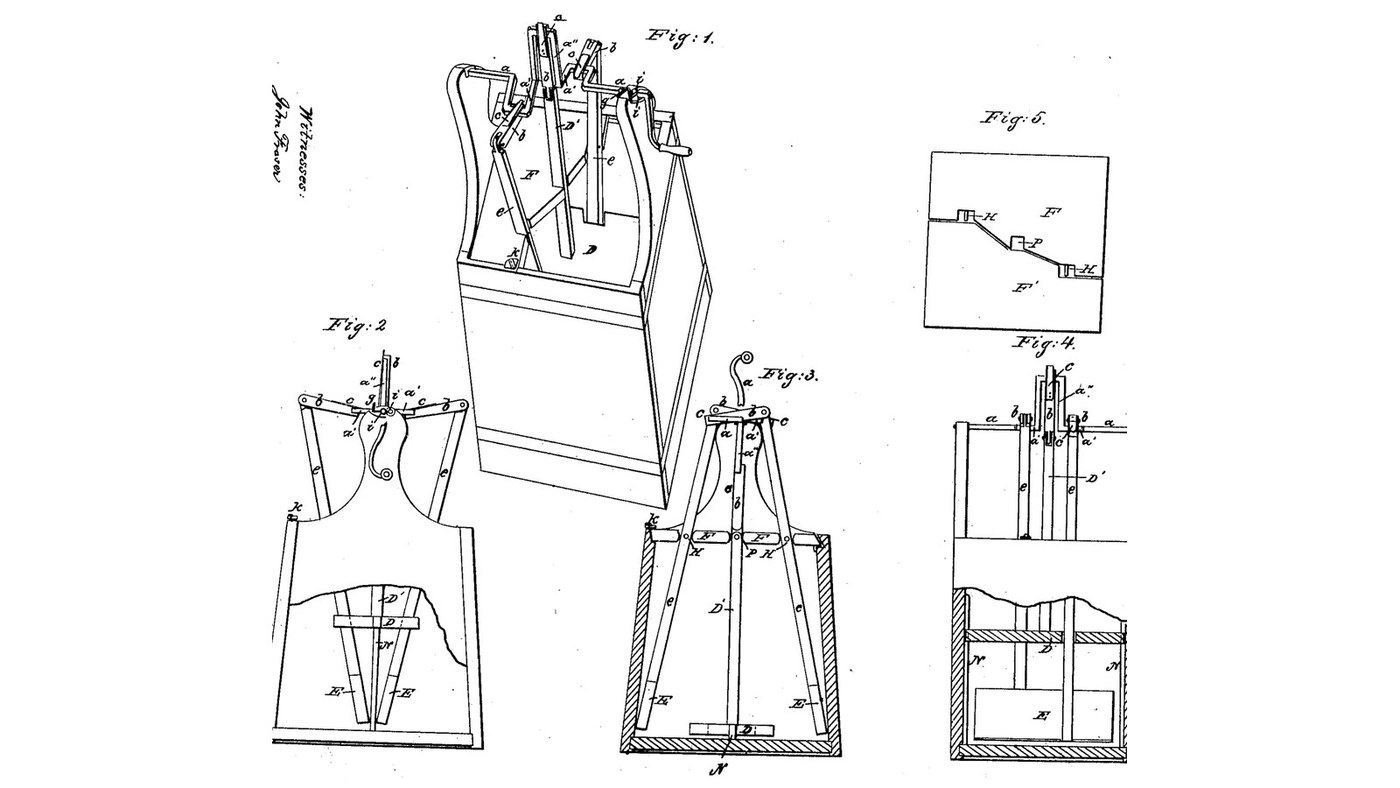

Three-Crank Churn: One Dasher Strokes Up and Down While Two Side Dashers Swing In and Out
Abel Austin of Altona, Illinois, received US 25,553, dated 27 September 1859, for a churn. A shaft bent into three cranks works three dashers: the middle one strokes straight up and down between guides on the box's ends, and two side dashers on levers pivoted in the lid swing sideways, coming together as the middle one rises and parting as it falls. The shaft and dashers lift out together, and the side dashers also press the buttermilk out of the butter.
The patent gives no sizes; every size here is ours.
Àárín
About 3 days, plus printing
Ìlànà
1
1
Up and down in the middle, in and out at the sides
Up and down in the middle, in and out at the sides
Ń ṣí ìwé Jupyter…
2
2
Dashers on a bent crank shaft, two weeks before
Dashers on a bent crank shaft, two weeks before
Gilpatrick's two dashers both stroke up and down. Austin keeps one up-and-down dasher and adds two that swing sideways.
3
3
Read US 25,553
Read US 25,553
"My invention uses the old principle of the up and down dasher and for the purpose the greatest possible effective motion to the milk in a breaking or dashing manner, the side dashers having a lateral stroke are added, they are also designed to gather the butter after it is churned and press and work out the buttermilk."
4
4
Print the middle link
Print the middle link
The link from the middle crank to D's handle: 120 mm between its two 12.6 mm eyes, 22 x 10 mm. PETG, 0.2 mm layers, 40 % infill, 4 walls.
5
5
Print the side links
Print the side links
The links from the side cranks to the side levers: 167 mm between their eyes, 22 x 10 mm. Print two. PETG, 0.2 mm layers, 40 % infill, 4 walls.
6
6
Box, stays N and posts
Box, stays N and posts
From 20 mm hardwood make a box 500 mm long inside, 300 mm wide at the floor and 360 mm at the top, 380 mm deep, with square ends and the sides sloping out. Carry each end up as a post 80 mm wide to 650 mm above the floor, cut a 13 mm slot down its middle to 600 mm, and hinge a hardwood cap over the slot, held by a hook and eye. Glue two strips 20 x 20 mm up the inside of each end, 64 mm apart, as the stays N. Fill the box with water overnight so it swells tight, then empty it.
Àwọn ohun èlò fún ìgbésẹ̀ yìí:
 Pátákó Igi Líle4 ẹyọ
 Ìdìpọ̀ Igi1 ẹyọ
 Ìṣó igi40 ẹyọ
 Ìsopọ̀ ilẹ̀kùn àpótí2 ẹyọ
 Ìkọ̀ àti ojú2 ẹyọ
Àwọn irinṣẹ́ tí a nílò:
 Ayùn tábìlì
 Ayùn Ọwọ́
 Ayùn Jígísò
 Ẹ̀rọ Ìlùkòkò Aláìlókùn
 Àkójọ Orí Ìlùkòkò
 Ìdìmú oní-ọ̀pá
 Igun-òsùwọ̀n tí ó dúró
 Okùn Ìdíwọ̀n
 Omi
 Ìṣù àwọn ohun ìyí skurú
7
7
Lid F, F' and pivots H
Lid F, F' and pivots H
Cut the lid to lie on the box between the posts, in two parts: F, 360 mm long from one end, and F' for the rest, with a turn button K on F to hold F'. In F cut a slot P 40 mm square in the middle, and two slots 30 x 50 mm each side, 40 mm either side of the middle and 133 mm out from it, and bore each across for a 10 mm stainless pin: the pivots H.
Àwọn ohun èlò fún ìgbésẹ̀ yìí:
Pátákó Igi Líle1 ẹyọ Ọ̀pá irin tí kò ń yá1 ẹyọÌṣó igi2 ẹyọ
Àwọn irinṣẹ́ tí a nílò:
Ayùn tábìlìAyùn Jígísò Ìṣó ihò ìdì
 Òòlù IgiẸ̀rọ Ìlùkòkò AláìlókùnÀkójọ Orí Ìlùkòkò
 Ayùn Irin
8
8
Shaft a with three cranks
Shaft a with three cranks
Bend 12 mm stainless rod about 900 mm long, heating each bend red with the torch, into three cranks side by side in the middle: a middle crank of 40 mm throw, and a 25 mm crank each side of it, those two pointing opposite ways and both at right angles to the middle one. Make each crank pin 40 mm long. Leave 220 mm of straight shaft one side and 250 mm the other, and fit a hardwood crank handle on the longer end.
Àwọn ohun èlò fún ìgbésẹ̀ yìí:
Ọ̀pá irin tí kò ń yá1 ẹyọPátákó Igi Líle1 ẹyọ Àwọn dowel igi líle1 ẹyọÌdìpọ̀ Igi1 ẹyọ
Àwọn irinṣẹ́ tí a nílò:
 Ọ̀pá Iná Pùróféènì
 Ìdìmú Tábìlì
 Òòlù
 Ìbọ̀wọ́ Tí Ń Fara Da OoruAyùn Irin
 Àwọn Ìfá (Ìfá Ọwọ́)Ẹ̀rọ Ìlùkòkò AláìlókùnÀkójọ Orí Ìlùkòkò
9
9
Dashers D and E, E
Dashers D and E, E
Make D a hardwood plate 498 x 60 x 20 mm, to slide between the stays, on a handle D' 30 mm square and 402 mm long, bored 12.6 mm 12 mm from its top. Make each side lever e 30 mm square and 514 mm long, bored 12.6 mm at its top and 10.4 mm 220 mm below it for the pivot, and screw a board E 440 x 120 x 20 mm across its foot. Set the lid on, D's handle through P and each lever in its slot on its pivot pin. Put the shaft in the posts' slots and close the caps, then join each crank to its handle with its printed link, fixed with washers and split pins.
Àwọn ohun èlò fún ìgbésẹ̀ yìí:
Pátákó Igi Líle2 ẹyọÌdìpọ̀ Igi1 ẹyọÌṣó igi8 ẹyọ Wáṣà Pẹrẹsẹ6 ẹyọ
 Ìṣó ẹlẹ́sẹ̀ méjì6 ẹyọ
 Okùn PETG1 ẹyọ
Àwọn irinṣẹ́ tí a nílò:
 Ẹ̀rọ ìtẹ̀ 3D oníwàyà (FDM)Ayùn tábìlìẸ̀rọ Ìlùkòkò AláìlókùnÀkójọ Orí ÌlùkòkòÌṣù àwọn ohun ìyí skurú
 Bébà ÌfáOkùn Ìdíwọ̀n
10
10
The build in 3D
The build in 3D
FreeCAD model of this build, one side and the loose half of the lid left off: the box with its stays and posts, the shaft with its three cranks, the links, the middle dasher in its stays and the two side dashers on their pivots. The crank was turned through 24 positions.
11
11
Churn, then press
Churn, then press
Pour about 20 litres of heavy cream at about 15 °C into the box, checked with the thermometer, put F' on and turn the button. Turn the crank steadily, timing it; F' can come off to look. When the butter comes, unhook the caps, slip the middle link off its crank, lift out the shaft with the side dashers and lid F, and pour off the buttermilk. Put the shaft and side dashers back, add cold water, and turn the crank to work the butter and press the buttermilk out with the side dashers. Lift out the butter, salt and weigh it.
Àwọn ohun èlò fún ìgbésẹ̀ yìí:
 Ọ̀rá wàrà tó nípọn20 l
 Iyọ̀ Òkun Rúkèrúdò1 ẹyọOmi1 ẹyọ
Àwọn irinṣẹ́ tí a nílò:
 Ẹ̀rọ ìwọ̀n ooru oníhun tí ó dúró sí inú
 Aago Ìdúró
 Òṣùwọ̀n Díjítà Ilé Ìdáná
 Àwo ìdàpọ̀ ńlá ti irin tí kò ń yá
12
12
Troubleshooting
Troubleshooting
Three-crank churn troubleshooting.
Flow
Loading...
13
13
History and honest limits
History and honest limits
**Abel Austin** of Altona, Knox County, Illinois, US 25,553, 27 September 1859, "Churn". He disclaimed the shaft with cranks and the dashers with handles on their own, and claimed their arrangement with the links, springs, bearing box i, spring g and lid F F'. The patent gives no sizes; every size here is ours. His springs c on the links and spring g on the bearing boxes are here split pins and a hook and eye.
Àwọn ohun-èlò
13- 4 ẹyọÀyè
- 3 ẹyọÀyè
- 50 ẹyọÀyè
- 2 ẹyọÀyè
- 2 ẹyọÀyè
- 1 ẹyọÀyè
- 1 ẹyọÀyè
- 6 ẹyọÀyè
- 6 ẹyọÀyè
- 1 ẹyọÀyè
- Àyè
- 1 ẹyọÀyè
- 1 ẹyọÀyè
Àwọn irinṣẹ́ tó nílò
24- 1 vendor sell this, none ship to you yetÀyè
- Àyè
- 1 vendor sell this, none ship to you yetÀyè
- 1 vendor sell this, none ship to you yetÀyè
- 1 vendor sell this, none ship to you yetÀyè
- Àyè
- Àyè
- Àyè
- Àyè
- Àyè
- Àyè
- Àyè
- Àyè
Àwọn fáìlì àpẹrẹ
3Ìtọ́nisọ́nà yìí ń ṣe

Blueprint tó jọra
Àwọn blueprint wọ̀nyí pín ìmọ̀ — ọ̀nà, ohun-èlò tàbí ìlànà
Twin-Crank Slide-Top Churn: Two Dashers on a Bent Crank Shaft, Sliding Plates Keep the Milk In
láti ọwọ́ Buttercup
Iṣẹ́ Igi
11
0
0
0
0
0
Hinged-Float Double-Dasher Churn: Floats That Close Going Down and Fall Open Coming Up
láti ọwọ́ Buttercup
Iṣẹ́ Igi
12
0
0
0
0
0
Churning Butter from Cream — The 5,000-Year-Old Fat Separation
láti ọwọ́ TheChef
IṢẸ́ ỌWỌ́
63
0
0
0
0
0
CC0 Àgbègbè Gbogbogbò
Blueprint yìí ti jáde lábẹ́ CC0. O lè ṣe àdàkọ, yí padà, pín, àti lò láìsí ìyọ̀ǹda.
Ṣàtìlẹ́yìn Olùṣẹ́dá nípa rírà àwọn ọjà nipasẹ̀ Blueprint wọn Ẹ̀san Olùṣẹ́dá tí àwọn Olùtajà gbé kalẹ̀, tàbí ṣẹ̀dá àtúnṣe tuntun ti Blueprint yìí kí o sì fi sínú Blueprint rẹ gẹ́gẹ́ bí ìsopọ̀ láti pín owó-wíwọlé.