Ìfọwọ́sowọ́pọ̀
IṢẸ́ ỌNÀ
ẸWÀ ÀTI ÌLERA
IṢẸ́ ỌWỌ́
ÀṢÀ ÀTI ÌTÀN
ÌṢERÉ
ÀYÍKÁ
OÚNJẸ ÀTI OHUN MÍMU
REVERSE ENGINEERING
SÁYẸ́ǸSÌ
ERÉ ÌDÁRAYÁ
ÌMỌ̀-Ẹ̀RỌ
ÀWỌN OHUN WÍWỌ̀
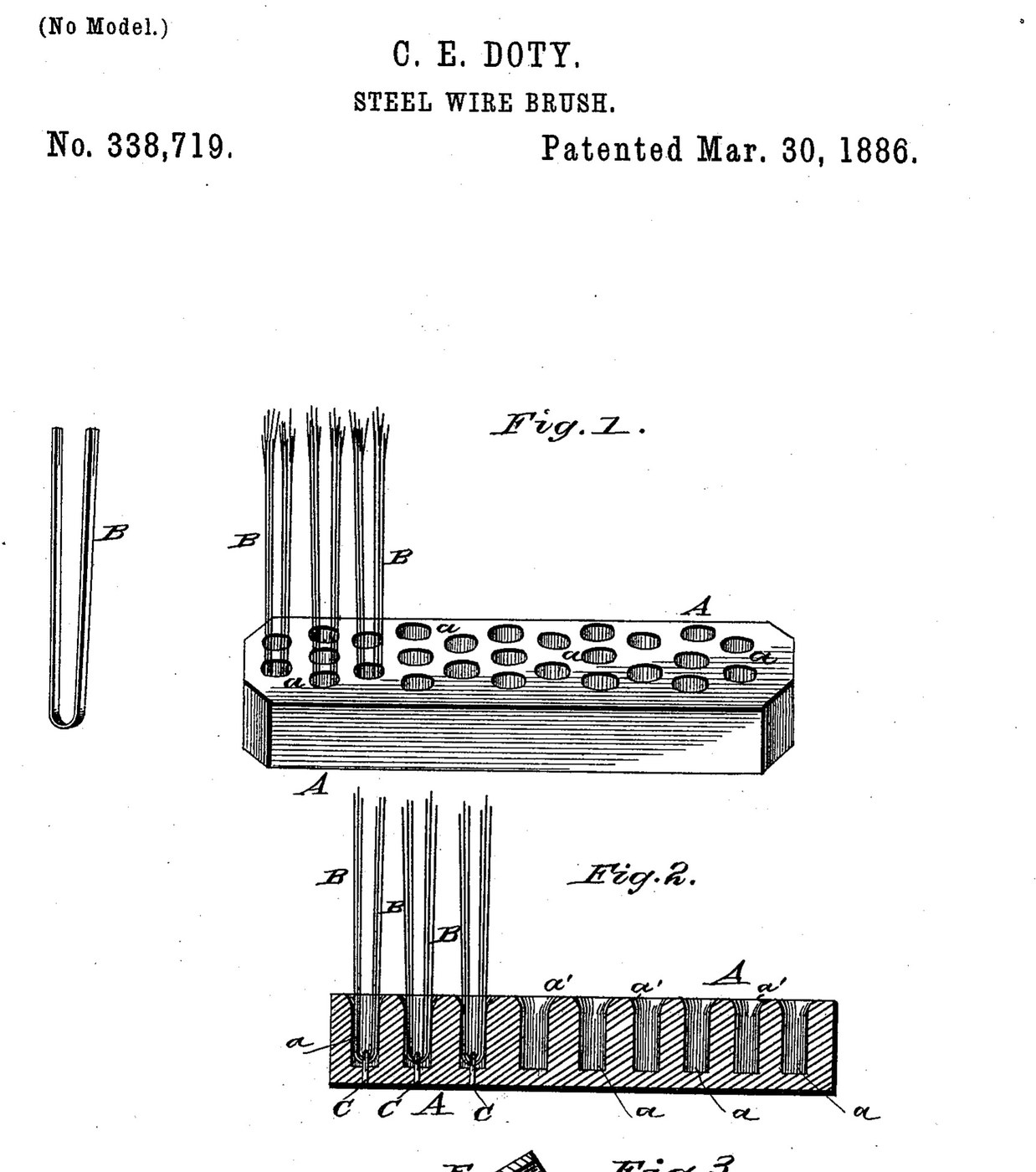


Wire Brush: Flat Steel Wire Tufts Stapled into a One-Piece Back (Doty, US 338,719, 1886)
A heavy steel wire brush whose back stays in one piece: flat steel wires are folded in bunches into blind holes and held by small staples driven right through the back and clinched on the other side. The holes flare at the mouth so the wires bend in a curve rather than snapping at the edge. All the wires lie the same way, so they flex alike and share the work.
Result: a steel wire brush for heavy scrubbing that holds its wires, with a smooth back.
Source: C. E. Doty, US 338,719 (1886). Unknown: the back material, sizes and wire gauge. Picture: the patent drawing.
Olùbẹ̀rẹ̀
Unknown
Ìlànà
1
1
Bore the back
Bore the back
Make the back in one piece and bore rows of holes into its face that do not go right through. Shape the mouth of each hole with a rounded, flaring wall so the wires bend in a curve there. Ours: a hardwood block. Not given: the back material, sizes.
Àwọn ohun èlò fún ìgbésẹ̀ yìí:
 Ìṣù Igi Líle1 brush back
Àwọn irinṣẹ́ tí a nílò:
 Ẹ̀rọ Ìlùkòkò Onídúró
 Ìwọ̀n tí a kò mọ̀
2
2
Flatten the wires
Flatten the wires
Use flat steel wires, so they flex most across their thin side. Cut them to twice the bristle length so each bunch folds in the middle. Ours: spring steel wire flattened on the anvil. Not given: the wire gauge.
Àwọn ohun èlò fún ìgbésẹ̀ yìí:
 Okùn irin kámánì1 bristle wires
Àwọn irinṣẹ́ tí a nílò:
 Ìdí Alágbẹ̀dẹ
 Òòlù
3
3
Staple in the tufts
Staple in the tufts
Lay the back, holes up, on a hard, smooth metal surface. Lay a bunch of wires across a hole, flat sides horizontal and lying the way the brush will be used. Set a short staple astride the middle of the bunch with its points in the hole. Bring a plunger down into the hole: it drives the folded bunch to the bottom and the staple's points right through the back. The points hit the metal surface and are bent over and clinched smoothly on the back. Tilt the back a little for the outer rows so their wires spread slightly outward.
Àwọn ohun èlò fún ìgbésẹ̀ yìí:
 Irin tí a kò mọ̀1 staples
Àwọn irinṣẹ́ tí a nílò:
 Ẹ̀rọ ìtẹ̀ ọwọ́Ìdí Alágbẹ̀dẹ
Àwọn ohun-èlò
3- 1 brush backÀyè
- 1 bristle wiresÀyè
- 1 staplesÀyè
Àwọn irinṣẹ́ tó nílò
5- Àyè
Àwọn Ohun Èlò Ìtọ́nisọ́nà Tí A So Pọ̀
Ìtọ́nisọ́nà yìí ń ṣe

CC0 Àgbègbè Gbogbogbò
Blueprint yìí ti jáde lábẹ́ CC0. O lè ṣe àdàkọ, yí padà, pín, àti lò láìsí ìyọ̀ǹda.
Ṣàtìlẹ́yìn Olùṣẹ́dá nípa rírà àwọn ọjà nipasẹ̀ Blueprint wọn Ẹ̀san Olùṣẹ́dá tí àwọn Olùtajà gbé kalẹ̀, tàbí ṣẹ̀dá àtúnṣe tuntun ti Blueprint yìí kí o sì fi sínú Blueprint rẹ gẹ́gẹ́ bí ìsopọ̀ láti pín owó-wíwọlé.