

Continuous Hay Press
Hay is almost all air. A wagon-load of loose hay is enormous and light, which makes it maddening to move and store — you cannot ship air across a country or stack much of it in a barn. The value is in the dried grass; the problem is the volume.
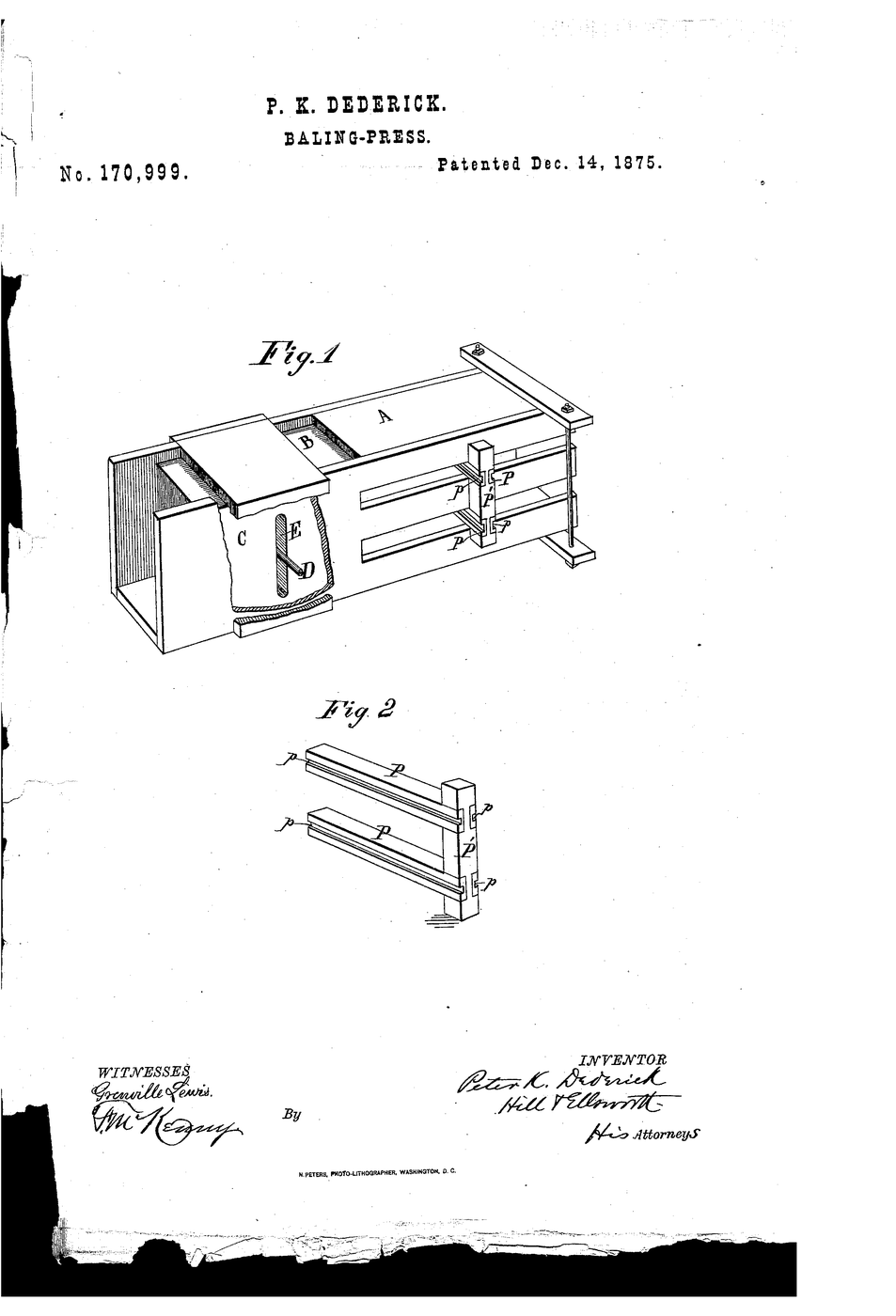
A hay press crushes that air out and locks the hay into a dense, tied bale you can stack, load and ship. Dederick's advance is to make the press continuous: instead of filling a box, ramming it, and emptying it, hay is fed in continuously and a reciprocating plunger compresses each charge against the resistance of the bale already forming ahead of it — so the machine never stops to unload.
The compression is the whole point, and it needs real force — which comes from mechanical advantage, a lever or toggle that turns a person's or horse's modest pull into the tonnes needed to squeeze hay to a fraction of its bulk.
US Patent 170,999, "Improvement in baling-presses", granted 14 December 1875 to P. K. Dederick of Albany, New York.
निर्देशनहरू
Read the word that matters: continuous
Read the word that matters: continuous
Presses existed; Dederick claims a continuous baling press — fed and compressed without stopping to unload. Note that word; it is the advance.
Measure the volume and mass of loose hay
Measure the volume and mass of loose hay
Loosely fill a box with dry grass or straw. Record its volume and mass, and compute its density. It will be tiny — hay is mostly air.
यस चरणका सामग्री:
 राई अन्नको पराल200 ग्राम
चाहिने औजार:
 तराजु
तराजुBuild a compression box with a plunger
Build a compression box with a plunger
Make a stiff open-topped box and a plunger that slides down inside it. This is the baling chamber.
यस चरणका सामग्री:
 बाल्टिक भुर्जा प्लाइउड1 पाना
चाहिने औजार:
 फलाम काट्ने आरा
Press the hay by hand and measure the new volume
Press the hay by hand and measure the new volume
Push the plunger down hard and hold. Measure the compressed volume. Same mass, far less space — density has jumped. Record it.
Feel how much force it takes
Feel how much force it takes
Read the force on the plunger with the spring scale as you compress. It rises steeply the more you squeeze — the last bit of air is the hardest to remove.
चाहिने औजार:
 बलमापक (स्प्रिङ तराजु)
Add a lever to the plunger
Add a lever to the plunger
Drive the plunger with a long lever pivoted near the plunger end. A small pull at the far end becomes a large push on the hay. Measure both forces.
यस चरणका सामग्री:
 काठको चुकुल1 टुक्रा
Compute the mechanical advantage
Compute the mechanical advantage
Divide the push on the hay by the pull on the lever. That ratio is your mechanical advantage — how the machine turns a horse's modest force into baling tonnes.
Tie the compressed charge before releasing
Tie the compressed charge before releasing
While it is squeezed, pass twine around the charge and tie it. Release — and it stays compressed. The tie holds the bale; the press only has to make it, not keep it.
यस चरणका सामग्री:
 भाङको डोरी1 मिटर
Compress against a bale already formed
Compress against a bale already formed
Leave the first tied bale in the box and press a new charge against it. The finished bale IS the back wall — this is the trick that makes the press continuous, no door to open.
Feed a second charge and push the first out
Feed a second charge and push the first out
Each new pressing shoves the chain of bales along and out the far end. Feed keeps going in, bales keep coming out — a production line, not a batch.
Compare stacking loose versus baled
Compare stacking loose versus baled
Stack the loose hay and the bales in the same footprint. Far more hay fits as bales — the reason a barn or a railcar can hold a season's feed.
Weigh a bale and a loose armful of equal size
Weigh a bale and a loose armful of equal size
Take equal volumes of bale and loose hay and weigh them. The ratio is the compression the press achieved — and the factor by which shipping got cheaper.
History & Context — squeezing the air out of the harvest
History & Context — squeezing the air out of the harvest
The patent. US 170,999, "Improvement in baling-presses", granted 14 December 1875 to P. K. Dederick of Albany, New York. Dederick is generally credited with the continuous hay press from the early 1870s, and the design principle is still used.
The invention is a change of cycle, not just a stronger press. Early presses were batch machines: fill a box, ram the charge, open a door, drag out the bale, start again — slow, and much of the time spent not pressing. Dederick's continuous press keeps a chain of bales in the chamber so that each new plunger stroke compresses fresh hay against the resistance of the bale already made (step 9), and simply pushes the whole train along and out the end (step 10). There is no unloading step, so the machine runs steadily as fast as hay is fed. That is the same insight as any continuous process: never stop the line to unload.
Why compression is worth so much force. Hay is perhaps nine-tenths air, and steps 2 and 4 show a bale can be a small fraction of the loose volume. But the last air is the hardest to remove — the force climbs steeply (step 5) — which is why the press needs the lever or toggle that multiplies a horse's pull into tonnes (steps 6 and 7). And crucially, the press does not have to hold the compression: the twine tie does that (step 8), so the machine only makes the bale and moves on. Dense, tied bales are why hay could be stored through winter, loaded onto wagons and railcars, and shipped from where grass grows to where animals are kept (steps 11 and 12).
Where it leads. The stationary continuous hay press is the direct ancestor of the field baler — the machine towed behind a tractor that picks up a windrow, compresses it, ties it and drops finished bales across the field, and of the big round balers that replaced it. Every one of them is doing what you did here: crush the air out, tie it off, and push the bale out the back so the next one can form. It is the packaging step of agriculture, and packaging is what lets a harvest travel.
सामग्री
4- 200 ग्रामप्लेसहोल्डर
- 1 पानाप्लेसहोल्डर
- 1 टुक्राप्लेसहोल्डर
- 1 मिटरप्लेसहोल्डर
आवश्यक उपकरणहरू
3- प्लेसहोल्डर
- प्लेसहोल्डर
- प्लेसहोल्डर
सम्बन्धित ब्लुप्रिन्ट
यी ब्लुप्रिन्टहरूले ज्ञान साझा गर्छन् — प्रविधि, सामग्री वा सिद्धान्त


CC0 सार्वजनिक डोमेन
यो ब्लुप्रिन्ट CC0 अन्तर्गत जारी गरिएको छ। तपाईं अनुमति नसोधी प्रतिलिपि, परिमार्जन, वितरण र प्रयोग गर्न सक्नुहुन्छ।
ब्लुप्रिन्ट मार्फत उत्पादनहरू किनेर सिर्जनाकर्तालाई सहयोग गर्नुहोस् सिर्जनाकर्ता कमिसन विक्रेताले तोकेको, वा यो ब्लुप्रिन्टको नयाँ संस्करण बनाउनुहोस् र आम्दानी बाँड्न आफ्नो ब्लुप्रिन्टमा जडानको रूपमा समावेश गर्नुहोस्।