
Edison Storage Battery
The lead-acid battery worked and still does, but around 1900 it had two properties Edison could not accept for an electric car: it was extremely heavy for the energy it held, and its plates degraded as it was cycled. He wanted a cell that could be charged and discharged indefinitely without changing.
His approach was to search the periodic table for one specific property. His earlier cell used cadmium and copper in an alkaline electrolyte. This patent describes what came next — hunting for an element whose oxide gives up its oxygen easily enough to replace copper, and finding one.
He states the target almost as a specification: an element "capable of being used in an alkaline electrolyte, the heat of formation of whose oxid should be as low or lower than that of oxid of mercury". The answer is nickel.
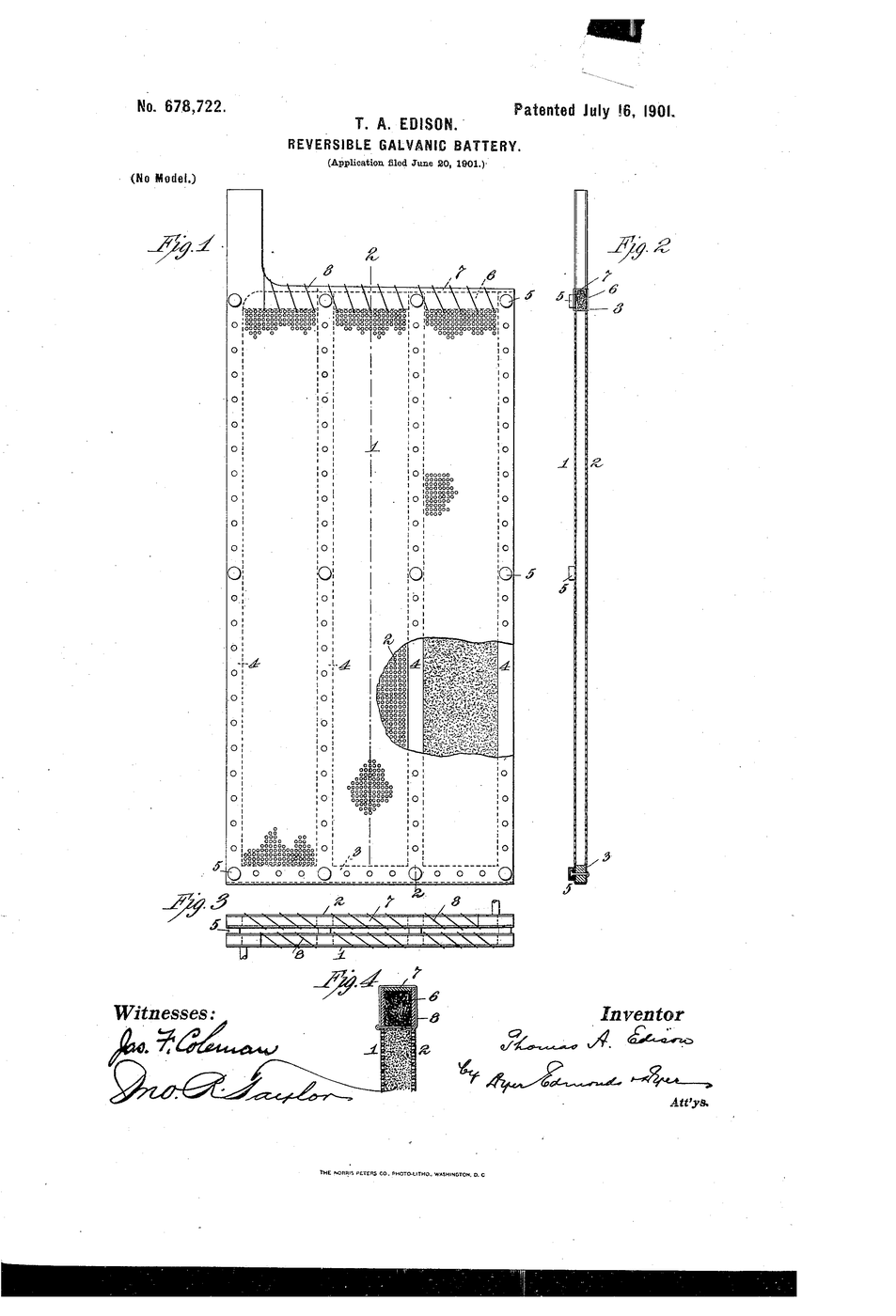
US Patent 678,722, "Reversible Galvanic Battery" (Case No. 1,060), filed 20 June 1901 and granted 16 July 1901 to Thomas A. Edison of Llewellyn Park, Essex County, New Jersey.
निर्देशनहरू
Read the requirement Edison set himself
Read the requirement Edison set himself
He wants an element usable "in an alkaline electrolyte" whose oxide has a heat of formation as low or lower than mercury oxide. That is a materials search written as a sentence.
Set up for alkali handling
Set up for alkali handling
The electrolyte is caustic: it attacks skin and eyes and does not hurt at first. Glasses and gloves on, water to hand, work over a tray.
चाहिने औजार:
 सफा सुरक्षा चस्मा
 बिजुली रोक्ने पन्जा
Cut an iron plate and a nickel-plated plate
Cut an iron plate and a nickel-plated plate
Cut two plates about 40 x 60 mm — one iron, one nickel-plated steel. Iron is the negative, nickel the positive.
यस चरणका सामग्री:
 फलामको पाता (घनले पिटिएको)1 पाना
चाहिने औजार:
 विद्युत् लेपन किट (निकल)
Clean both plates back to bare metal
Clean both plates back to bare metal
Abrade and degrease both. Oxide and grease from handling add resistance and make the cell look worse than it is.
Mix a dilute alkaline electrolyte
Mix a dilute alkaline electrolyte
Dissolve 20 g of sodium hydroxide in 200 ml of water, adding alkali to water, never the reverse. It warms as it dissolves; let it cool.
यस चरणका सामग्री:
 सोडियम हाइड्रोक्साइड — प्रयोगशाला स्तर20 ग्राम
 सिसाको भाँडो1 टुक्रा
Note the honest substitution
Note the honest substitution
Edison specifies potassium hydroxide. Sodium hydroxide is the safer, cheaper stand-in and behaves the same way here — record the change rather than pretending it is the original.
Assemble the cell without letting plates touch
Assemble the cell without letting plates touch
Suspend both plates in the electrolyte, parallel, about 20 mm apart, not touching. Keep the top edges dry for the leads.
Measure the cell before charging
Measure the cell before charging
Read the voltage. It is small — near zero. A storage cell holds nothing until you put it there. That is the difference from the dry cell.
चाहिने औजार:
 प्रयोगशाला स्तरको डिजिटल बहुमापक
Charge at low current for ten minutes
Charge at low current for ten minutes
Apply about 2 V with the nickel plate positive. Bubbles form on both plates. Charge for ten minutes, then disconnect.
Measure the recovered voltage
Measure the recovered voltage
Read it again with nothing connected. The cell now holds a voltage of its own. Compare with step 8 — you stored energy chemically.
Discharge into a lamp and time it
Discharge into a lamp and time it
Connect a small lamp and time how long a useful voltage lasts. Record it — this is the cell's capacity in the crudest honest terms.
चाहिने औजार:
 बल्ब
बल्बCycle it three times and compare
Cycle it three times and compare
Charge and discharge three times, recording each. The figures should hold up rather than collapse. Edison's claim was permanence — test it.
Inspect the plates for shed material
Inspect the plates for shed material
Lift both plates and look for sediment. An alkaline nickel-iron cell sheds very little, which is exactly why Edison chose the chemistry.
History & Context — the battery that lost the car and won the mine
History & Context — the battery that lost the car and won the mine
The patent. US 678,722, "Reversible Galvanic Battery", Case No. 1,060, filed 20 June 1901 and granted 16 July 1901 to Thomas A. Edison of Llewellyn Park, Essex County, New Jersey. Note the pace: filed and granted inside a month, which happened when an examiner had a clear, well-drafted case in front of him.
⚠ The grant date is not the date Google Patents shows first. The metadata date on this patent is 20 June 1901, which is the filing date; the printed sheet says "Patented July 16, 1901". This trips people up constantly on twentieth-century patents, and the rule is simple — read the "Patented" line on the document.
This patent is one move in a series, and it says so. Edison refers to his earlier application of 31 October 1900 (Serial No. 34,994) in which "the metals, cadmium, and copper are employed as the elements in an alkaline electrolyte", giving a cell "wherein the initial and final states of the electrolyte are the same". That last phrase is the whole design philosophy: in a lead-acid cell the electrolyte is consumed and regenerated, so its state tells you the charge and its chemistry attacks the plates. In an alkaline cell the electrolyte is a spectator — it carries ions and is not used up. The present patent's contribution is to replace copper as "the oxygen-furnishing element" with something lighter and more energetic, and the element he lands on is nickel.
Why he cared so much about weight. The target was the electric car, in an era when electric, steam and petrol vehicles were genuinely competing. Battery mass is the whole problem for an electric vehicle, because every kilogram of battery is a kilogram the battery must also move. Edison's own words are "remarkably light weight per unit of energy" and "deliver the energy to the exterior circuit at a higher rate" — energy density and power density, named in 1901 in almost the terms an engineer would use now.
He was right about the chemistry and wrong about the market. The nickel-iron cell turned out to be phenomenally durable — cells from the 1910s have been recovered still working, because there is no sulphation and very little shedding. But it is inefficient, it self-discharges noticeably, it performs poorly in cold, and it was expensive. Meanwhile the electric starter motor arrived in 1912 and removed the hand crank, which was the petrol car's worst feature, and the electric car market largely evaporated. Edison's battery found its long life instead in mine locomotives, railway signalling, standby power and lighting — places where nothing may fail for twenty years and nobody minds the weight. A technology that misses its intended market and thrives in another is a normal outcome, not a failure, and it is worth saying so plainly.
सामग्री
3- प्लेसहोल्डर
- प्लेसहोल्डर
- 1 टुक्राप्लेसहोल्डर
आवश्यक उपकरणहरू
5- प्लेसहोल्डर
- प्लेसहोल्डर
- प्लेसहोल्डर
- प्लेसहोल्डर
- प्लेसहोल्डर
यो खाकाले बनाउँछ
सम्बन्धित ब्लुप्रिन्ट
यी ब्लुप्रिन्टहरूले ज्ञान साझा गर्छन् — प्रविधि, सामग्री वा सिद्धान्त


CC0 सार्वजनिक डोमेन
यो ब्लुप्रिन्ट CC0 अन्तर्गत जारी गरिएको छ। तपाईं अनुमति नसोधी प्रतिलिपि, परिमार्जन, वितरण र प्रयोग गर्न सक्नुहुन्छ।
ब्लुप्रिन्ट मार्फत उत्पादनहरू किनेर सिर्जनाकर्तालाई सहयोग गर्नुहोस् सिर्जनाकर्ता कमिसन विक्रेताले तोकेको, वा यो ब्लुप्रिन्टको नयाँ संस्करण बनाउनुहोस् र आम्दानी बाँड्न आफ्नो ब्लुप्रिन्टमा जडानको रूपमा समावेश गर्नुहोस्।