कला
सुन्दरता र कल्याण
हस्तकला
संस्कृति र इतिहास
मनोरञ्जन
वातावरण
खाना र पेय
रिभर्स इन्जिनियरिङ
विज्ञान
खेलकुद
प्रविधि
पहिर्न मिल्ने
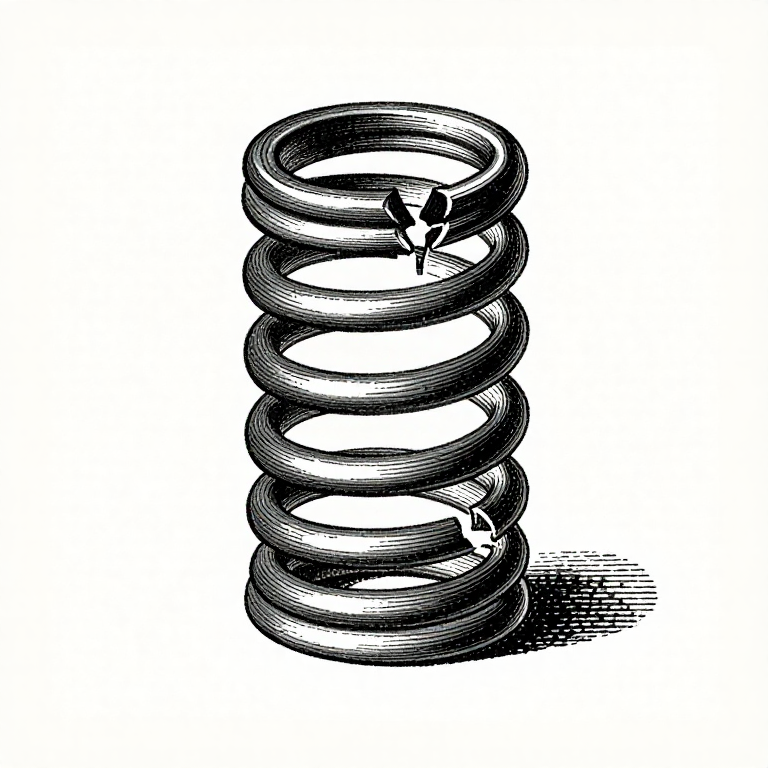


Spring Fatigue: It Is the Swing That Breaks It
A spring held at a steady load will sit there for ever. A spring cycled between two loads has a life, and the thing that sets that life is not the peak load — it is the difference between the two loads. Split the loading into a steady part and a swinging part and only the swinging part opens cracks.
That one fact reorganises the whole problem, because it means the most effective thing you can do to a fatigue-limited spring costs nothing: fit it already compressed. The same spring reaching the same peak load, but starting from a preload instead of from free length, can see a quarter of the alternating stress.
This rung is the mean-and-alternating split, the Zimmerli endurance limits — which for small springs barely depend on the steel at all, only on whether it was shot peened — and an ordered list of what actually moves the number. Two of the entries are surprises.
उन्नत
4 hours
निर्देशनहरू
1
1
Where a spring cracks, and why there
Where a spring cracks, and why there
**On the inside of a coil, at the surface.** Every fatigue crack in a helical spring starts there unless something else is badly wrong, and it starts there for two reasons that stack.
*The stress is highest there* — that is the whole content of the Wahl correction, and at an index of 6 it is about 25% above the average.
*The surface is where the defects are.* Drawing marks from the wire's manufacture run along the wire. Seams, laps and inclusions break the surface. Corrosion pits are sharp-bottomed notches. A crack needs a starter and the surface supplies one.
**Which is why shot peening works.** Blasting the surface with small hard shot yields a thin layer plastically, and because the bulk underneath does not yield, that layer is left in **compression** when the shot stops. A crack cannot open against a compressive stress. The residual layer has to be overcome before the working stress does anything at all.
**It also makes the surface rougher**, which would normally be bad, and the residual compression wins comfortably. Peened springs are standard wherever life matters.
**And why corrosion is so expensive.** A rust pit is a sharp notch in exactly the worst place, and it also relieves the peening. A peened spring that is allowed to corrode has lost most of what it was peened for.
**One more starter worth knowing:** the ground end of a compression spring. Grinding can burn the surface and leave tensile residual stress, and the end coil is where the spring bears. A spring that breaks a coil or two in from the end has usually been told something by its grinding.
यस चरणका सामग्री:
 दबाब स्प्रिङ सेट1 टुक्रा
 स्प्रिङ स्टिलको तार1 टुक्रा
चाहिने औजार:
 आवर्धक लुप
 माइक्रोमिटर
2
2
Mean and alternating, and the endurance limits
Mean and alternating, and the endurance limits
Jupyter नोटबुक लोड हुँदैछ…
चाहिने औजार:
 टेबुल कम्प्युटर
3
3
Surge: the failure that only happens fast
Surge: the failure that only happens fast
A spring has mass as well as stiffness, so it has a natural frequency of its own, and it can resonate along its own length.
**What happens.** Compress one end quickly and the disturbance travels along the spring as a wave, reflects off the far end and comes back. If the spring is being cycled at or near the frequency at which those waves fit the spring, the wave builds. Individual coils then slam together and fly apart with stresses far higher than the working deflection suggests.
**What it looks like.** A spring that is visibly jumping, or coils that are polished or hammered where they have been striking each other, or a spring that breaks at a stress the calculation says is safe. In an engine it is a valve that does not follow its cam.
**The rule.** The spring's natural frequency should be well above the frequency it is driven at — a common design target is at least thirteen times the operating frequency, so that no low harmonic of the drive lands on it. That number is not magic; it comes from wanting clearance above the twelfth harmonic.
**How to raise it.** A spring's natural frequency goes up with wire diameter and down with coil diameter and coil count. So a stiffer, shorter, fewer-coiled spring surges at a higher speed. That is often in tension with everything else the design wants.
**How to damp it.** A second spring nested inside, wound the opposite hand, so the two rub and kill the wave. A friction damper. A variable-pitch spring, where the coils are not evenly spaced so there is no single clean resonance — this is why a modern valve spring has unevenly spaced coils.
**When to care.** Anything cycling faster than a few hertz. A door spring never surges; a valve spring surges for a living.
यस चरणका सामग्री:
दबाब स्प्रिङ सेट1 टुक्रा थिच्ने स्प्रिङको सेट1 टुक्रा
चाहिने औजार:
आवर्धक लुप4
4
Specifying a spring that has to last
Specifying a spring that has to last
What goes on the drawing, beyond the rate and the dimensions:
**Two force-at-length points**, with tolerances, rather than a rate. The rate is then implied and the maker can hit the forces, which is what you actually care about.
**The material and its specification**, by standard rather than by name: 'music wire to EN 10270-1 SH' says something a supplier can act on; 'spring steel' does not.
**Shot peened, or not.** If it matters, say it. It is a process, it costs money, and it will not happen unless asked for.
**Preset to solid, or not.** Same argument.
**The finish.** Plain, oiled, phosphated, zinc plated, passivated stainless. And here a warning worth its own line: **electroplating a highly stressed spring can cause hydrogen embrittlement**, which makes it fail suddenly at a load it has carried a thousand times. Plated springs must be baked promptly afterwards to drive the hydrogen out, and the specification should say so.
**The direction of the helix**, if anything nests or if it is a torsion spring.
**Squareness and the end treatment**, if the spring is slender or must seat evenly.
**The service temperature**, if it is not room temperature.
**And the cycle count you are expecting**, stated as a requirement. It tells the maker whether they are selling you a commodity or designing something, and it is the number that decides most of the answers above.
यस चरणका सामग्री:
दबाब स्प्रिङ सेट1 टुक्राचाहिने औजार:
टेबुल कम्प्युटरसामग्री
3- 1 टुक्राप्लेसहोल्डर
- 1 टुक्राप्लेसहोल्डर
- 1 टुक्राप्लेसहोल्डर
आवश्यक उपकरणहरू
3- प्लेसहोल्डर
- प्लेसहोल्डर
- प्लेसहोल्डर
सम्बन्धित ब्लुप्रिन्ट
यी ब्लुप्रिन्टहरूले ज्ञान साझा गर्छन् — प्रविधि, सामग्री वा सिद्धान्त


CC0 सार्वजनिक डोमेन
यो ब्लुप्रिन्ट CC0 अन्तर्गत जारी गरिएको छ। तपाईं अनुमति नसोधी प्रतिलिपि, परिमार्जन, वितरण र प्रयोग गर्न सक्नुहुन्छ।
ब्लुप्रिन्ट मार्फत उत्पादनहरू किनेर सिर्जनाकर्तालाई सहयोग गर्नुहोस् सिर्जनाकर्ता कमिसन विक्रेताले तोकेको, वा यो ब्लुप्रिन्टको नयाँ संस्करण बनाउनुहोस् र आम्दानी बाँड्न आफ्नो ब्लुप्रिन्टमा जडानको रूपमा समावेश गर्नुहोस्।