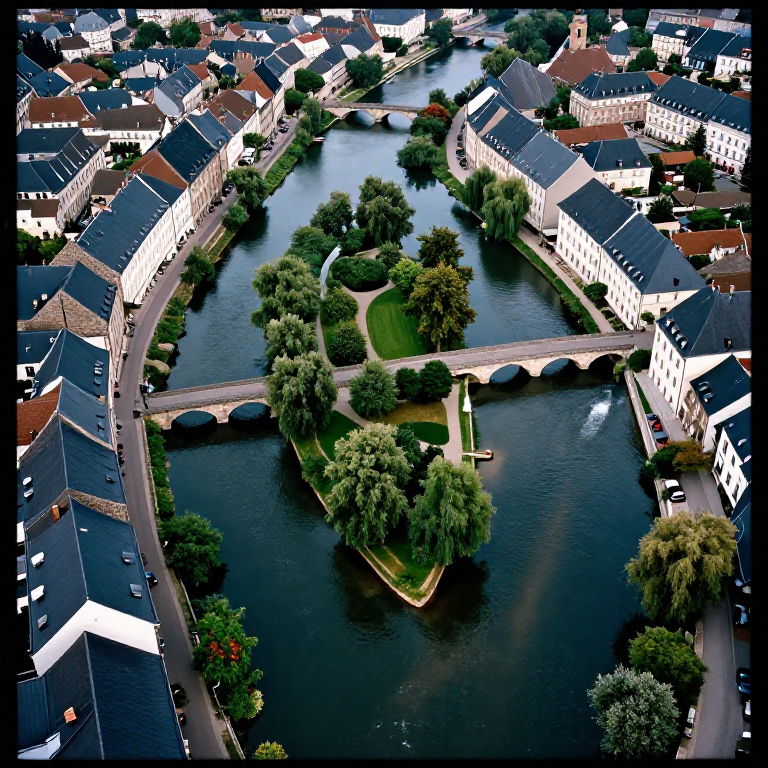


Königsberg Bridges
निर्देशनहरू
Try it the obvious way first
Try it the obvious way first
Attempt the walk on the actual map before simplifying anything.
- Draw the two banks, two islands and seven bridges.
- Trace routes with a pencil, trying to cross every bridge exactly once.
- Record how many attempts you make and where each one fails.
यस चरणका सामग्री:
 रेखाचित्र कागज1 pad
 ग्रेफाइट सिसाकलमको सेट1 सेट
Throw the geography away
Throw the geography away
Reduce the map to dots and lines.
- Replace each landmass with a single dot — four dots.
- Replace each bridge with a line joining two dots — seven lines.
- Redraw it several times with the dots in different places.
Count the odd vertices
Count the odd vertices
One count answers the question.
- For each dot, count the lines meeting it — its degree.
- Mark which dots have an ODD degree.
- In Königsberg, all four are odd.
Find where the approach does apply
Find where the approach does apply
The same count tells you when a route IS possible, which is the useful half.
- Redraw the graph, adding one bridge to make exactly two odd vertices.
- Find a walk — it must start at one odd vertex and end at the other.
- Now make all vertices even and find a walk that returns to its start.
यस चरणका सामग्री:
 रङ्गीन बाक्लो कागजको सेट1 प्याक
History and context
History and context
Leonhard Euler presented the solution to the St Petersburg Academy in 1735 and published in 1736. He was mildly dismissive of the problem itself — it looked like a triviality with no mathematics in it — and what he actually contributed was the method of turning it into a question about connection alone.
The city has changed and the puzzle with it. Königsberg is now Kaliningrad; two bridges were destroyed in the Second World War and others rebuilt, and with the modern arrangement a walk is possible. The mathematics did not change — the graph did.
What the approach opened up: graph theory now underlies routing on networks, scheduling, dependency resolution in software builds, molecular structure in chemistry, and social network analysis. The Chinese postman problem — find the shortest route covering every edge, repeating as few as necessary — is the practical descendant used to plan refuse collection and gritting rounds.
The transferable idea is the discarding. Euler's contribution was recognising which features of a situation carry the answer and which are decoration. That judgement is doing the same work in every abstraction since: a circuit diagram ignores the physical layout of wires, an underground map ignores real distances, and both are more useful for it.
सामग्री
3- 1 padप्लेसहोल्डर
- प्लेसहोल्डर
- 1 प्याकप्लेसहोल्डर
CC0 सार्वजनिक डोमेन
यो ब्लुप्रिन्ट CC0 अन्तर्गत जारी गरिएको छ। तपाईं अनुमति नसोधी प्रतिलिपि, परिमार्जन, वितरण र प्रयोग गर्न सक्नुहुन्छ।
ब्लुप्रिन्ट मार्फत उत्पादनहरू किनेर सिर्जनाकर्तालाई सहयोग गर्नुहोस् सिर्जनाकर्ता कमिसन विक्रेताले तोकेको, वा यो ब्लुप्रिन्टको नयाँ संस्करण बनाउनुहोस् र आम्दानी बाँड्न आफ्नो ब्लुप्रिन्टमा जडानको रूपमा समावेश गर्नुहोस्।